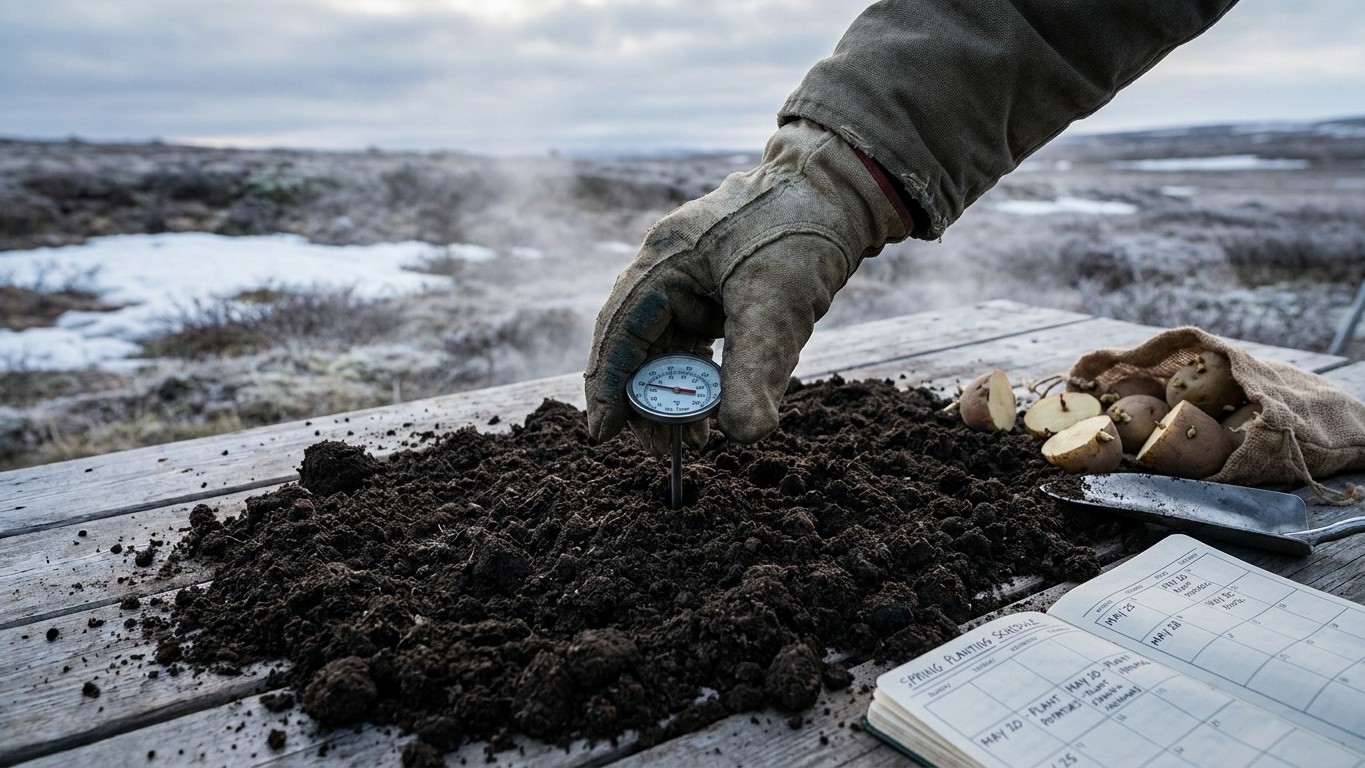

Count back 14 to 21 days from Rankin Inlet’s average last frost of June 19, and the planting window lands between roughly May 29 and June 5. That’s when soil hits the 50 F mark potatoes need, according to Utah State University Extension and the University of Maine Cooperative Extension. In Nunavut, that soil threshold typically arrives before the average frost date, not after it.
The short answer
The figure to anchor on is June 19, the mean last spring frost recorded at Rankin Inlet A, published by Environment and Climate Change Canada in its Canadian Climate Normals for 1981-2010. Working backward from that date using the 14-to-21-day rule from Utah State University Extension and the University of Maine Cooperative Extension puts the planting window at roughly May 29 through June 5 for a garden near Rankin Inlet itself.
That’s the number, but it needs a qualifier attached every time you use it. A mean frost date is not a safe date. Half the years on record, the last frost at Rankin Inlet fell later than June 19. The normal is a midpoint, built from thirty years of readings averaged together, not a line the weather respects on command. Treat it as the center of a range you can’t fully see, and plan your planting decision around soil conditions you can actually measure rather than a date on a chart.
Rankin Inlet is also the only station this figure represents. Nunavut spans a landmass larger than most countries, and a single weather station on the western shore of Hudson Bay doesn’t speak for a community three hundred miles inland or one perched at higher elevation. If you garden somewhere else in the territory, use Rankin Inlet’s June 19 as a reference point and expect colder, more exposed, or northern locations to run behind it, sometimes by weeks.
Seed choice matters as much as timing. Buy certified seed potatoes rather than pieces cut from a grocery-store bag or last year’s leftover harvest. Certified seed is tested and tracked to keep viral disease out of the tuber, and virus is the kind of problem you can’t see in the seed piece but will see in a stunted, unproductive plant. Choose an early or mid-season variety suited to baking or boiling, since Utah State and Maine’s extension guides classify potatoes by season length and by use, not by a days-to-maturity count that either source would stand behind for Nunavut’s short, cool summer.
What actually decides it
Two separate mechanisms are doing the work behind that May 29-June 5 window, and understanding both lets you adjust the answer for your own garden.
Soil temperature, not air temperature, triggers planting
Potatoes go into the ground based on what the soil is doing, not what the thermometer on the porch says. Utah State University Extension and the University of Maine Cooperative Extension both set 50 F soil temperature as the trigger point. Soil warms more slowly than air in spring, but it also holds heat longer once it starts climbing, which is why the 50 F mark can show up 14 to 21 days ahead of the average last air frost. A raised bed with dark, well-drained soil in full sun will hit 50 F sooner than a low, shaded, wet corner of the same yard, even on the same day of the calendar. That’s the real variable driving the answer, and it’s one a soil thermometer measures directly instead of guessing.
The frost normal is an average, not a guarantee
A climate normal is built by averaging thirty years of last-frost dates into a single figure. That process smooths out the years with a frost in early June and the years with a frost in early July into one number, June 19. Nothing about that number tells you which kind of year you’re in. The practical consequence: a gardener who plants strictly on June 19 minus three weeks, without checking the soil, is betting on an average year showing up on schedule, when the underlying data guarantees roughly half the years won’t cooperate.
Heat above 90 F stops the crop from filling, not from starting
Once potatoes are up and setting tubers, soil temperatures above 90 F inhibit tuber set and fill, per Utah State University Extension. This is largely a non-issue for most Nunavut gardens given the short, cool growing season, but it matters if you’re gardening in a sheltered, south-facing, dark-soil bed that traps heat unusually well. Where summer heat is a real risk, the fix is to plant as early as soil allows and harvest a spring-set crop, not to try to push a crop through the hottest stretch of the season and hope watering compensates. Watering doesn’t fix a tuber that has stopped sizing from heat.
How to do it
- Identify the last-frost reference for your location; use Rankin Inlet A’s June 19 mean if you’re near that station, and expect other Nunavut communities to trail behind it, especially inland or northern sites.
- Count back 14 to 21 days from that reference date to mark the earliest planting window, understanding it shifts with how the current spring is actually behaving.
- Check soil temperature directly with a soil thermometer at planting depth rather than relying on the calendar window alone; wait until it reads 50 F.
- Order certified seed potatoes in an early or mid-season variety chosen for baking or boiling use, avoiding uncut grocery-store tubers or saved seed of unknown virus status.
- Cut and cure seed pieces if using whole certified seed larger than a golf ball, letting cut surfaces dry before planting to reduce rot risk in cold, wet soil.
- Plant seed pieces once soil has reached 50 F, even if that date arrives before the average last frost has passed.
- Keep row cover or another frost barrier on hand for the weeks immediately after planting, since sprouts can still meet a late frost event in a year running behind the mean.
- Monitor soil temperature through the growing season if your bed is unusually warm or sheltered, watching for readings that approach 90 F during tuber set and fill.
What goes wrong
- Planting by the calendar instead of the soil. Using June 19 minus three weeks as a fixed date, without ever checking soil temperature, ignores the actual trigger. Carry a soil thermometer and wait for a 50 F reading at planting depth before putting seed in the ground.
- Treating the mean frost date as a guarantee. June 19 is an average built from thirty years of data, and roughly half of those years had a later frost. Keep row cover ready for two to three weeks after planting so an off-schedule frost doesn’t take out young sprouts.
- Using uncertified seed. Seed cut from a grocery-store bag or saved from a previous harvest of unknown origin can carry virus that never shows up until the plant is already stunted. Buy certified seed potatoes from a supplier that tests and tracks its stock.
- Assuming one date covers all of Nunavut. Rankin Inlet A is a single station on the coast; a garden farther inland, farther north, or at higher elevation will lag behind its June 19 mean, sometimes by weeks. Use the nearest available reading and adjust the count-back window accordingly rather than importing a coastal date wholesale.
- Ignoring heat buildup in an unusually warm bed. A dark-soiled, south-facing, wind-sheltered plot can climb toward the 90 F ceiling that stalls tuber fill, even in a generally cool territory. If a bed runs hot, plant as early as soil allows and expect an earlier harvest rather than trying to extend the season through the warmest stretch.
Common questions
Can I plant potatoes before the last frost date in Nunavut?
Yes, and the mechanism explains why: potatoes are planted once soil reaches 50 F, a threshold that Utah State University Extension and the University of Maine Cooperative Extension note typically arrives 14 to 21 days before the average last frost date. Seed pieces sit below the soil surface, insulated from a light air frost that would damage exposed foliage above ground.
What if my community isn’t near Rankin Inlet?
The June 19 figure comes specifically from the Rankin Inlet A station in Environment and Climate Change Canada’s Canadian Climate Normals for 1981-2010. Communities farther inland, farther north, or at higher elevation should expect their own last frost, and their own 50 F soil threshold, to arrive later. No single figure published here covers the whole territory.
Which potato variety should I choose for a short Nunavut season?
Choose by season class and intended use rather than by a days-to-maturity number, since neither Utah State University Extension nor the University of Maine Cooperative Extension publishes maturity-day figures for individual varieties. Both sources classify potatoes as early, mid-season, or late, and separately note what each variety is suited for, such as baking or boiling. An early or mid-season variety fits a short growing season better than a late one.
Does the 90 F heat ceiling matter for Nunavut gardens?
Rarely, given the territory’s short and cool summer, but it isn’t impossible. Utah State University Extension notes that soil above 90 F inhibits tuber set and fill regardless of location. A dark-soiled, sheltered, south-facing bed can occasionally trap more heat than the surrounding air suggests, so it’s worth checking soil temperature in an unusually warm spot rather than assuming the ceiling never applies.
Some gardeners also time this by the Moon: when to plant potatoes by the moon, as almanac tradition rather than fact.