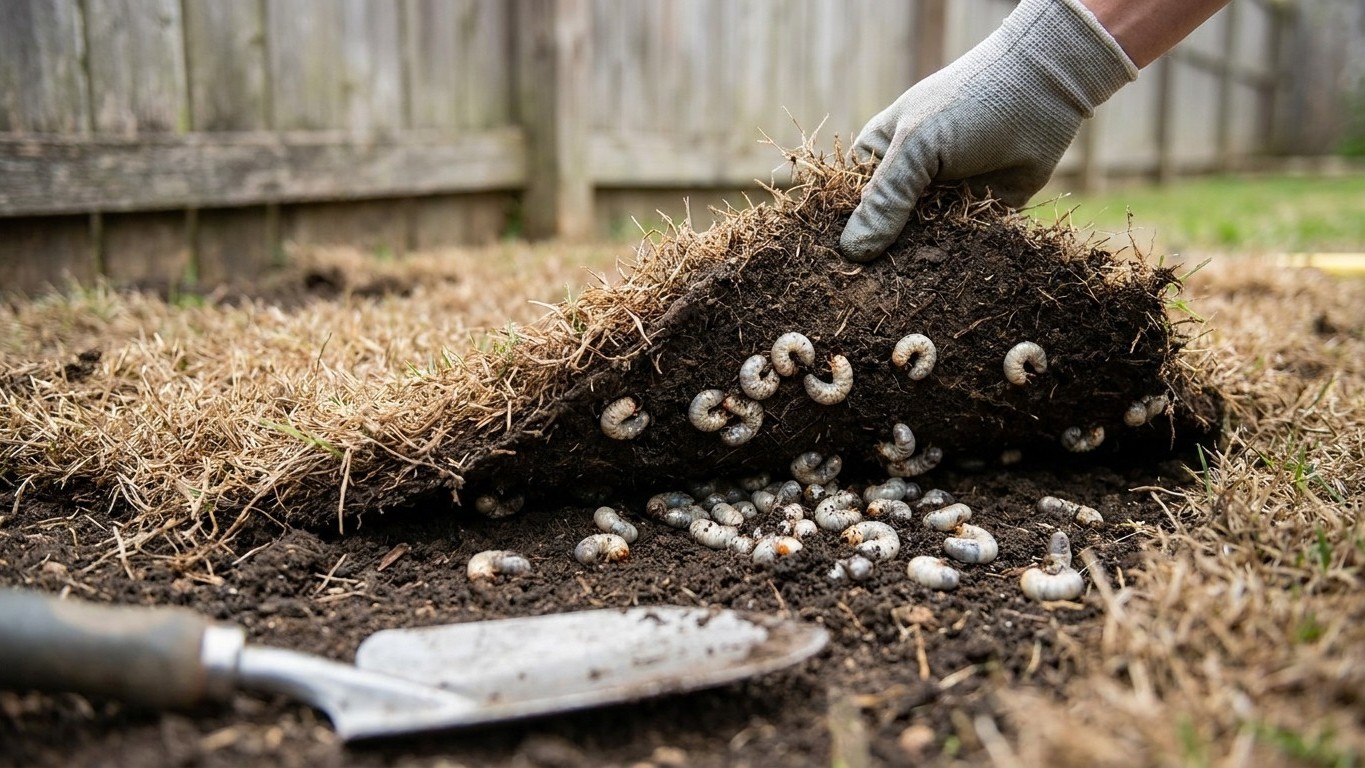

White grubs are the C-shaped larvae of beetles like Japanese beetles, June beetles, and chafers, and they feed on grass roots just under the surface. Enough root loss and the turf detaches from the soil in solid sheets, so a patch that rolls back like a rug rather than tearing is the signature sign. Grab a corner of the dead turf and pull: if it lifts free with almost no roots holding it down, dig a few inches and check for grubs before you treat for anything else.
The damage you see first

The first clue is rarely the insect. It’s a patch of lawn that feels spongy underfoot, like walking on a mattress, followed within days by brown, dying grass in that same spot. It’s one of the more damaging of the underground lawn pests precisely because by the time you see the sod lift, the roots holding it down are already gone. Damage tends to spread as irregular patches through late summer and fall, often starting at the edges of the yard or along a sunny slope where soil warms first.
Push a little harder and the difference from ordinary drought stress becomes obvious. Grass killed by grubs peels back in solid sheets, almost like pulling up loose carpet, because the roots that normally anchor it to the soil have been chewed away below the crown. Grass that is merely dormant or drought-stressed stays rooted even when it turns brown, and you’ll feel resistance if you tug on it. That difference is the fastest way to rule grubs in or out before you dig anything up.
Secondary damage often confirms it. Skunks, raccoons, crows, and moles all dig for grubs as a food source, and a lawn suddenly pocked with shallow divots or torn-up turf overnight, especially after a summer rain, is a strong hint that something underground is worth eating. None of this proves grubs on its own, since chinch bugs and sod webworms cause thinning and browning that can look similar from the porch. The damage from chinch bugs tends to look like a spreading drought patch that watering doesn’t fix, while sod webworms leave ragged, close-cropped patches with moths flushing up at dusk. Grubs are the one where the sod itself comes loose in your hand.
Confirming it is this and not something else
The reliable check is physical, not visual. Using a spade or a bulb planter, cut a one-foot-square section of turf at the edge of a damaged area, about two to three inches deep, and fold it back like a page. Count the grubs you find curled in the soil and thatch. They’re easy enough to spot: white to cream-colored, C-shaped when disturbed, with a distinct brown head capsule and three pairs of legs near the front of the body.
Do this in three or four spots around the yard, not just the worst-looking patch, because grub distribution is uneven and a single sample can mislead you either way. Compare counts to the treatment threshold your local cooperative extension office publishes for your grass species and region. Thresholds are set locally because they depend on grass type, soil, and how much wear a lawn tolerates, so a count that justifies treatment on one lawn may not on another. Call before you buy anything.
Most established lawns carry some grub population without visible damage, and treating turf that isn’t actually declining wastes money and kills the natural predators that would otherwise keep grubs in check. A healthy stand of grass, mowed and watered well, can outgrow a light infestation on its own. Save the insecticide for counts that clear the threshold and for turf already showing the lifting, spongy symptoms described above, not for a lawn that merely looks a little thin in August.
When it does its damage
White grubs run a one-year life cycle across most of the country, though the calendar shifts with climate and grass type. Adult beetles emerge, mate, and lay eggs in soil during summer. Those eggs hatch into tiny first-instar grubs that feed lightly near the surface, then molt twice more into larger second- and third-instar grubs that do almost all of the visible root damage as they fatten up before cold weather.
The third instar in late summer and early fall is both the most destructive stage and the easiest one to control, because the grubs are still feeding near the surface where a soil-applied product can reach them. Once the ground cools, grubs move several inches deeper to overwinter, come back up to feed briefly in spring, and then pupate into adult beetles. Neither cultural nor chemical controls do much good at that point.
Why timing moves with your climate
Because adult emergence and egg-laying track soil temperature, the window for young, treatable grubs comes earlier in warmer regions and later in cooler ones, and it can shift by several weeks from one year to the next depending on rainfall and heat. Treating on a fixed calendar date is the most common way growers waste a season’s control effort. Digging a sample first, as described above, confirms whether the grubs present are still small enough for the treatment to matter. Your local extension office can tell you which beetle species are common in your area and roughly when their grubs are most vulnerable.
What actually works
Cultural control comes first because a dense, deep-rooted lawn tolerates far more root feeding before it shows damage than a thin, shallow-rooted one. Mowing at the higher end of the recommended range for your species, and keeping the lawn on a steady watering schedule rather than frequent shallow sprinkles, builds the root mass that lets turf shrug off moderate feeding. Clemson Cooperative Extension’s HGIC 1205 mowing fact sheet, along with the species mowing ranges below, is the starting point for that decision.
Biological options
Beneficial nematodes, most often the species Heterorhabditis bacteriophora, are sold to home gardeners as a soil drench and work by infecting young grubs with a bacterium that kills them within a couple of days. They need moist soil and only work against small, actively feeding grubs, so timing them to the same late-summer window described above matters more than most product labels explain. Milky spore, made from the bacterium Bacillus popilliae, targets Japanese beetle grubs specifically and can take a year or more to build up in the soil before it provides noticeable control, so it suits a long-term program rather than a lawn in crisis this season.
Chemical options
Homeowners can buy granular products containing imidacloprid, clothianidin, or chlorantraniliprole at most garden centers; these are preventive, applied before or just as eggs hatch, and need to be watered in to reach the root zone where grubs feed. Trichlorfon is a curative active ingredient that kills grubs already present and acts faster, but formulations and application rates vary by state and some are limited to licensed applicators, so check the label and your state’s rules before buying. None of these products work well once grubs have moved deep to overwinter, which is one more reason the digging check comes before the purchase, not after.
Making the lawn less inviting
Adult beetles prefer to lay eggs in moist soil, so a lawn watered deeply but infrequently, letting the surface dry out between waterings, gives females fewer good egg-laying sites during the summer flight period. This is the same watering habit that builds deep roots against ordinary drought, so it does double duty against grubs too.
Choosing and mowing a recovery-friendly grass
Mowing height matters, and it depends on what you’re growing. Grass mowed at the top of its recommended range recovers faster from root loss because more leaf surface means more photosynthesis to rebuild roots. The table below, drawn from Clemson Cooperative Extension’s HGIC 1214 and Penn State Extension’s lawn establishment guidance, lines up mowing height with drought and wear tolerance, since a species that already handles drought and wear well has more reserve capacity to outlast light grub feeding.
| Grass | Mowing height | Drought tolerance | Wear tolerance |
|---|---|---|---|
| Tall Fescue | 2.5 to 3.5 in | Fair | Fair |
| Kentucky Bluegrass | 2 to 3 in | Fair | Good |
| Zoysiagrass | 0.75 to 2 in | Good | Very good |
| Bermudagrass | 0.75 to 1.5 in | Excellent | Excellent |
| St. Augustinegrass | 2.5 to 4 in | Good | Fair |
None of these numbers change because grubs showed up. They’re the same mowing and tolerance ranges Clemson Cooperative Extension and Penn State Extension publish for choosing and maintaining a lawn in the first place, which is the point: a lawn already managed well for its species handles a grub season without the drama a neglected one goes through.
Common questions
Will grubs kill my whole lawn or just patches?
Usually just patches, and often the same ones each year if the conditions that favor egg-laying, like moist soil in a sunny, well-watered section, don’t change. A whole lawn wiped out in one season points to either a very heavy infestation or another stress working alongside it, like drought or disease.
Can I just reseed over the damage without treating the grubs?
Only if the grub population has already dropped below the treatment threshold you counted, since new seedlings have even less root mass to spare than established turf. Reseeding into an active infestation usually just means feeding the new grass to the same grubs.
Do grubs come back every year in the same spot?
They can, especially where soil stays moist and sunny during the adult beetles’ summer flight, but a healthy population of natural predators, birds, and existing soil organisms keeps numbers down in many yards without any product at all.
Is it too late to treat once the lawn already looks bad?
It depends on the grub stage, not how bad the lawn looks. Dig a sample first. If the grubs are still small and feeding near the surface, a properly timed product still helps, but if they’ve already moved deep for winter, nothing reaches them until they come back up in spring.