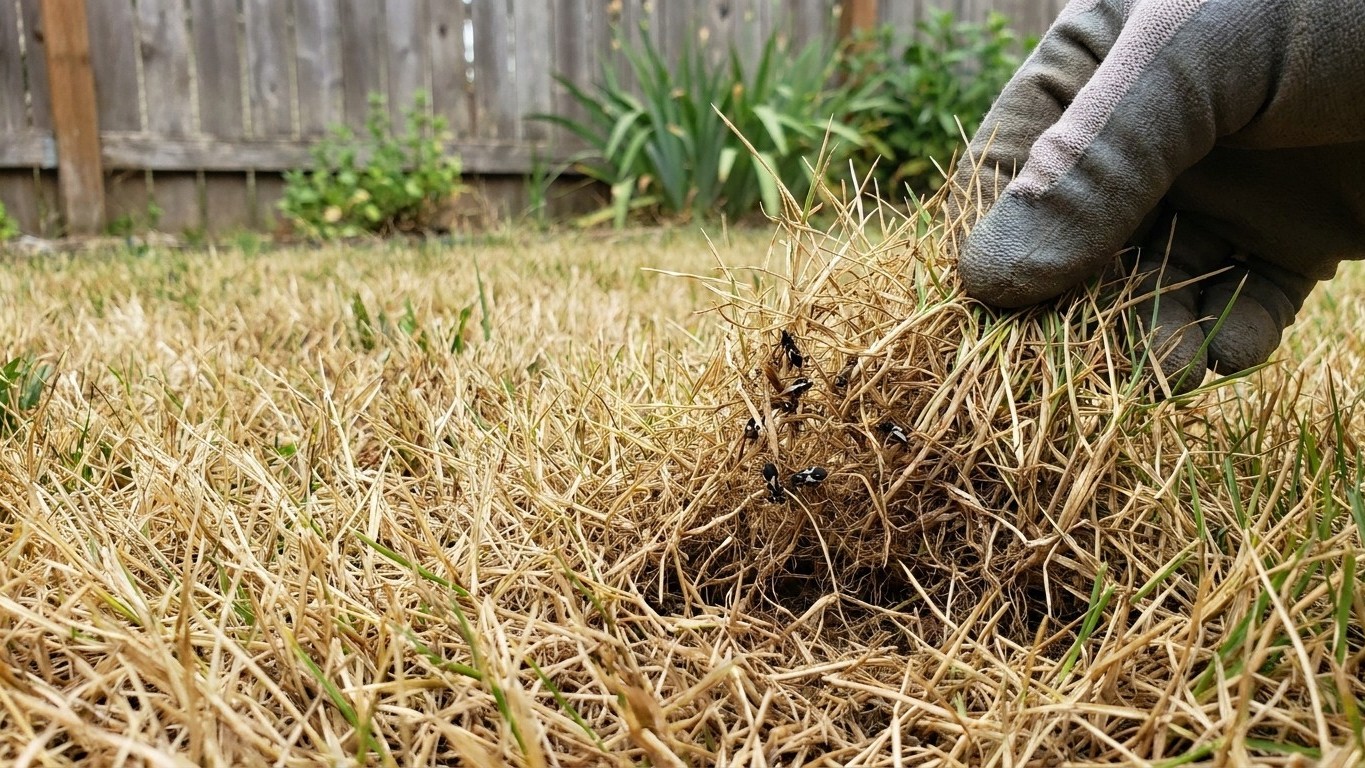

Chinch bug damage looks exactly like drought because both start the same way: a lawn losing its ability to move water, showing up as yellow patches that don’t green back up after rain. The insects feed at the crown of the grass and inject a toxin that damages the plant’s vascular tissue, so watering a chinch bug patch does nothing that watering a real drought patch would fix. Before you run another irrigation cycle, part the grass at the edge of a yellow patch and look for small insects moving in the thatch, or push an open-ended can into the turf and flood it to float them out.
The damage you see first

The first sign is almost never the insect. It’s an irregular patch of turf, yellow at first and then straw brown, usually starting in the hottest, driest spot in the yard: next to a driveway, along a south-facing slope, or in a strip of lawn boxed in by concrete on two sides. These are the same spots that show drought stress first, which is exactly why chinch bug damage gets missed until it’s spread across half the yard.
The patches grow outward from the edges rather than appearing all at once. A patch that keeps expanding after a good soaking rain is the detail that separates chinch bug damage from actual drought, since drought-stressed turf usually perks back up within a day or two once it gets water. Chinch damage does not, because the roots and crown are still being fed on underneath.
The damage stays flat against the soil. There’s no mounding, no ridges, no soft tunnels underfoot. If you’re finding raised ridges or soft give when you walk across the lawn instead of flat dead patches, you’re probably dealing with Moles in a Lawn: They Are Not Eating Your Grass, a completely different problem with a completely different fix.
To confirm the culprit is underneath rather than in the soil beneath, get down at the edge of a yellowing patch, part the grass with your fingers, and look right at the thatch line where the blades meet the soil. Adult chinch bugs are small, roughly the size of a match head, black with white patches folded across their wings, and they move fast when disturbed. Nymphs are smaller and reddish, and they tend to cluster rather than scatter. Seeing either at the thatch line, right where the damage is worst, is the confirmation that separates this from ordinary heat stress.
Confirming it is this and not something else
The flotation test
The most reliable home test doesn’t need any special equipment. Cut both ends off a metal can, push one end a couple of inches into the turf right at the border of the damaged area, fill it with water, and watch the surface for a few minutes. Chinch bugs float and struggle at the surface within minutes if they’re present in the soil column below the can. Run the test at the edge of the damage, not the dead center, since the insects tend to feed at the advancing front of the patch and move on once the grass underneath them is dead.
What a healthy count looks like
Finding a few chinch bugs in the test does not mean you have a problem. Most lawns carry a background population of chinch bugs that does no visible harm, and a lawn’s own predators, particularly big-eyed bugs and various parasitic wasps, usually keep that number in check without any input from you. Treating a lawn that isn’t actually showing chinch damage kills those predators along with a harmless population and tends to make the next outbreak worse, not better. There is no single national number for how many chinch bugs per square foot justify treatment, because that threshold shifts with grass species and region. Ask your local cooperative extension office for the count that applies to your grass type before buying anything.
Damage that appears almost overnight across a wide area, rather than building over a couple of weeks from a small patch, is a different pest entirely. That pattern points to Armyworms: A Lawn That Disappears in Three Days, which chew blades from the top down instead of feeding at the crown, and which move through a lawn far faster than chinch bugs do.
When it does its damage
Chinch bugs overwinter as adults in thatch and leaf litter, then lay eggs in the crevices of the crown once the weather warms. Eggs hatch into nymphs that go through several molts before becoming winged adults, and in warmer regions the whole cycle repeats enough times in a season to produce two or more overlapping generations. That overlap is exactly why damage tends to build through the hottest, driest stretch of the growing season: by the time the first generation’s damage is visible, the next generation is already hatching underneath it.
The narrow window when control actually works is while the population is dominated by young nymphs, before wings develop and before egg-laying starts the next generation. Treating a lawn full of winged adults after damage is already obvious wastes the product on insects that have already done most of their feeding and are about to move or lay eggs elsewhere in the lawn anyway. Treating too early, before eggs have hatched, wastes it on a stage nothing you can buy affects.
That window moves with the climate. A longer, hotter warm season supports more generations and pushes the damaging population earlier and later in the year than it would run in a cooler region. Because the exact timing depends on local temperature history, it’s not something a national fact sheet can pin to a date. Your state or county extension office tracks degree-day models for chinch bugs specifically, and that’s the most reliable way to know when nymphs are active in your area rather than guessing from the calendar.
What actually works
Cultural controls come first
Thatch is where chinch bugs live, lay eggs, and hide from predators, so reducing it does more long-term good than any spray. Mowing at the correct height for the species matters here too: Clemson Cooperative Extension’s HGIC 1205 (Mowing Lawns) and HGIC 1214 (Selecting a Lawn Grass) put St. Augustinegrass at 2.5 to 4 inches, Zoysiagrass at 0.75 to 2 inches, and Bermudagrass at 0.75 to 1.5 inches, and cutting below that range stresses the grass into the same weakened state chinch bugs exploit. Nitrogen matters in the other direction. Clemson’s HGIC 1201 (Fertilizing Lawns) covers feeding schedules, and pushing a lawn with more nitrogen than that schedule calls for produces the soft, lush growth chinch bugs prefer to feed on.
Biological options
Beneficial nematodes, sold under species names like Steinernema carpocapsae, are available to home growers and work best applied to moist soil in the evening, since the nematodes themselves are vulnerable to UV light and drying out. Encouraging the lawn’s existing predator population, chiefly big-eyed bugs, by skipping unnecessary broad-spectrum sprays does more for long-term control than any single product application.
Chemical controls, last resort
Home-garden products containing bifenthrin or cyfluthrin are the active ingredients most commonly available over the counter for chinch bugs, applied to the thatch layer and watered in lightly rather than washed straight through it. Carbaryl is another labeled option, but its availability and use restrictions vary by state, so check your state’s department of agriculture or cooperative extension site for current rules before buying it. Anything beyond that, including some longer-residual products, is typically applied by a licensed lawn care professional rather than sold for homeowner use. For the wider picture of what else competes with chinch bugs for space in a struggling lawn, Lawn Pests covers the rest of the usual suspects.
Making the lawn less inviting
Watering habits do more to invite or discourage chinch bugs than any single product. Frequent, shallow watering builds the thick thatch layer chinch bugs favor, while deep, infrequent watering that lets the top inch of soil dry between sessions produces deeper roots and less of the spongy thatch they hide in. This is also the watering pattern that helps a warm-season lawn hold up through summer heat regardless of chinch bugs, since Clemson’s HGIC 1214 rates Bermudagrass and Bahiagrass drought tolerance as excellent and St. Augustinegrass and Zoysiagrass as good, figures worth knowing if you’re deciding whether to replace a chronically damaged section rather than keep treating it.
| Grass | Mowing height | Drought tolerance |
|---|---|---|
| St. Augustinegrass | 2.5 to 4 in | Good |
| Bermudagrass | 0.75 to 1.5 in | Excellent |
| Zoysiagrass | 0.75 to 2 in | Good |
| Centipedegrass | 1.5 to 2 in | Fair |
Mowing too short compounds the problem, since a scalped lawn has less leaf area to recover from feeding damage and more exposed thatch for the insects to move through. Sticking to the mowing range Clemson’s HGIC 1214 lists for your specific grass, rather than cutting it as short as a neighbor’s Bermudagrass lawn, keeps the turf dense enough that chinch bugs have a harder time establishing in the first place. A dense, correctly mowed, deeply watered lawn is not immune to chinch bugs, but it recovers from light feeding on its own instead of turning into a dead patch that needs reseeding.
Common questions
Can chinch bugs actually kill a lawn, or does it just look dead?
Badly infested turf can die outright once the crown is destroyed, unlike simple drought dormancy which usually recovers once rain returns. If the grass pulls up easily with no white root growth attached, that patch is dead and needs reseeding or replacing rather than watering.
Do chinch bugs bother Kentucky bluegrass or fescue lawns?
Rarely. Chinch bugs are overwhelmingly a warm-season grass problem, especially in St. Augustinegrass, and cool-season lawns like Kentucky bluegrass, tall fescue and perennial ryegrass see them far less often. If a cool-season lawn is browning in patches, drought, grubs or fungal disease are more likely culprits worth ruling out first.
Will a grub control product also handle chinch bugs?
Not usually. Grub products are timed and formulated for soil-dwelling beetle larvae, and chinch bugs feed at the thatch and crown level rather than in the root zone, so a grub-labeled product often misses them entirely. Check that the product label specifically lists chinch bugs before relying on it.
How long before a damaged patch bounces back after treatment?
It depends on how much of the crown survived. Lightly damaged turf can push new growth within a few weeks of the infestation being controlled and regular watering resumed, but patches that went fully brown at the crown need reseeding or sodding since there’s no living tissue left to regrow from.