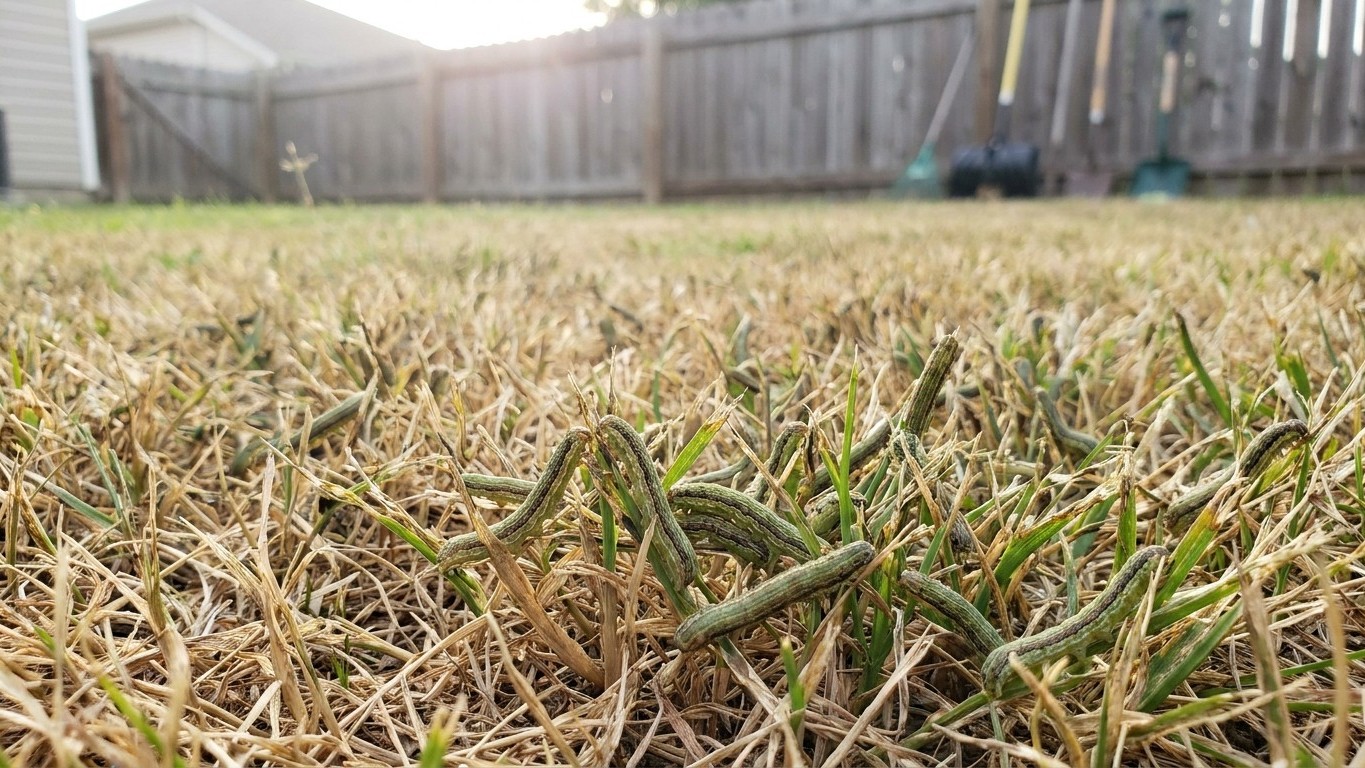

A lawn can go from green to grazed-down brown in a matter of days when armyworm larvae move through in large numbers, chewing grass blades down to the crown faster than the turf can mask it. There is no single worm count that applies everywhere, since population size and timing shift by species, region and season, but the speed of the collapse is the tell: drought stress and most fungal patches take weeks to spread, armyworm damage takes days. Get down on your knees at the edge of the damaged area, part the grass to the soil, and look for caterpillars before you treat for anything else.
The damage you see first

Most people notice armyworms because the lawn looks scalped in patches that were mowed at the normal height a few days earlier. The grass blades look ragged and chewed rather than wilted or yellowed, and the damaged area often has a slightly bleached or straw colored look where larvae have skeletonized the leaf tissue, leaving thin papery strips behind. This is different from a fungal patch, which usually has a defined ring or a smell of rot, and different from drought stress, which fades gradually across the whole lawn rather than advancing in one direction.
The damage typically starts at an edge, along a driveway, a sidewalk, or a thin patch where turf is already stressed, and then spreads in a visible front across the yard over a few days. If you watch the same patch morning to morning you can often see the line of damage move, which is a detail drought and disease never show.
Before treating, confirm the culprit is underneath. Signs worth checking:
- Chewed, ragged blade tips rather than wilted or discolored whole blades
- A moving edge to the brown patch, visible day over day
- Increased bird activity on the lawn, since birds feed heavily where larvae are active
- Green frass (caterpillar droppings) visible when you part the grass near the damage
Brown is not the same as dead. If the crown of the grass plant survived the feeding, most lawns push new growth once the larvae move on or are controlled, especially in species with good wear tolerance. Confirming the cause before you spend money on a control is the step people skip, and it is why so many treatments happen on lawns that only needed water.
Confirming it is this and not something else
The standard field check is a soap flush. Mix a small amount of dish soap into a few gallons of water and pour it slowly over a one square yard section at the edge of the damaged area, then wait several minutes. Irritated larvae surface and can be counted on the grass blades. Do this at more than one spot, since populations are rarely even across a lawn.
What the count means
Most extension services publish a specific larvae-per-square-foot count that justifies chemical treatment, and that number varies by turf species and by the specific caterpillar involved, so check with your local extension office for the figure that applies in your area rather than relying on a number from another region. What matters more than any single count is the trend: a lawn that shows the same low number in a repeat check a few days later is holding steady, while one where the count is climbing fast is worth acting on before the damage front widens.
Most lawns carry some caterpillar population without visible harm. Birds, parasitic wasps and predatory beetles keep ordinary numbers in check, and treating a lawn that is not actually losing ground kills those predators along with the pest, which tends to make the next outbreak worse rather than better. This is the same reasoning used for sod webworms, another caterpillar that causes small brown patches and is often confused with armyworm damage because both show up as chewed grass rather than wilted grass. If the damage looks more like a hollowed stem than a chewed blade, check for billbugs instead, since their larvae feed inside the stem rather than on the leaf surface and the soap flush test will not bring them up.
When it does its damage
Armyworm moths lay eggs on grass blades or nearby structures, and the larvae that hatch do essentially all the damage during their feeding weeks before dropping into the soil to pupate. The adult moths that emerge do not feed on turf themselves, they fly at night and lay the next batch of eggs, which is why an infestation can seem to reappear after you thought it was handled.
The window that matters
Control works best while larvae are still small, in their early feeding stage, when they are easier to kill and have not yet done most of their damage. Once larvae reach their final growth stage they eat far more per day and are markedly harder to control with the same product, so a spray applied a week too late can miss the window entirely even if the product itself works. This window shifts with the climate: warm-season turf regions can see more generations in a year and an earlier start to the feeding season, while cooler regions typically see a single generation later in the season. There is no fixed calendar date for this window nationally, since it tracks temperature, so watching the lawn itself, rather than the calendar, is the more reliable trigger for checking.
What actually works
Cultural controls first
A lawn mowed at the correct height for its species and kept on a deep, infrequent watering schedule recovers faster and resists damage better than one mowed short and watered lightly every day, a point covered in more detail in HGIC 1205, Mowing Lawns. Removing thatch buildup also removes shelter that larvae use during the day, since armyworm larvae typically feed at night or in low light and hide low in the canopy during heat.
Biological options
Products containing Bacillus thuringiensis kurstaki (Btk) are a selective biological control that targets caterpillars specifically without harming most beneficial insects, and these are sold over the counter at garden centers. Btk works best against small, young larvae, which is another reason the early window matters more than the product label makes it sound.
Chemical options, by active ingredient
Spinosad, derived from a soil bacterium, is available in homeowner formulations and is generally considered a lower-impact option among the chemical controls. Synthetic pyrethroids such as bifenthrin and permethrin are widely sold to home growers and act faster but have a broader impact on beneficial insects in the lawn, including the same predators that would otherwise help keep populations down. Some granular lawn insect controls use chlorantraniliprole, which has residual activity against caterpillars; check the product label to confirm it is labeled for your turf species. Not every product on a store shelf is legal to use everywhere, and restrictions vary by state, so read the label fully and check with your state department of agriculture or your local extension office if a product’s use is unclear before applying it.
Making the lawn less inviting
Nitrogen pushed on heavy and often produces the soft, lush new growth that armyworm larvae prefer, so following the rates in HGIC 1201, Fertilizing Lawns, rather than fertilizing on a whim, removes some of that attraction. Shallow, frequent watering keeps the blade surface tender and moist in exactly the way larvae favor, while deep, infrequent watering that lets the surface dry between sessions produces tougher growth and deeper roots that recover faster once damage happens.
Mowing height and species matter together
Mowing at the low end of a species’ recommended range, or scalping after a damage event, slows recovery because there is less leaf surface left to rebuild the plant. The table below, drawn from Clemson Cooperative Extension’s HGIC 1214 and Penn State Extension’s lawn establishment guidance, shows how mowing height and wear tolerance compare across common turf species, since a species with poor wear tolerance takes longer to bounce back from any feeding damage, armyworm or otherwise.
| Grass | Season | Mowing height | Wear tolerance |
|---|---|---|---|
| Bermudagrass | Warm-season | 0.75 to 1.5 in | Excellent |
| Zoysiagrass | Warm-season | 0.75 to 2 in | Very good |
| Kentucky Bluegrass | Cool-season | 2 to 3 in | Good |
| Tall Fescue | Cool-season | 2.5 to 3.5 in | Fair |
| St. Augustinegrass | Warm-season | 2.5 to 4 in | Fair |
If you are reseeding or overseeding a patch that armyworms hit hard, a wear-tolerant species recovers foot traffic and repeat stress better than one rated fair or poor, though shade and drought tolerance for your particular yard should still weigh into that choice as much as wear does. For a broader look at what else digs, chews or sucks its way through a lawn, the full Lawn Pests library covers the other common culprits side by side.
Common questions
Can armyworms kill my lawn for good, or will it grow back?
Most lawns recover on their own once the crown of the grass plant survives the feeding, since armyworms eat the leaf blades rather than the roots. Recovery speed depends on the species and how much leaf tissue is left, which is why the table above matters more than it might seem.
How fast do I need to act once I see damage?
Faster than you would for most lawn problems, since the feeding window when control works best is narrow and closes as larvae mature. A day or two of delay while you confirm the cause with a soap flush is reasonable, but waiting a week to decide usually means the easy window has passed.
Will one treatment get rid of them for the season?
Not necessarily. Moths can fly in from neighboring properties and lay a fresh batch of eggs, and warmer regions can see more than one generation in a season, so a lawn that was clear a month ago is not guaranteed to stay that way without another check.
Do birds pecking at my lawn mean I have armyworms?
It is a reasonable clue but not proof on its own, since birds also feed on grubs, earthworms and other insects in turf. Treat heavy bird activity as a reason to do the soap flush test, not as a diagnosis by itself.