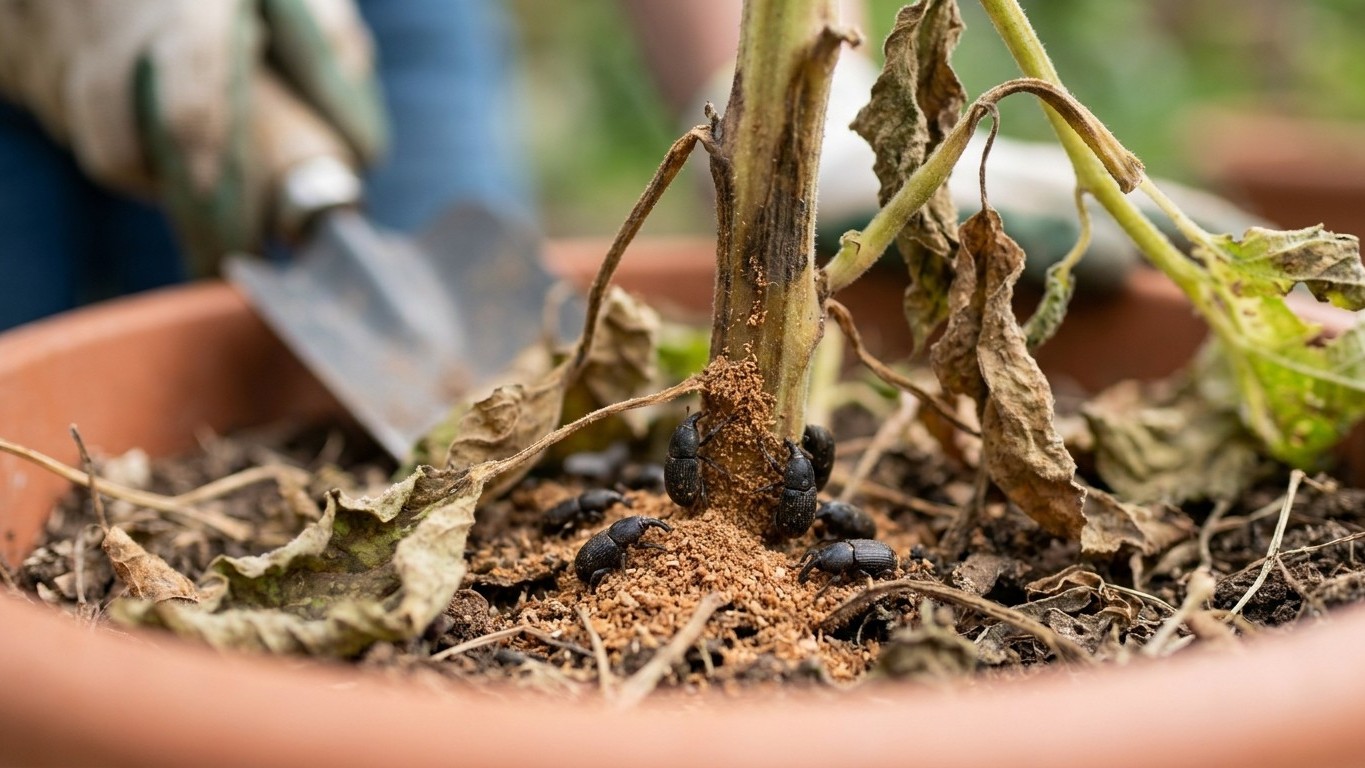

A dying grass stem that leaves fine, sawdust-like material at its base when you pull on it is the clearest field sign of billbug larvae, not a fungus or a watering problem. The larvae feed inside the stem first, then move underground to chew through crowns and roots, which is why the damage often reads as drought stress before it reads as an insect problem. Pull a few dead stems from the ragged patch: if they snap cleanly at the crown and leave a pile of pale frass behind, run the tug test on the surrounding turf next, before you reach for a spray.
The damage you see first

Billbug damage almost never announces itself as an insect. It shows up as irregular, roughly circular patches of thinning or dead turf, often starting along a sidewalk, driveway edge, or curb where the soil runs hotter and drier. The patches expand slowly over a few weeks rather than overnight, which is one reason they get blamed on drought or a bad mower blade first.
The confirming detail is in the stem, not the color of the grass. Grab a handful of blades in the damaged patch and pull gently. Healthy turf resists and the roots hold. Turf hollowed out by billbug larvae comes away in your hand with almost no resistance, and the cut end of the stem is packed with a light, sawdust-like material, which is actually the larva’s frass and chewed plant tissue. That texture is the single most reliable visual cue before you dig for the insect itself.
Because billbugs feed at the crown and just below it, watering the patch usually does not bring it back the way a drought-stressed area responds. A drought patch greens up within a few days of consistent watering. A billbug patch stays thin because the plant tissue that would regrow is already gone. This distinction matters because billbugs are one of several lawn pests that mimic drought stress closely enough to send a homeowner straight to the sprinkler timer instead of the trowel.
Cool-season lawns built on Kentucky bluegrass or perennial ryegrass tend to show this damage as the weather warms into early summer, once the larvae have moved from the stem into the crown. Warm-season lawns, especially zoysiagrass and bermudagrass, are attacked by a different species, the hunting billbug, and the visible patches can appear later in the season as the turf is already under heat stress, making the two problems even easier to confuse.
Confirming it is this and not something else
The tug test is the fastest way to rule billbugs in, but it will not rule out everything else on its own. White grub larvae also live at the root zone and also cause turf to pull up loosely, but they are C-shaped, cream-colored, and roll back with the sod in a way billbug frass does not, a distinction covered in more depth on our white grubs page. Armyworm damage, by contrast, chews leaf blades from the top down and moves across a lawn in days rather than weeks, which is worth checking on our armyworms page if the damage front is moving fast.
To confirm billbugs specifically, cut a section of turf at the edge of a damaged patch, roughly where healthy grass meets dead grass, and pull it up along with the top inch or two of soil. Sift through it for small, legless, white larvae with brown heads, and check the surface thatch for the adults, which are dark, hard-shelled weevils with a long snout, usually found at night or by soaking a suspect patch in soapy water and watching for them to float up.
- Frass at the stem base: check first, takes seconds
- Larvae in the top inch of soil at the damage edge: confirms the life stage present
- Adults floating up after a soapy water soak: confirms the species is active on the property
Most lawns carry some billbug population without visible harm, and a healthy stand of turf can tolerate a fair number of larvae feeding on it before the damage shows. Treating a population that isn’t causing visible damage wastes money and kills the ants, ground beetles, and birds that would otherwise keep the population in check. Your county extension office can tell you the per-square-foot count it uses locally to justify treatment, since that threshold is set regionally and is not the same number everywhere.
When it does its damage
The life cycle in order
Adult billbugs overwinter in thatch, leaf litter, and grass clumps near the lawn’s edge. As the soil warms in spring, they become active, feed on grass blades (leaving small notches you might mistake for general chewing insect damage), and then chew a small hole in a stem to lay eggs inside it. The egg hatches inside that hollow stem, and the young larva feeds there first, which is exactly why the frass shows up at the stem base before any root damage is visible.
As the larva grows, it outgrows the stem and drops into the soil, where it continues feeding on the crown and roots through its later instars. This underground stage is where the real turf loss happens, and it’s also the stage that is hardest to reach with any treatment, since the larva is protected by soil and, later, by its own toughening cuticle.
Why the window matters
Control works best while the larvae are still small and in the upper soil layer, shortly after they leave the stem. Once they’ve molted into larger instars, they’re both more resistant to insecticides and harder to reach physically, since they’ve moved deeper looking for roots. Treating after that point, which is when most homeowners actually notice the damage, is the single most common reason a billbug treatment “doesn’t work.” The insect is still there, it has simply outgrown the window.
That window falls at a different calendar point depending on how quickly the soil warms in a given spring, so it shifts by region and by year within the same region. Your state or county extension office tracks regional degree-day models for exactly this reason, and checking with them before buying a product is worth more than guessing from a bag label written for a national market.
What actually works
Cultural controls come first
A dense, deep-rooted lawn tolerates billbug feeding far better than a thin, compacted one, so mowing at the correct height for your species is the cheapest control you have. Cutting too short removes leaf area the plant needs to recover from root damage and pushes roots shallower, right into the zone where larvae feed.
| Grass | Mowing height | Drought tolerance | Source |
|---|---|---|---|
| Kentucky Bluegrass | 2 to 3 in | Fair | Penn State Extension |
| Perennial Ryegrass | 2 to 3 in | Fair | Penn State Extension |
| Tall Fescue | 2.5 to 3.5 in | Fair | Clemson HGIC 1214 |
| Zoysiagrass | 0.75 to 2 in | Good | Clemson HGIC 1214 |
| Bermudagrass | 0.75 to 1.5 in | Excellent | Clemson HGIC 1214 |
General mowing guidance for these heights, and how often to cut to stay within them, is laid out in Clemson Cooperative Extension’s HGIC 1205, Mowing Lawns.
Biological options
Beneficial nematodes in the species Steinernema carpocapsae are sold to home growers as a soil-applied product and work by infecting billbug larvae directly in the root zone. They need moist soil and are most effective against the young larval stage, which lines up with the same early-season window that matters for chemical control, and they die off quickly in dry soil, so timing the application around irrigation matters as much as timing it around the calendar.
Chemical options, by active ingredient
Homeowners can buy granular or liquid lawn products containing imidacloprid or chlorantraniliprole as season-long preventives, applied before egg-laying begins, and products containing bifenthrin or carbaryl as curative treatments aimed at young larvae already in the soil. Some formulations of these same active ingredients are sold in higher concentrations restricted to licensed applicators, so check the product label for “restricted use” language and confirm your state’s rules with your extension office before buying, since availability varies.
Making the lawn less inviting
Watering habits change how survivable a lawn is for billbug larvae more than most homeowners expect. Deep, infrequent watering encourages roots to grow down and away from the shallow zone where young larvae feed, while frequent shallow watering keeps that same top layer moist and attractive to them. A lawn watered deeply and less often is a harder target than one watered lightly every day.
Mowing height works the same way from the other direction. Grass kept at the upper end of its recommended range, per Clemson HGIC 1214 and Penn State Extension’s published figures for each species, carries more leaf area and a deeper root system, both of which buy the plant time to recover from feeding before the patch turns visible. Cutting into the lower end of that range removes the margin that would otherwise let the lawn outgrow light larval damage.
Reduce the adult habitat
Because adult billbugs overwinter in thatch and leaf litter at the lawn’s edge, a lawn with a thick thatch layer or heavy leaf buildup along fence lines and walkways gives them more places to survive the winter close to next year’s damage site. Dethatching in the appropriate season for your grass type and clearing leaf litter from lawn edges in fall removes some of that overwintering habitat before it becomes next spring’s infestation.
Common questions
Will the dead patches come back on their own?
Sometimes, if the damage was light and the plant’s crown survived. A patch where the crown is intact will send up new growth once the larvae have moved on or pupated. A patch that’s been chewed down to bare soil at the crown level needs reseeding or sodding, since there’s no living tissue left to regrow from.
Can I just use a grub control product for billbugs too?
Some products labeled for white grubs share active ingredients, like imidacloprid or chlorantraniliprole, that also work on billbug larvae, so check the label rather than assuming the pest name has to match exactly. What matters more than the pest listed on the front of the bag is whether the active ingredient and application timing line up with the young larval stage.
Is brown grass in a billbug patch actually dead?
Not necessarily. Brown turf can mean dormancy rather than death, especially in warm-season lawns going into a stress period, and dormant grass recovers on its own once conditions improve. The tug test is still the fastest way to tell the two apart: dormant grass resists a gentle pull, billbug-damaged grass does not.
Why does my lawn get billbugs every year in the same spot?
Adult billbugs don’t travel far and tend to reinfest the same lawn edges and thin patches where they successfully overwintered before. If the same strip along a driveway or sidewalk shows damage year after year, that spot’s soil, drainage, and thatch conditions are worth addressing directly rather than treating the symptom fresh each season.