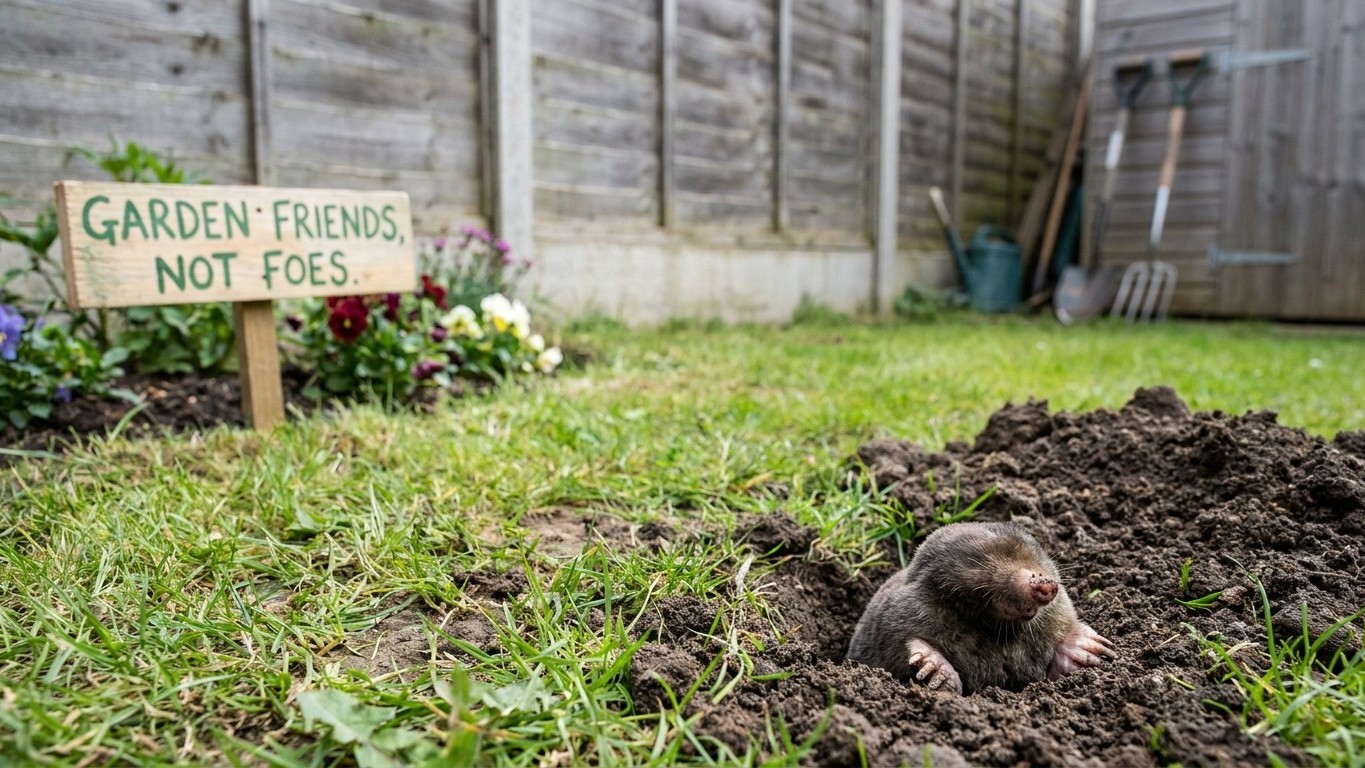

Moles do not eat grass, and they do not eat roots either. They tunnel through the top few inches of soil hunting earthworms, grubs and other soil insects, and the ridges and mounds you see on the surface are spoil from that digging, not a feeding wound. Press down on a fresh ridge with your foot: a soft, spongy collapse means an active tunnel underneath, and it usually means the grass itself is still alive under the disturbed soil.
The damage you see first

The first sign is usually a raised ridge running across the lawn in a loose, winding line, sometimes a few feet long, sometimes a tangle that doubles back on itself. These are shallow feeding tunnels, dug just under the surface where a mole hunts earthworms and grubs after rain pushes them upward. A day or two later a volcano-shaped mound of loose soil may show up nearby, several inches across, with no visible entrance hole. That mound is spoil from a deeper tunnel, the kind a mole uses as a main travel route between feeding areas, and it sits on top of the grass rather than growing out of it.
Grass along a ridge often yellows or wilts within a few days, because the tunnel separates the blades from soil moisture and root contact below, not because anything ate the leaf tissue. Press on a fresh ridge and check the result: a soft, spongy collapse that springs back later means the tunnel underneath is active and recently used. An old, dry ridge that stays flat after you press it has likely been abandoned, and the grass over it usually greens back up on its own once you re-firm the soil.
The confirming detail is what’s missing rather than what’s there. Look for chewed leaf blades, sawdust-like debris at the base of a stem, or turf that lifts away from the soil in a loose sheet: none of that belongs to a mole. A mole leaves disturbed soil and severed root contact, not eaten grass tissue. Find both a mole ridge and a patch that pulls up like loose carpet elsewhere in the yard, and you’re very likely looking at two separate problems at once, one animal and one insect, each needing its own fix.
Confirming it is this and not something else
Voles will use the tunnels a mole leaves behind, and also cut their own surface runways: narrow, flattened trails of matted grass right at ground level, without the raised ridge a mole pushes up. A flat trail with grass chewed short along it is a vole runway, not a mole tunnel. Cross-section width helps too, since a mole’s ridge tends to run wider and rounder because the animal digging it is bigger.
Insect damage looks nothing like either. Billbugs leave a stem that snaps off at the crown and crumbles into sawdust-like frass, with irregular dead patches turning up as the larvae feed inside the stem base. Chinch bugs cause patches that look exactly like drought stress, yellow rings that expand and don’t green up after watering, because the insects are sucking sap from the crown rather than disturbing any soil. Neither produces a ridge or a mound.
Grubs are the pest most often confused with mole damage, because grubs are part of what draws a mole into a lawn in the first place. Extension services set grub treatment thresholds at a certain count found per square foot of turf, because most lawns carry a background population that does no visible harm, and treating a healthy population wastes an insecticide application and kills what would otherwise feed birds and other predators. Moles don’t work on that kind of threshold. A single mole can tunnel through an entire lawn regardless of whether the grub or earthworm count underneath is high or low, because it’s following an active soil food web, not responding to an infestation level. Treating the lawn for grubs to starve out a mole is a slow, unreliable strategy, and it does nothing for a mole that’s mostly after earthworms, which no insecticide reaches.
For a broader read on what else might be living in the turf before you settle on a control, the lawn pests roundup is a good place to check, since a yard showing more than one kind of damage at once is common.
When it does its damage
Moles stay active underground through most of the year wherever the soil doesn’t freeze solid, but the tunneling you actually see on the surface tracks soil moisture, not a fixed date on a calendar. In spring and again in fall, when rain keeps the top few inches of soil damp, earthworms and grubs move up close to the surface and a mole follows them, digging the shallow ridges that show up in the lawn. Through the hottest, driest stretch of summer, both the prey and the mole retreat to deeper, cooler soil, and surface ridges slow down or stop even though the animal is still there.
The narrow window that matters
Whatever control method you choose, the moment to act is right after a ridge appears, not weeks later. A mole patrols its main tunnels within its territory repeatedly, and a fresh ridge is one it’s currently using. An old, weathered ridge that’s sat untouched for a while is far less likely to see the animal pass through again soon, and a trap set in it usually just sits empty. Because fresh ridges track rainfall and soil temperature rather than a set week, that active window shifts earlier or later depending on where you live and what the season is doing. Watching the lawn after a rain, rather than marking a date, is the more reliable trigger for setting traps or placing bait.
Young moles born earlier in the year disperse from a parent’s territory as they mature, digging new tunnels of their own as they search out unclaimed ground. That dispersal is often what shows up as a second wave of fresh mounds in a lawn that seemed to have settled down, and it means a yard can go from hosting one mole’s territory to two or three without anything else in the landscape changing.
What actually works
Cultural fixes come first because they remove what’s drawing the mole in without touching the animal at all. Cutting back on how often you irrigate keeps the top few inches of soil drier, which pushes earthworms deeper and makes the lawn a less productive hunting ground for an animal working near the surface. Fixing drainage in a low spot that stays soggy after every rain does the same thing over the longer term.
Biological control targets grubs specifically, not moles and not earthworms. Parasitic nematodes and milky spore disease, both sold to home growers as a soil drench or granular application, reduce one part of a mole’s diet but leave the earthworm population untouched, so don’t expect either product to move a mole out on its own.
Trapping is the most reliable control a home grower can do without hiring anyone. Scissor-jaw and harpoon-style traps, set directly into an active ridge and checked daily, catch moles far more consistently than any repellent on the market. Placement matters as much as the trap itself: set into a deep, straight main tunnel rather than a shallow feeding ridge, since the animal passes a main tunnel far more often and a trap there intercepts a route it’s committed to using again, not a one-time feeding pass. Castor oil-based granular repellents and vibrating sonic stakes are widely sold, but their effect is inconsistent and often temporary, and a mole will simply tunnel around a treated section and resume activity once the smell or vibration fades.
Toxic bait shaped like a worm or grub, formulated with bromethalin or zinc phosphide, is sold over the counter in many states and placed directly into an active tunnel rather than on the surface. Gas cartridges and fumigants containing aluminum or magnesium phosphide are restricted in most places and typically applied by a licensed pest control operator rather than bought off a shelf. Check your state’s pesticide regulations before assuming a fumigant is something you can apply yourself, and keep any bait out of reach of pets and children regardless of how it’s formulated.
Making the lawn less inviting
Moles follow moisture, so the habits that keep a lawn drier at the surface make it a less attractive hunting ground without changing how the grass itself looks. Watering deeply and infrequently, rather than a light daily sprinkle, lets the top few inches dry out between waterings even as the root zone stays supplied, and that dry surface layer is what pushes earthworms and grubs back down out of easy reach.
Mowing at the higher end of your grass’s recommended range helps too, since a deeper root system dries the soil faster after rain than a shallow one does. Clemson Cooperative Extension’s mowing guidance (HGIC 1205) recommends removing no more than about a third of the blade at a time, and staying near the top of your grass’s range does more for root depth than any single mowing session will.
Choosing a grass that needs less water
Since drought tolerance and watering frequency are directly linked, the species already growing in a yard affects how often the surface stays damp enough to interest a mole. Cool-season figures below come from Penn State Extension’s guidance on lawn establishment, and warm-season figures come from Clemson Cooperative Extension’s HGIC 1214.
| Grass | Season type | Mowing height | Drought tolerance |
|---|---|---|---|
| Bermudagrass | Warm-season | 0.75-1.5 in | Excellent |
| Bahiagrass | Warm-season | 3-4 in | Excellent |
| Zoysiagrass | Warm-season | 0.75-2 in | Good |
| St. Augustinegrass | Warm-season | 2.5-4 in | Good |
| Tall Fescue | Cool-season | 2.5-3.5 in | Fair |
| Kentucky Bluegrass | Cool-season | 2-3 in | Fair |
| Fine Fescues | Cool-season | 2.5-3.5 in | Good |
The warm-season grasses rated excellent for drought tolerance in that table, Bermudagrass and bahiagrass among them, need far less supplemental watering to stay green than the cool-season fine fescue or Kentucky bluegrass rated only fair to good, and a lawn watered less often simply offers a mole less to hunt for underneath it. That’s worth weighing alongside shade and wear tolerance when choosing a replacement grass, not a reason to tear out an existing lawn just because it has moles in it.
Common questions
Will planting daffodils or castor bean around the lawn keep moles away?
Not reliably. A mole may avoid the roots directly under a bulb or castor plant, but that doesn’t stop it tunneling everywhere else in the same lawn, and no border planting has been shown to clear an existing tunnel network.
Does flooding a mole tunnel with a garden hose get rid of them?
It doesn’t kill the mole or push it out of the yard, only out of that one tunnel section for the moment. Moles have side tunnels and dry ground nearby to retreat to, and the flooded section is often rebuilt within a day or two.
Is it legal to trap or poison moles on my own property?
Rules on lethal control of moles vary by state, and some states restrict certain traps or baits to licensed applicators. Check with your state’s wildlife or agriculture department before buying anything, rather than assuming a product sold at a hardware store is automatically legal to use everywhere.
Why does mole damage seem to show up overnight after it rains?
Wet soil is easier for a mole to push up, and it holds the shape of a ridge or mound instead of crumbling flat the way dry soil does, so several nights of digging become visible all at once. The mole was very likely already there. The rain didn’t attract it so much as expose digging that had already been happening underground.