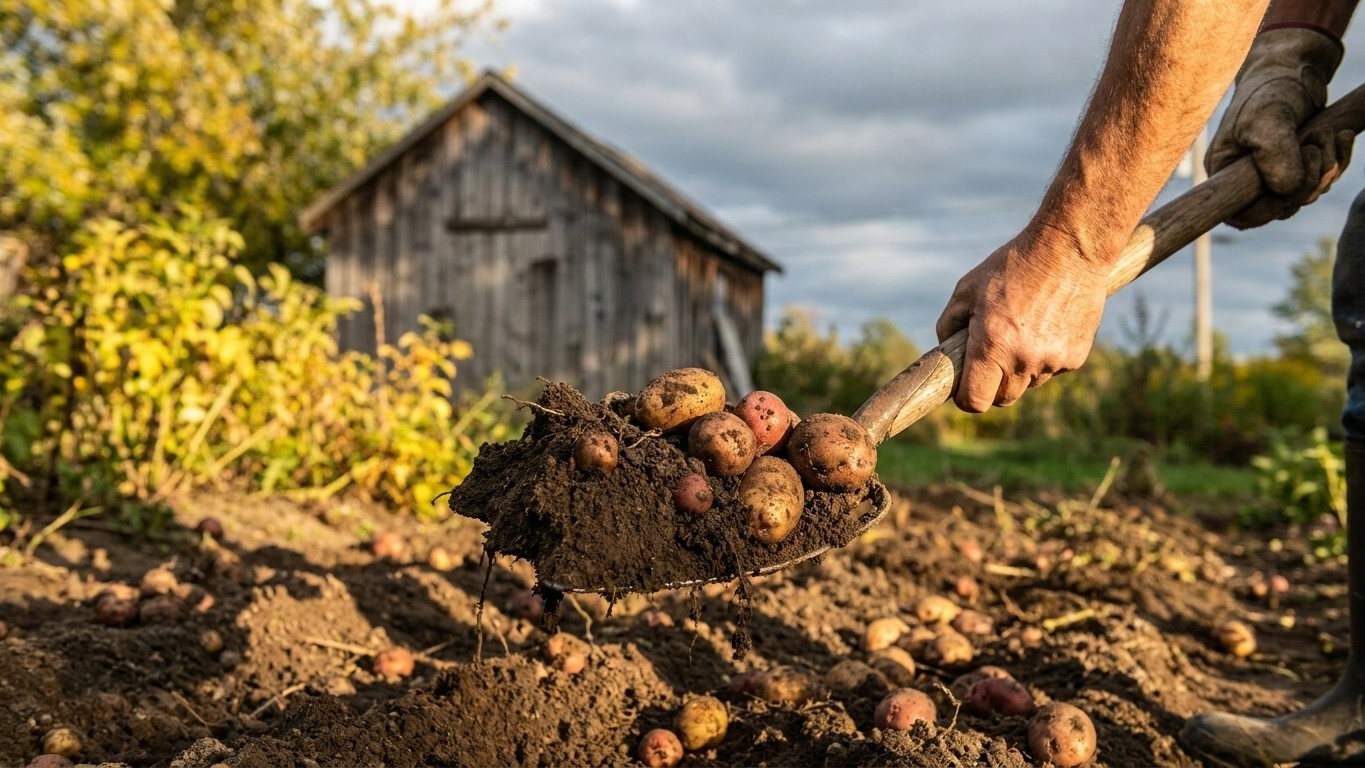

Dig potatoes in Quebec before the ground turns cold and the vines die back, cure them for two to three weeks in a mild, humid spot, then move them into storage held at 40-45 F in the dark. The trouble is that Quebec’s winters drop far below that range, so an unheated shed or garage will not hold it once December arrives. That means picking an insulated or partly heated space before harvest day, not after.
The short answer
Environment and Climate Change Canada’s 1981-2010 climate normals put the average first fall frost, recorded at the MONTREAL/ST-HUBERT A station, at October 5. That figure is a mean, not a guarantee. In roughly half the years on record, frost arrives later than October 5; in the other half, it lands earlier. Treat that date as the midpoint of a window rather than a line you can safely plan a harvest weekend around, and lean toward digging early rather than late.
The same set of normals gives a mean daily minimum for the coldest month, using Montreal as the reference station, of 6.7 F. That number has nothing to do with the growing season, but it decides everything about what happens to the crop after it’s dug. A storage target of 40-45 F sits somewhere between 33 and 38 degrees above that mean minimum. No unheated garage, shed, or three-season porch in this climate closes a gap that size once real winter sets in.
When to dig
Lift the crop once the foliage has yellowed and died back on its own, and do it ahead of the average frost window rather than waiting to see if this particular year runs mild. Because October 5 is a mean date pulled from decades of records, a grower who waits for a hard freeze before digging is gambling on the half of years that run late. The tubers themselves aren’t hurt by a light frost on the vines, but a freeze that reaches the soil damages the potatoes sitting just under it.
Answering the unheated-space question
Given a coldest-month mean minimum of 6.7 F, the honest answer is no: an unheated space in Quebec will not hold 40-45 F through the winter. It will track close to outdoor air once a cold snap sets in, and a batch of stored potatoes left in that kind of space will freeze solid, not just chill. Anyone planning to store a harvest here needs a cellar, a heated basement corner, or another space with some insulation or a modest heat source, checked with an actual thermometer rather than assumed.
Curing, and where
Utah State University Extension recommends curing potatoes at 55-60 F with high humidity for two to three weeks before storage. That range is narrower than it sounds, and in Quebec, at the point in the season when digging typically happens, outdoor air is already sliding toward the average frost date. An open shed or an uninsulated porch can swing well below 55 F overnight even before the ground freezes, which stalls curing rather than completing it. The more reliable spots are enclosed and indoors: a basement room away from the furnace, an attached garage that stays a few degrees warmer than outside, or a closed, shaded porch on a still-mild early-fall stretch.
- Dig the tubers on a dry day, and shake or brush off loose soil by hand. Do not wash them before curing.
- Move them immediately to the curing spot rather than leaving them in direct sun or in the field overnight, since exposure to light and cold both work against the process.
- Choose an enclosed indoor space that reads 55-60 F, such as a basement room, an insulated garage, or a closed porch, rather than an open-air shed that will already be tracking toward the season’s cooler nights.
- Hold humidity high by loosely covering the tubers with burlap or a slightly damp cloth, especially in a basement, which tends to run naturally humid in Quebec’s fall.
- Leave them undisturbed for two to three weeks so cuts and bruises can heal and skins can set, checking periodically that the space hasn’t drifted outside the 55-60 F band.
- Sort before moving to storage, and set aside anything soft, cut, or discolored rather than mixing it in with the sound tubers.
Storing through this winter
Utah State University Extension puts the storage target at 40-45 F in the dark. The University of Maine Cooperative Extension gives a tighter figure of 38 F at 95 percent humidity. Both numbers describe the same idea from slightly different angles: cold, dark, and humid, without ever freezing and without warming enough to wake the tubers up. Against a Quebec coldest-month mean minimum of 6.7 F, neither range survives in an unheated structure. A garage or shed that isn’t insulated or heated will drop well past freezing for stretches of the winter, and a batch of potatoes left in that cold turns to mush once thawed, exactly as ruined as if it had sprouted from too much warmth.
The workable options in this climate are a cellar or basement room that sits naturally in the 40-45 F range, an insulated root cellar dug or built below the frost line, or a cold but not freezing corner of an attached garage that gets some residual heat from the house. Whatever the space, it needs monitoring rather than assumptions, since a mild stretch can push an unheated area above 45 F just as easily as a cold snap can drop it below freezing. A simple thermometer left in the storage container, checked every week or two through the winter, catches both problems before they cost the crop.
Darkness matters as much as temperature. Light exposure, even indirect daylight from a window, triggers greening and turns the skin bitter, regardless of whether the temperature sits exactly in range. A covered bin, a cardboard box, or a curtained-off cellar shelf handles that part cheaply.
What goes wrong here
- Frost catches the vines before the crop is dug. Because October 5 is a mean and not a hard boundary, a grower waiting for a “safe” date can get caught by an early year. Dig once the foliage dies back naturally rather than watching the calendar.
- Curing stalls in a shed or porch that’s already too cold at night. By the time potatoes come out of the ground, Quebec nights are closing in on frost, and an open-air spot can sit well under the 55-60 F range from Utah State University Extension. Move curing indoors to a basement room or enclosed garage instead.
- Storage freezes in an unheated garage or shed once the coldest month arrives. With a mean minimum of 6.7 F, an unheated structure tracks close to outdoor air, and a hard cold snap freezes the whole batch solid. Insulate the space, add a modest heat source, or relocate the crop to a basement or root cellar before December.
- Storage runs too warm near a furnace or heated living space. The opposite failure sprouts the crop early and softens the tubers. Pick the coolest interior corner available, ideally along an exterior wall away from ductwork, and confirm the temperature with a thermometer rather than a guess.
Common questions
Can I leave potatoes in the ground past October 5 in Quebec?
Some years, yes, since October 5 is only the average first frost from Environment and Climate Change Canada’s 1981-2010 normals at the MONTREAL/ST-HUBERT A station, and frost lands later than that in about half of all years. But treating it as a safe date is a gamble, since the other half of years run earlier or right on schedule. Dig once the vines have died back rather than waiting on the calendar.
What’s the best spot for curing potatoes in Quebec?
An enclosed indoor space that holds 55-60 F with decent humidity, per Utah State University Extension, works best: a basement room, an insulated garage, or a closed porch. An open shed at this point in the Quebec calendar is often already too cold overnight to cure properly.
Will potatoes freeze in an unheated garage in Quebec?
Very likely, once the coldest month sets in. With a mean daily minimum of 6.7 F for that month, an unheated garage tracks close to outdoor temperatures and will drop well below the 40-45 F storage target from Utah State University Extension, or the 38 F figure from the University of Maine Cooperative Extension. Some insulation or a low-level heat source is usually needed.
How long do cured potatoes keep in proper storage?
Neither Utah State University Extension nor the University of Maine Cooperative Extension publish a fixed storage-life number in the guidance used here. What both sources stress instead is holding a steady temperature, dark conditions, and the right humidity consistently, since fluctuation into warmth or freezing shortens storage life faster than any set countdown would.