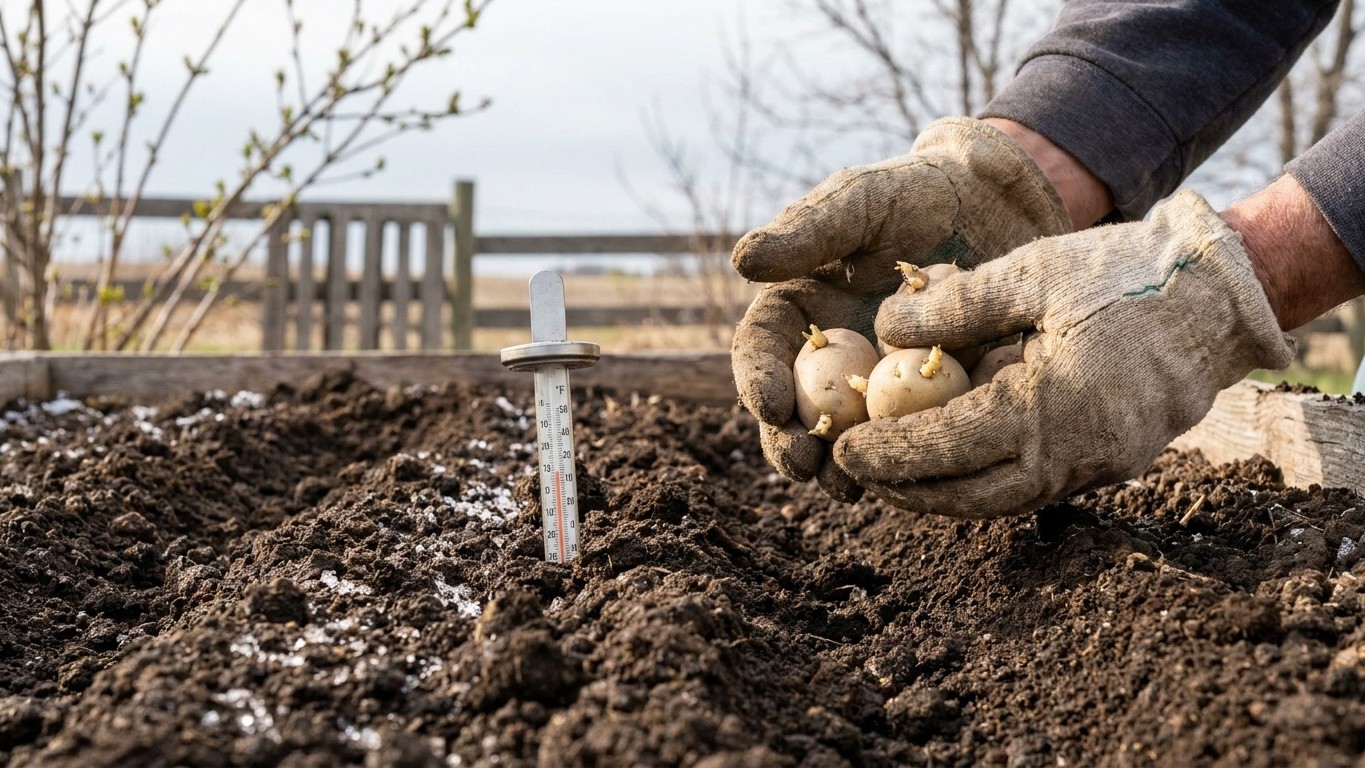

Plant potatoes in South Dakota 14 to 21 days before your local last spring frost, as soon as soil temperature hits 50°F, per Utah State University Extension and the University of Maine Cooperative Extension. For the Sioux Falls reference station, NOAA NCEI puts that frost date between April 29 and May 9, which pushes the digging-in window into mid-to-late April for that area. Your county may run earlier or later.
The short answer
NOAA NCEI’s 1991-2020 Climate Normals, drawn from station USW00014944 near Sioux Falls, place the last spring freeze (32°F) somewhere in the April 29 to May 9 stretch, based on the 30-70% probability band. Count backward 14 to 21 days from that window and you land in mid-to-late April as the working target for getting seed potatoes into the ground around Sioux Falls. That’s not a calendar rule so much as a soil-temperature rule wearing a calendar’s clothing: Utah State and Maine Extension both tie planting to the soil hitting 50°F, and the 14-to-21-day figure is simply how long before an average last frost that threshold tends to arrive in a lot of climates.
Here’s the catch worth sitting with for a second: this is one station’s number, not South Dakota’s number. A field outside Rapid City, a bottomland garden near the Missouri River, or a yard tucked into the hills of the Black Hills region will each have their own frost rhythm, and none of them owe anything to Sioux Falls’ airport thermometer. Elevation changes things. So does whether cold air pools in your yard overnight or drains away. The NOAA dataset is a reference point, not a guarantee, and the agency’s own normals are built from thirty years of station data specifically to smooth out year-to-year noise, not to predict your exact microclimate.
So the real short answer has two parts. First, use the Sioux Falls window (April 29 to May 9) as a rough anchor if you’re in that part of the state, and adjust outward if you’re further west, further north, or at higher elevation, since gardens away from paved airport tarmac commonly see frost linger later in spring and arrive earlier in fall, sometimes by a week or two. Second, don’t plant off the calendar alone. Get a soil thermometer, push it a few inches into the bed, and wait for a reading at or above 50°F before seed potatoes go in. That’s the number both extension sources actually build their planting guidance around, and it’s the number that matters more than any date on a wall calendar.
What actually decides it
Two temperature thresholds do the real work here, one on each end of the growing season, and understanding both lets you plan a potato crop anywhere in South Dakota without needing this page to spell out your specific county.
The 50-degree soil trigger
Potato seed pieces don’t care what the air temperature says. Utah State University Extension and the University of Maine Cooperative Extension both point to soil temperature, specifically that 50°F mark, as the signal to plant. Below that, seed pieces sit in cold, often wet soil and are more prone to rot before they ever sprout. The 14-to-21-day-before-last-frost guidance exists because, in a lot of temperate climates, soil crosses 50°F roughly two to three weeks ahead of the last spring freeze. That’s a correlation, not a fixed law, which is exactly why checking soil temperature directly beats trusting the date alone. A raised bed with dark soil in full sun might hit 50°F well ahead of a heavy clay bottomland field even in the same town.
The 90-degree ceiling on the other end
The other bookend matters just as much and gets ignored far more often. Once soil temperatures climb above 90°F, tuber set and tuber fill both get inhibited, according to the same extension sources, and no amount of extra watering reverses that once it’s underway. This is the mechanism that should drive the whole planning decision in a state where western and central counties routinely rack up plenty of 90°F days in mid-summer. If your area runs hot early, the strategy isn’t to baby a potato patch through August heat. It’s to plant as early as that 50°F soil threshold allows, so tubers are sizing up during the cooler weeks before the ceiling gets hit, rather than trying to push a crop through peak summer heat and hoping it fills anyway.
Put those two thresholds together and you have a portable framework: find your local soil-warms-to-50°F date, and know your local run of 90°F-plus soil days. Everything about timing potatoes in South Dakota, or anywhere else, sits inside that window.
How to do it
- Source certified seed potatoes. Uncertified seed carries a real risk of viral disease that can undercut a whole planting before it starts, and certification is the one variable a home gardener can fully control.
- Check your local soil temperature with a simple soil thermometer pushed a few inches into the bed, rather than relying on the calendar alone, since a 50°F reading is the actual planting trigger both extension sources use.
- Count backward from your own last frost date, not Sioux Falls’ number if you garden elsewhere in the state, using the 14-to-21-day window as your rough target for when soil is likely to reach that 50°F mark.
- Cut larger seed potatoes into pieces a couple of days before planting so cut surfaces can callus over, reducing the chance of rot once they’re in the ground.
- Plant into soil that has already reached 50°F, rather than jumping the gun on a warm afternoon before the ground itself has caught up.
- Choose a season class that matches your local heat pattern. Early varieties finish sizing before summer heat peaks; mid-season and late varieties need a longer stretch of cooler soil to fill tubers before any run of 90°F-plus days sets in.
- Match variety use to the crop’s purpose, since extension guidance describes potatoes by what they’re suited for, baking or boiling, rather than by texture labels that aren’t part of the published record.
- Watch soil temperature again as summer approaches, and if your area is prone to early heat, plan on digging as an early or spring crop rather than letting tubers sit in soil that’s climbed past 90°F.
What goes wrong
- Planting by the calendar date alone. A gardener plants exactly on a remembered “average last frost” date without ever checking soil temperature, and cold, wet soil rots the seed piece before it sprouts. The fix is simple: carry a soil thermometer and wait for 50°F, regardless of what the date on the wall says.
- Assuming Sioux Falls’ frost window applies statewide. A gardener in a higher-elevation or more rural part of South Dakota plants using the April 29 to May 9 window and gets caught by a later frost. The remedy is to treat that window as a Sioux Falls-area reference only and check local conditions, since outlying gardens often run a week or two behind an airport station.
- Letting a late-season crop ride through peak summer heat. Tubers stop sizing once soil passes 90°F, and extra irrigation doesn’t undo that. The fix is to plant as early as the 50°F soil trigger allows and, in hot-summer areas, plan on digging a spring crop before the heat ceiling arrives rather than expecting a full season’s growth.
- Using uncertified seed potatoes from a grocery bin or unknown source. This is the single most avoidable failure, since uncertified stock can carry virus that undermines the whole planting invisibly, before any symptom shows above ground. Buying certified seed removes that risk at the source.
- Skipping the curing step on cut seed pieces. Planting freshly cut pieces straight into cold soil raises the odds of rot at the cut surface. Letting pieces callus for a couple of days before planting cuts that risk down.
Common questions
Is the April 29 to May 9 frost window true for the whole state?
No. That figure comes specifically from NOAA NCEI’s 1991-2020 Climate Normals for station USW00014944 near Sioux Falls. Other parts of South Dakota, particularly at higher elevation or further from that station, commonly see later spring frosts and earlier fall frosts, sometimes by a week or two.
Why 14 to 21 days before last frost instead of an exact date?
Because the actual trigger, according to Utah State University Extension and the University of Maine Cooperative Extension, is soil reaching 50°F, not the calendar. The 14-to-21-day range is a rough estimate of when that soil temperature tends to arrive ahead of an average last frost, which is why checking soil temperature directly is more reliable than counting days.
What happens if I plant too late and heat arrives early?
Soil temperatures above 90°F inhibit tuber set and fill, per the same extension sources, and that damage isn’t reversible with irrigation. In areas prone to early or intense summer heat, the better strategy is planting as early as the soil allows and treating the crop as an early or spring harvest.
Should I pick an early, mid-season, or late variety?
That depends on how long your soil stays below 90°F before summer heat sets in. Early types finish sizing sooner and suit areas where heat arrives fast; mid-season and late types need a longer cool stretch. Neither Utah State nor Maine Extension publishes specific days-to-maturity numbers, so season class, rather than an exact day count, is the guidance to plan around.