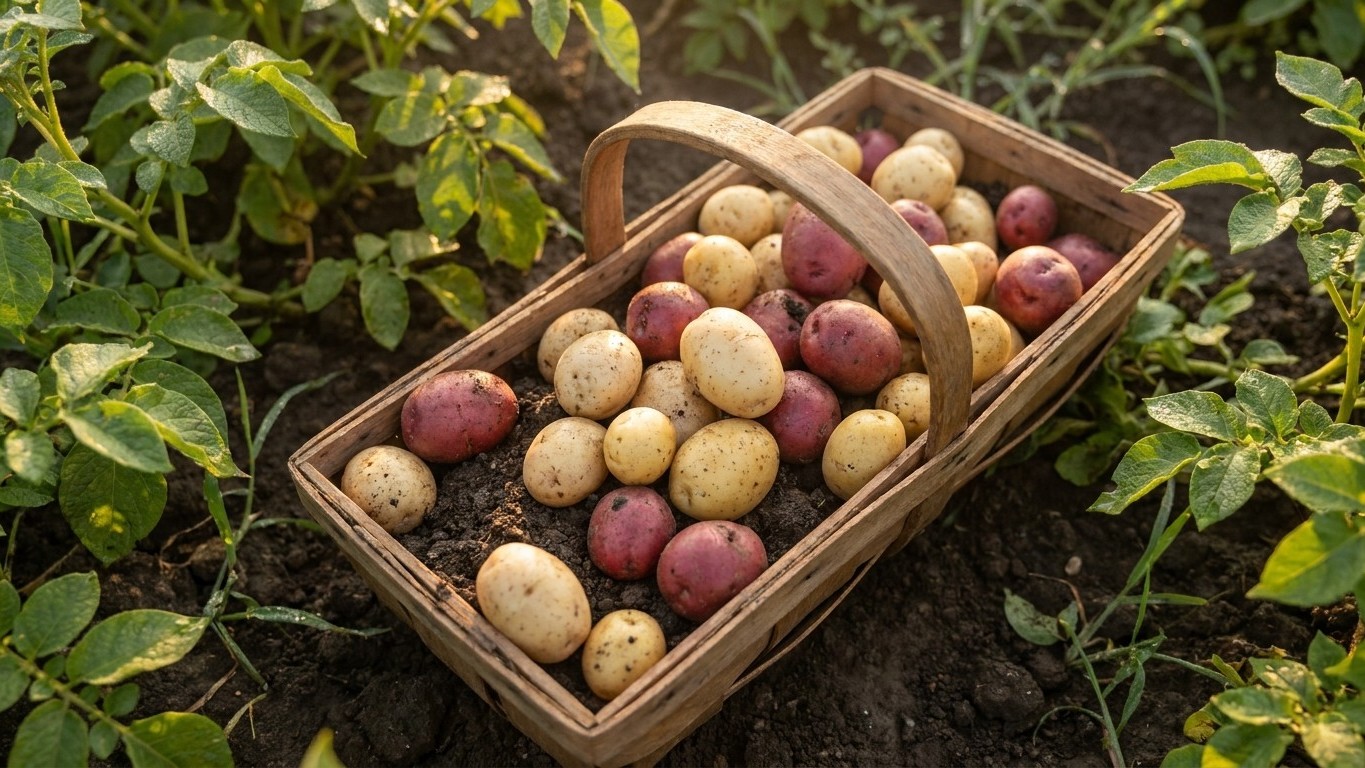

South Dakota gardeners get the best results from early- and mid-season potatoes, not late-season ones. The state’s frost window closes fast in spring and the summer soil often runs hot enough to stall tuber growth before a late variety finishes filling. Matching a variety’s season class to that window, and starting from certified seed, is what actually separates a full basket from a handful of golf-ball tubers.
The short answer
At the reference station for this region, Sioux Falls (NOAA station USW00014944), the last spring freeze falls somewhere between April 29 and May 9, based on the 1991-2020 Climate Normals from NOAA’s National Centers for Environmental Information. That’s a real range, not a single date, and it’s built from 32°F freeze probabilities. A garden outside the immediate Sioux Falls area, especially one at higher elevation or farther from the moderating effect of a city, can see frost run one to two weeks later in spring and earlier in fall than this station shows. Check county-level data before setting a date on the calendar.
That short window is why early- and mid-season potatoes are the safer bet across most of the state. Utah State University Extension and the University of Maine Cooperative Extension, the two authorities behind the horticultural guidance on this page, both describe potatoes by season class (early, mid-season, late) rather than by a fixed day count, because maturity shifts with soil temperature, moisture, and daylight. Neither publishes a days-to-maturity number for named varieties, and no such number appears here.
What that means in practice: an early variety like Norland types (grown for boiling and salads) gets planted, sizes up, and can be dug before the hottest stretch of summer arrives. A mid-season type such as Yukon Gold works for both boiling and baking and tolerates a slightly longer window. Late-season types, the ones bred for long storage and baking, need the most days of cool soil to fill out, and that’s exactly what a short South Dakota season doesn’t reliably offer.
| Season class | Typical use | Fit for South Dakota |
|---|---|---|
| Early | Boiling, salads | Best match: dug before peak summer heat |
| Mid-season | Boiling, baking (dual purpose) | Good match in most counties |
| Late | Baking, long storage | Riskier: needs a longer cool stretch than many areas reliably give |
None of this is a guarantee tied to a specific address. It’s a way to weigh risk before buying seed.
What actually decides it
Two mechanisms run this whole decision, and they work independently of each other. A gardener who understands both can size up a potato plan for any county in the state, not just the ones mentioned here.
The frost window sets the start line
Potatoes go in the ground as soon as soil reaches 50°F, according to Utah State University Extension and the University of Maine Cooperative Extension. That threshold typically arrives 14 to 21 days before the last frost date, because soil warms ahead of the air holding steady above freezing. In practice, a gardener working from the Sioux Falls window (late April into early May) is often planting in mid-to-late April, once soil temperature confirms it, not the calendar. Waiting for a frost-free date on paper wastes two to three weeks of usable soil warmth, and those weeks matter more for a late variety than an early one, since the late type needs every extra day it can get.
The heat ceiling sets the finish line
Above 90°F soil temperature, tuber set and fill shuts down, per the same two extension sources. This is the mechanism most gardeners never see coming, because the plant above ground can look fine while the tubers below stop sizing. Watering more doesn’t reverse it. This is a soil-temperature problem, not a moisture problem, and no amount of irrigation during a 90°F stretch will restart tuber bulking once it stalls.
Put those two mechanisms together and the logic writes itself: the gardener wants to be in the ground the moment soil hits 50°F, and finished bulking before soil regularly hits 90°F. A county with more 90°F days on record has a shorter effective window for tuber fill, which pushes the safer choice toward early and mid-season varieties dug ahead of the worst heat, rather than late types counting on a long, cool fall to catch up. This same reasoning applies whether the garden sits in a river valley with heat-holding soil or on a breezy ridge that runs several degrees cooler; the gardener just needs their own soil thermometer readings, not this page’s numbers, to apply it.
How to do it
- Get a soil thermometer and start checking it in early spring, well before any date on a calendar.
- Buy certified seed potatoes rather than grocery-store tubers or leftover seed of unknown origin; uncertified seed carries viruses that spread through the plant and reduce yield for the life of the crop.
- Choose a season class (early, mid-season, or late) based on how many 90°F soil days your area typically logs, favoring early or mid-season where those hot stretches run long.
- Cut and cure seed pieces if needed, then plant as soon as soil reaches 50°F, which generally falls 14 to 21 days ahead of the last frost date for your county.
- Hill the rows as plants grow to keep developing tubers covered and shaded from direct heat.
- Track soil temperature through the season; if a stretch of 90°F soil arrives, don’t compensate with heavier watering, since it won’t restart tuber fill once it has stalled.
- Dig early-season varieties as soon as they finish sizing, ahead of the hottest weeks, rather than waiting for foliage to die back on its own.
- Cure and store whatever quantity of late-season potatoes you did plant promptly after digging, since they were already working with a tighter cool-weather margin.
What goes wrong
- Planting uncertified seed. It looks like a shortcut, but it carries viruses that stunt yield season after season. Buy certified seed potatoes instead.
- Waiting for a frost-free calendar date instead of checking soil temperature. This costs 14 to 21 days of usable planting window. Use a soil thermometer and plant once it reads 50°F.
- Choosing a late-season variety expecting a long, cool fall to bail it out. If the season’s heat arrives before the tubers finish filling, they won’t catch up later. Match variety season class to your county’s heat pattern before buying seed, not after.
- Watering harder during a hot spell to “fix” slow tuber growth. Above 90°F soil, tuber set and fill stop regardless of moisture. The fix is timing (plant and dig earlier), not irrigation.
- Assuming the whole state shares one frost date. The Sioux Falls window (April 29 to May 9) reflects one station. Gardens elsewhere, especially at higher elevation or away from urban heat retention, often see frost a week or two later in spring and earlier in fall. Check your own county’s data before locking in a planting date.
Common questions
Can I still grow a late-season variety in South Dakota?
Yes, but plan around the risk. A late type needs the longest run of cool soil to bulk properly, so it only makes sense where the local frost window is on the longer side and summer heat spikes are short-lived. Check your county’s own frost data rather than relying on a single reference station.
Does mulching help protect tubers from the 90°F heat ceiling?
The published guidance from Utah State University Extension and the University of Maine Cooperative Extension addresses soil temperature as the controlling factor, without a specific mulch-effect figure. What is published clearly is that watering alone does not reverse the effect once soil crosses 90°F, which is why timing the crop to finish before that threshold matters more than trying to compensate for it afterward.
Why does certified seed matter so much?
Uncertified seed can carry viruses invisibly, meaning a gardener plants a problem without knowing it. Those viruses reduce vigor and yield, and they can persist in saved seed from year to year. Certified seed is inspected specifically to avoid that risk.
How do I know my own soil has hit 50°F if I don’t have a thermometer?
A soil thermometer is inexpensive and gives a direct reading, which is more reliable than guessing from air temperature or a calendar date. Insert it a few inches into the planting row at the same time each morning for a few days running to get a consistent read before committing seed to the ground.