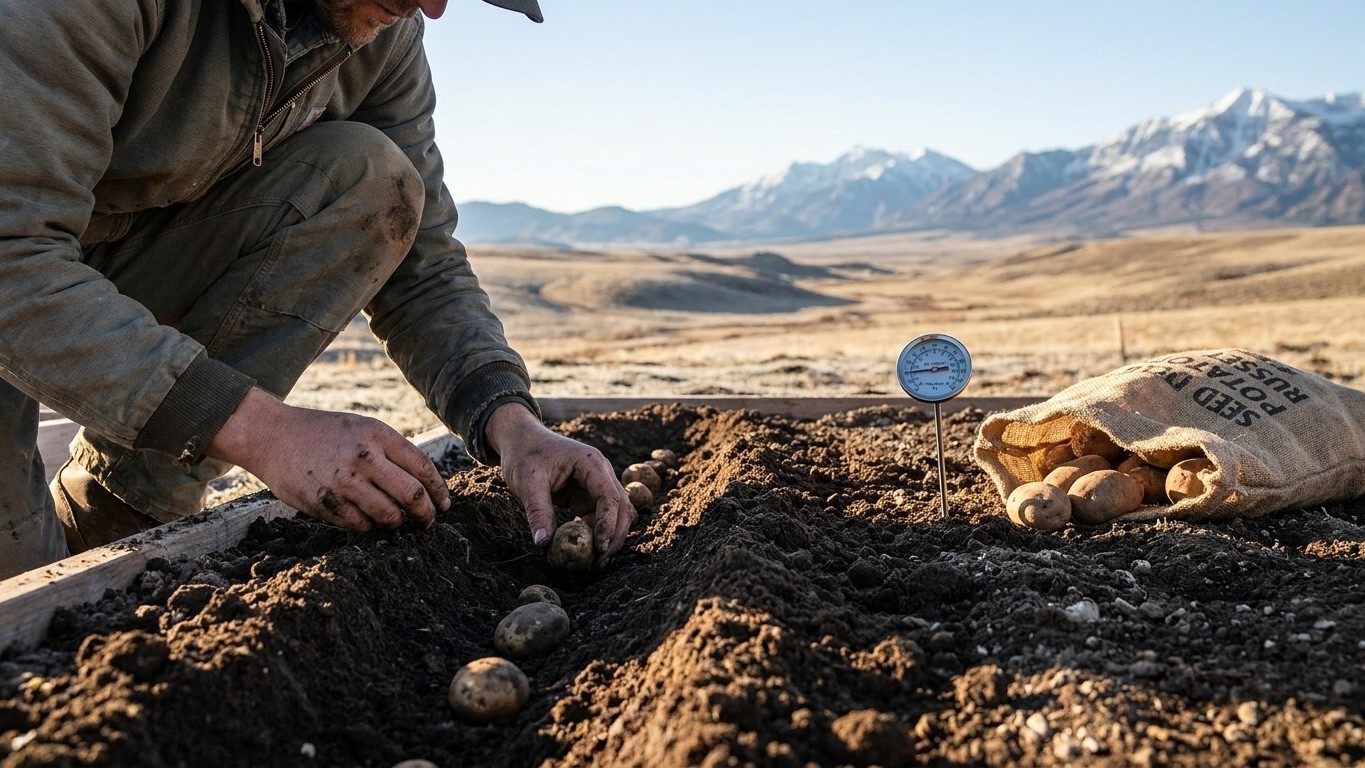

For Salt Lake City, the reference station in NOAA’s 1991-2020 Climate Normals, the last spring frost falls somewhere between April 12 and April 29 (NOAA NCEI, station USW00024127). Potatoes go into the ground 14 to 21 days before that date, once soil temperature reaches 50°F. That puts a typical Salt Lake-area planting window in late March to early April. Everywhere else in Utah, count back from your own local last-frost date instead, elevation changes the math.
The short answer
Fourteen to 21 days before the last frost. That’s the rule Utah State University Extension gives in its fact sheet Potatoes in the Garden, and it’s tied to soil temperature, not to a date on a wall calendar. Once the soil hits 50°F, seed potatoes go in, frost or no frost, because the eyes sit several inches underground where a light freeze at the surface rarely reaches them.
Run the numbers against Salt Lake’s own frost window and you get two different planting targets depending on which end of the range your yard lands on:
| If last frost falls on | Plant 14-21 days earlier, meaning |
|---|---|
| April 12 (early end of Salt Lake’s range) | Roughly March 22 to March 29 |
| April 29 (late end of Salt Lake’s range) | Roughly April 8 to April 15 |
Notice the spread. Salt Lake City’s own frost date wanders by more than two weeks year to year, and that’s before accounting for anything outside the valley floor. NOAA’s normals come from a single station, and the caution built into that data matters here: Salt Lake sits in a mild valley. Most of Utah sits higher and colder, and a gardener in Cache Valley, Park City, or anywhere above the valley floor should expect a later last frost than what this station records. Southern Utah, around St. George and the lower Virgin River basin, runs warmer and earlier. Neither of those local dates is published in the source used for this page, so the honest answer for a reader outside Salt Lake City is to pull the same NOAA Climate Normals product for the station nearest home and run the same 14-to-21-day subtraction.
The station-specific nature of this figure is the whole point. A “Utah” planting date doesn’t exist. A Salt Lake City planting date does, and it’s built from 30 years of freeze-probability data at one airport-area station. Treat it as a starting model, not a statewide rule.
What actually decides it
Soil temperature, not the calendar
Air temperature and soil temperature move on different clocks. Soil holds heat and cold longer than the air above it, which is why a warm week in late March doesn’t guarantee plantable dirt, and why a cold snap after planting rarely kills a seed potato that’s already buried. Utah State University Extension sets the working threshold at 50°F soil, measured a few inches down, as the point where potatoes can go in. That’s the number that actually drives the calendar back 14 to 21 days from frost. A gardener with a south-facing raised bed, black plastic mulch, or sandy soil that warms fast could hit 50°F well ahead of a neighbor with heavy clay in a shaded yard, even though both live under the same NOAA frost window. The frost date sets an outer boundary; the soil thermometer sets the real one.
The 90°F ceiling that ends tuber sizing
The other end of the season has its own hard limit, and it’s the more consequential one for Utah gardeners. Once soil temperature climbs above 90°F, tuber set and tuber fill shut down. This comes from both Utah State University Extension and the University of Maine Cooperative Extension’s Bulletin #2077, and neither source treats it as a minor detail: this is the mechanism that decides the whole crop. Above that soil temperature, the plant stops putting energy into sizing tubers, and no amount of extra watering reverses it. Watering keeps the plant alive; it does not restart tuber growth once the soil has crossed that line.
This is the fact that should reshape how a Utah gardener thinks about “late” plantings. In regions of the state that rack up long stretches of 90°F-plus days, summer is not a growing window for potatoes, it’s a shutdown window. The practical response isn’t to fight the heat with irrigation. It’s to plant as early as the 50°F soil threshold allows and treat the crop as a spring dig, pulled before the ground bakes, rather than a summer-long project. A reader gardening at elevation, where summer soil temperatures stay lower for longer, has more slack in this calendar than a reader in a low, hot valley. Same rule, different outcome, because the mechanism is soil temperature at both ends of the season, not a fixed number of weeks.
How to do it
- Find the NOAA Climate Normals freeze-probability data for the station nearest your garden, not just the Salt Lake City figure used here, and note your own last-frost range.
- Push a soil thermometer several inches into the planting bed on a few different mornings once that frost window approaches, and track when readings settle at or above 50°F.
- Count back 14 to 21 days from your local last-frost date and compare that target against your actual soil-temperature readings; plant when the two line up, favoring the soil reading if they conflict.
- Buy certified seed potatoes. Uncertified seed carries virus that can quietly cut yield for the whole season, and it’s not something you can inspect your way around at the garden center.
- Choose a season class, early, mid-season, or late, based on how your region’s heat arrives rather than chasing a specific days-to-maturity number, since neither Utah State Extension nor University of Maine Extension publishes one for individual varieties.
- Cut and cure seed pieces if they’re larger than a golf ball, then plant into the prepared bed at the soil-temperature-confirmed date.
- Hill soil over the developing plants as they grow, both to protect shallow tubers from sunlight and to keep the root zone a little cooler and more insulated as air temperatures climb.
- Watch soil temperature again as summer approaches; if your area regularly crosses 90°F, plan to harvest before that point rather than extending the season into it.
What goes wrong
- Planting strictly by a printed date instead of soil temperature. A calendar date is an estimate built from 30 years of averages; your actual yard might warm faster or slower. Check soil temperature directly rather than trusting the date alone.
- Using saved or uncertified seed potatoes. Virus carried in uncertified seed can reduce vigor and yield without any obvious symptom at planting time. Buy certified seed potatoes each season.
- Treating Salt Lake City’s frost window as a statewide figure. Higher elevations across most of Utah run colder and later than the valley floor station this figure comes from; southern Utah runs earlier and warmer. Pull the Climate Normals for your own nearest station instead of borrowing this one.
- Pushing a summer-long harvest in a hot region. Once soil crosses 90°F, tuber sizing stops, and extra irrigation does not restart it. In areas with long stretches of 90°F soil, plant early and dig a spring crop rather than expecting growth to resume once temperatures fall.
- Picking a variety by taste alone without matching it to the local heat pattern. A variety bred for baking or for boiling doesn’t come with a guaranteed maturity window from these sources, so match the season class, early, mid-season, or late, to how quickly your soil is likely to cross that 90°F ceiling.
- Assuming a raised bed or mulched bed follows the same soil-temperature schedule as open ground. Dark mulch and raised beds warm faster in spring and can also overheat sooner in summer, shifting both ends of the safe planting window.
Common questions
Can I plant potatoes before the last frost in Utah?
Yes, and the 14-to-21-day-before-frost rule from Utah State University Extension assumes exactly that. Seed potatoes sit underground where a light frost at the surface usually doesn’t reach them, which is why the soil-temperature threshold, not the frost date itself, is what actually triggers planting.
What if my soil never reaches 50°F by the planting window?
That points to a cold, slow-draining, or shaded bed rather than a problem with the calendar math. Wait for the soil reading rather than the date; planting into cold soil risks rot before the seed piece can sprout.
Does the frost date differ elsewhere in Utah?
It does, and significantly. The April 12 to April 29 range cited here comes from a single Salt Lake City-area station. Most of the state sits higher and colder, with later last-frost dates, while southern Utah runs warmer and earlier. This page doesn’t carry the specific figures for those other stations; pull them from the same NOAA Climate Normals product for your nearest reporting station.
Should I choose an early or late potato variety for Utah’s heat?
Match the season class to how soon your area typically crosses that 90°F soil threshold. In regions with a long hot stretch, an early or mid-season variety planted as soon as soil hits 50°F gives the plant more time to size tubers before heat shuts that process down. Neither Utah State Extension nor University of Maine Extension publishes a fixed days-to-maturity number, so plan around the season class and your local heat pattern rather than a specific date.