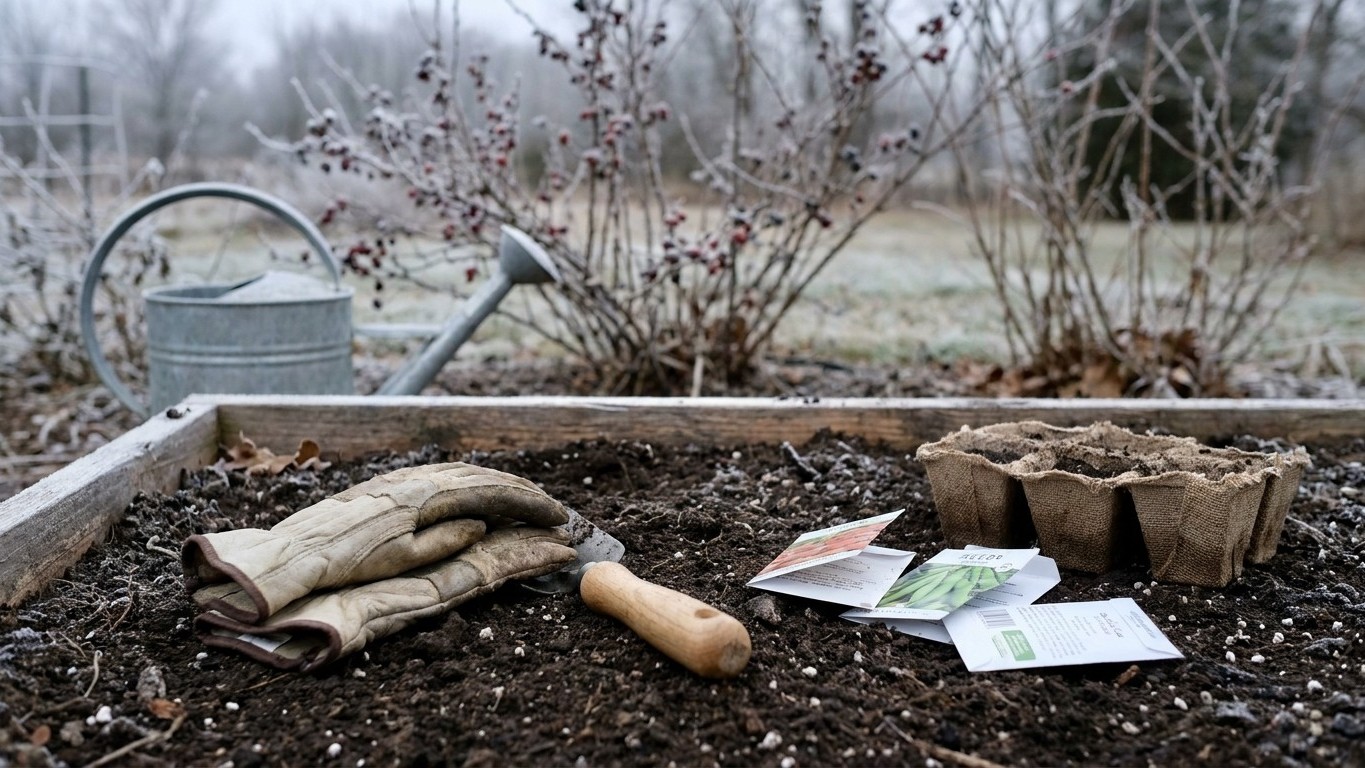

February answer for Wyoming gardeners: almost nothing goes into open ground yet. Last spring frost across the state runs May 7 to May 18, and most of Wyoming sits in USDA hardiness zones 3a to 6a, cold enough that frozen or waterlogged soil rules out direct sowing almost everywhere this month. What does work: dormant bare-root planting where ground is workable, cold frames and low tunnels for hardy greens, forcing rhubarb or chicory indoors, and the seed-starting and pruning work that sets up the whole season.
What goes in the ground in February

The calendar says February, but the soil doesn’t care what month it is. It cares about temperature, and across most of Wyoming that temperature sits well below what any vegetable root wants to sit in. With NOAA’s 1991-2020 climate normals putting the last spring freeze between May 7 and May 18, gardeners are still ten to twelve weeks from a safe planting window in open ground. That gap is the whole story this month.
Elevation makes the gap worse in a lot of the state. Wyoming’s hardiness range spans zones 3a to 6a, and that range isn’t a rounding error, it’s the difference between a mountain valley and a lower-elevation basin. At roughly 6,000 feet, the growing season shrinks to around 130 frost-free days, and frost can show up in any month of the year. A gardener near the lower, milder end of that zone range might see thawed, workable soil in a sheltered south-facing bed by late February in an unusually mild stretch. A gardener at higher elevation is often still looking at snowpack.
So the honest answer for the vast majority of Wyoming gardens this month is: nothing goes into open, unprotected soil. That’s not a failure of planning, it’s physics. What changes the picture is protection. Cold frames and low tunnels can warm the soil underneath by several degrees and let a gardener tuck in the toughest hardy greens, spinach and mâche among them, weeks before open beds would tolerate them. Bare-root fruit trees, canes and roses can go in as dormant stock the moment ground is workable, since they aren’t actively growing yet and won’t be damaged by a cold snap the way a leafed-out seedling would. Rhubarb crowns and chicory roots can be brought indoors, kept dark and cool, and forced for an early, out-of-season harvest that has nothing to do with outdoor soil temperature at all.
| Zone within Wyoming | Typical setting | What February looks like |
|---|---|---|
| 3a | Mountain valleys, high elevation basins | Ground frozen solid, snowpack likely, no outdoor planting |
| 6a | Lower elevation pockets, sheltered sites | Occasional thaw windows; bare-root and cold-frame work possible |
What to start under cover
Indoor seed starting in Wyoming has to be counted backward from a frost window, not forward from a date on the wall. With the last freeze landing anywhere from May 7 to May 18 depending on location, a gardener has to decide which end of that range applies to their own yard before doing the math. Onions and leeks are the classic February indoor start here, because they need something like ten to twelve weeks of growth before they’re ready to go outside, and they tolerate the cool, imperfect light of an early start better than most seedlings. Counting back from even the earlier end of the frost window puts a mid-to-late February sowing date well within reason for alliums.
Long-season warm crops are a different story, and this is where the two failure modes show up. Start tomatoes, peppers or squash too early in February and by the time the ground is actually safe in May, the seedlings are rootbound, leggy and stressed, stretching for light in a pot that’s too small. Wait too long, on the other hand, and a short-season crop like celery, which needs ten or more weeks before transplant, simply never catches up once it goes outside. The safe move in February is to start the slow growers, onions, leeks, celery, artichokes where attempted, and hold off on tomatoes and peppers until the timing lines up with the actual frost window rather than the urge to get something growing.
A heat mat and a grow light do more work than a sunny windowsill this time of year, since day length is still short across the state and window-grown seedlings tend to stretch toward the glass and go weak-stemmed.
What is ready to pick
Little to nothing is coming out of an open Wyoming garden in February, and there’s no point pretending otherwise. But that doesn’t mean the kitchen goes without. Kale and leeks left in the ground under a heavy mulch layer or a blanket of snow often survive and can be dug or cut when the ground thaws enough to get a fork in, since both crops actually sweeten after hard cold. A cold frame that was seeded with spinach or mâche back in fall may still be producing small, slow leaves that are worth checking every week or two.
Indoors, sprouts and microgreens are the fastest payoff in the whole gardening calendar, ready in as little as a week from seed and requiring nothing but a tray, water and a windowsill. They’re also the easiest way to get fresh greens onto a plate without touching frozen ground.
The other job this month is going through the root cellar or pantry. Stored squash should be firm with no soft spots or sunken patches, since a squash that’s starting to give under light pressure is on its way to rotting from the inside. Potatoes need to come out of any bag that’s collecting moisture and get sorted, sprouting ones set aside and used first. Onions stored in mesh or crates should be checked for any going soft at the neck, since one rotting onion in a bag can take down its neighbors within days.
The jobs that matter this month

This is the month the garden gets built even though nothing is planted yet, and the list of real deadlines is long. Dormant pruning of fruit trees, brambles and grapevines belongs here, done while the plant is fully dormant and before sap starts moving in spring, which makes cuts heal cleaner and lowers the risk of disease entering a fresh wound. Wait until buds swell and the tree is actively pushing growth, and pruning stresses it at exactly the wrong time.
Seed ordering has its own deadline, one set by other gardeners rather than the weather. Popular varieties, especially the shorter-season ones that actually work at Wyoming’s elevations, sell out from seed companies weeks before spring planting even starts. Ordering in February, while catalogs are still fully stocked, is the difference between growing the variety that was actually chosen and settling for whatever’s left.
Soil work pays off now too. A soil test taken while beds are empty gives time to actually correct a pH or nutrient problem before planting, since lime and some amendments need weeks to work into the soil rather than acting overnight. Compost piles built up over fall and winter benefit from a turn this month to keep the decomposition going and have finished material ready by spring. Tools are worth pulling out of the shed for cleaning, sharpening and a coat of oil on wooden handles, since a dull hoe or pruner does more damage to a plant than a sharp one and rust only gets worse with use.
Fencing and raised bed frames that took winter damage should get repaired now, before the ground softens and repair work turns into mud work. And that root cellar check mentioned above isn’t a one-time job. A weekly pass through stored crops catches rot before it spreads to the whole bin.
What not to do in February
The most common mistake this month is trusting the air instead of the ground. A stretch of 50-degree afternoons can feel like spring, but soil several inches down often hasn’t caught up, and seeds sown into cold, wet soil either rot before they germinate or come up weak and stunted. Soil temperature, not air temperature, is the number that matters, and in February across most of Wyoming that number is still too low for anything but the hardiest crops under cover.
A close second is uncovering cold frames, row covers or mulched beds too early after a mild spell. It feels productive to let some fresh air in, but Wyoming’s weather swings hard, and a warm week is often followed by a hard freeze that catches exposed plants or thawed soil off guard. The safer habit is to vent covers during the warm hours and close them back up every evening rather than removing protection altogether.
Feeding nitrogen this early is another trap. Nitrogen pushes soft, leafy growth, and any plant coaxed into that kind of growth before the frost window has passed is exactly the plant a late freeze will damage worst. Save the nitrogen for when growth is actually underway and the frost risk has genuinely passed, and use February instead for phosphorus and potassium work like bonemeal or a slow-release base fertilizer that doesn’t force growth on its own.
Checking this against your own county
A statewide month is a starting point, not an instruction, and Wyoming makes that truer than most states. Elevation swings from valley floor to mountain basin move frost windows by weeks in either direction, and a garden on the lower, southeastern edge of the state behaves nothing like one tucked into a high mountain valley. Local topography, wind exposure and even a nearby reservoir can shift things further still.
The most reliable next step is checking conditions against a local source rather than a statewide average. The University of Wyoming Extension tracks county-level growing conditions and can point to a planting calendar built for a specific part of the state rather than the state as a whole.
Common questions
Can anything be direct-sown outdoors in Wyoming in February?
For nearly all of the state, no. With the last spring frost running May 7 to May 18 and much of Wyoming sitting at high elevation, open soil is typically frozen or too cold for germination. Cold frames and low tunnels are the workaround, not open beds.
Is it too early to start tomato seeds indoors in February?
Yes, in most cases. Tomatoes are best started roughly six to eight weeks before the last frost, and starting in February for a May transplant window risks leggy, rootbound plants sitting in pots far longer than they should.
What’s the point of pruning fruit trees if nothing else is growing?
Dormant pruning works precisely because the tree isn’t growing. Cuts made while a tree is fully dormant heal cleaner and carry less disease risk than cuts made once sap is moving and buds are swelling in spring.
How much does elevation really change the planting window?
Enough to matter a great deal. Wyoming spans USDA zones 3a to 6a, and locations near 6,000 feet see roughly 130 frost-free days with frost possible in any month, while lower elevation pockets can run noticeably milder. Checking a local extension resource beats relying on a statewide frost date.
Gardeners who plant by the Moon can check the February 2027 moon planting calendar, a tradition rather than a proven method.