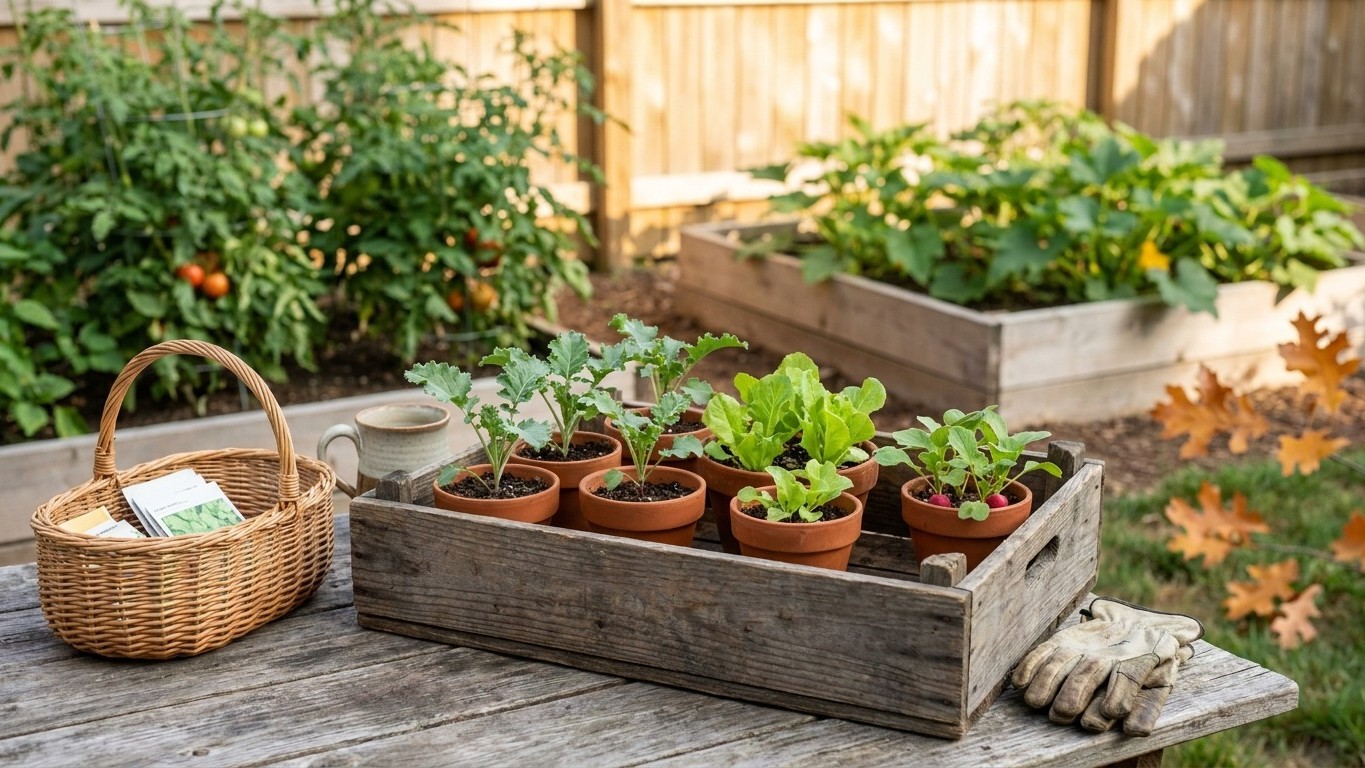

August in Yukon sits right on the edge of the growing season rather than in the middle of it. With an average first fall frost landing August 25, the month opens with a few workable weeks and closes with the season’s most likely turning point already behind most gardens. That timing changes almost everything about what’s worth planting versus what’s worth protecting and bringing in.
What goes in the ground in August
The math here is blunt: last spring frost averages June 5, first fall frost averages August 25. That’s roughly eleven weeks of frost-free growing on paper, and August eats into what’s left of it fast. Both dates are mean dates from Environment and Climate Change Canada’s climate normals for the Whitehorse A station, not guarantees. In half of all years, frost arrives later than August 25, but in the other half, it arrives earlier. That uncertainty should shape every decision this month, not just the calendar page.
Early August, roughly the first two to three weeks, still leaves a narrow window for the fastest-maturing hardy crops: radishes, baby lettuce mixes, spinach, arugula, and quick turnip greens. These can mature in three to four weeks under decent conditions, which puts a harvest just inside the average frost date if sown promptly. Anything slower is a gamble, and by the back half of the month that gamble gets steep.
Cold frames and row covers earn their keep here. A sheet of floating row cover or a simple cold frame can buy a crop an extra week or two past the average frost, which is often the difference between a harvest and a loss. This is also a reasonable time to think ahead to fall garlic and shallots, which many Yukon gardeners tuck into the ground once the soil starts cooling but is still workable, well after the main harvest push of this month rather than during it.
What doesn’t belong in the ground now: anything warm-season, anything with a maturity window longer than what’s left before frost, and any transplant that needs weeks to establish roots before cold nights arrive. Skip beans, squash, and tomato transplants entirely at this point, the arithmetic simply doesn’t work.
What to start under cover
Starting new outdoor transplants in August makes little sense in Yukon given how close the average frost sits. But starting crops meant to live their entire life under cover, in a hoophouse, greenhouse, or cold frame, is a different calculation entirely, and one worth using.
Count backward from the frost window rather than from a date on a calendar. If a green needs four weeks to reach a pickable size and the average frost is August 25, anything sown after the first week of August is racing a coin flip. Move that same seed into a protected structure, though, and the countdown resets: a hoophouse or cold frame can run several weeks past the outdoor average frost, sometimes into fall, because it buffers the sharpest overnight temperature drops.
Good candidates for this kind of protected, second-act sowing include loose-leaf lettuce, spinach, mustard greens, pak choi, and other fast brassica greens. Sow them under cover through the first half of the month and expect a harvest that stretches into the weeks after the open garden has already frosted off.
The two failure modes to watch for are mirror images of each other. Sow too early relative to the space available, and seedlings sit too long before conditions call for them, turning leggy and rootbound in cramped trays. Sow too late, and there simply isn’t enough daylight or warmth left, even under cover, to bring a crop to a useful size before the light drops off through autumn. Neither mistake is fatal on its own, but Yukon’s compressed season leaves little room to recover from either.
What is ready to pick
This is the busiest stretch of the Yukon garden year for a reason: everything planted back near the average last frost in early June is converging on harvest right around now. Peas, radishes, spinach, lettuce, early bok choy, kohlrabi, and turnips planted in late spring should be reaching a pickable size through the month. New potatoes, dug carefully by hand from the edge of a hill, are often ready even before the main crop matures.
Rhubarb, if it’s established, keeps producing stalks worth cutting well into the month, and hardy herbs like chives, dill, and parsley are usually still going strong. Root crops sown in June, carrots and beets in particular, are worth checking by gently brushing back soil at the shoulder to see whether they’ve sized up.
Because the average first fall frost falls inside this same month, the real skill in August is timing the harvest of anything tender against the forecast rather than the calendar. A cold, clear night with a dropping barometer is worth more attention than the date on the wall. Once frost is forecast, bring in anything soft-leaved and unprotected before nightfall rather than hoping it survives, and treat any crop still under row cover or in a cold frame as the extension of the season it’s meant to be.
The jobs that matter this month
Harvest timing is the headline job, but it isn’t the only one. As soon as a frost warning appears in the forecast, tender crops need to come in that day, not the next morning. Keep row cover or an old sheet on hand and ready to throw over anything still in the ground overnight; a few degrees of protection is often all it takes to push a harvest a week or two further.
Curing and storing start now too. Onions and garlic that were planted earlier in the season and have died back at the tops should be lifted, cured in a dry, airy spot out of direct sun, and checked over before storage. Any bulb with a soft neck or bruised skin should be used first, not stored, since it will be the first to rot.
Succession sowing still has a narrow place this month, but only for the fastest greens and only under cover, as covered above. Pest scouting matters more than it might seem: aphids and cabbage worms often build up quietly through midsummer and become obvious just as crops are sizing up for harvest, so a quick check of leaf undersides pays off before an infestation sets in.
Watering rhythm should start easing back as days shorten and evaporation slows, but don’t let that turn into neglect right before harvest, when consistent moisture still affects size and flavor. This is also a sensible time to start turning compost, tidy up spent early crops to make room for a fall cold-frame planting, and take stock of which varieties actually kept pace with the short season, since that’s the kind of note that’s easy to forget by the time seed orders open again.
What not to do in August
The most common mistake is trusting warm daytime air over the actual overnight forecast. Yukon days can feel mild well into the month while nights drop fast, especially in low-lying or open areas prone to cold air pooling. A warm afternoon is not a signal that frost risk has passed.
A second mistake is feeding crops nitrogen this late in the season. High-nitrogen fertilizer pushes soft, leafy new growth, and that new growth is exactly what frost damages first and worst. If anything, easing off nitrogen and letting plants naturally slow down helps them handle a cold night better, not worse.
Third, don’t assume the gap between the average last spring frost and the average first fall frost, roughly eleven weeks, gives more room than it actually does. Both dates are averages, which means a longer-season crop planned around the full eleven weeks has no buffer if either date shifts against you, and no protection if frost arrives on the early side of its range.
Finally, resist uncovering row covers or cold frames too early after a mild stretch. A few warm days in a row can make it tempting to pull protection off entirely, but a single cold night afterward can undo weeks of careful timing. Leave protection in place, or at least nearby and ready, through the entire month rather than packing it away at the first sign of warmth.
Early versus late August, at a glance
| Timing | What’s realistic outdoors | What’s realistic under cover |
|---|---|---|
| Early August | Fast greens and radishes still worth sowing directly | Sow greens meant to finish inside a cold frame or hoophouse |
| Late August | Harvest and protect only; new sowing is a gamble | Protected greens continue growing past the average frost |
Checking this against your own county
A territory-wide frost date is a starting point, not an instruction. Yukon’s frost figures here come from the Whitehorse A station, and elevation, valley cold pockets, and the sheer distance between communities move real frost timing by weeks in either direction. A garden in Dawson or Watson Lake shouldn’t assume it shares Whitehorse’s exact window, even though the pattern of a short, sharply bounded season holds true across the territory.
For local adjustments, soil test recommendations, and planting guidance closer to a specific community, the federal agriculture department’s site is a reasonable starting point: agriculture.canada.ca.
Common questions
Is it too late to plant vegetables in Yukon in August?
Not entirely, but the window is narrow. Fast-maturing greens and roots sown in the first couple weeks can still reach harvest before the average first fall frost on August 25, especially under a cold frame or row cover. Anything slower is unlikely to finish outdoors.
What does hardiness zone 1b actually mean for planting decisions?
Zone 1b is the Canadian hardiness zone for the reference city, based on Natural Resources Canada’s system, which weighs seven climate variables rather than the single minimum-temperature measure the USDA system uses. It doesn’t convert directly to a USDA zone, and Canadian zones can span multiple USDA zones, so it should be used only within the Canadian system, not compared against US zone numbers elsewhere.
Why does the frost date feel unreliable some years?
Because it’s a mean date, not a forecast. Environment and Climate Change Canada’s climate normals show the average timing of frost, but by definition, roughly half of all years see frost arrive later than that average, and half see it earlier. Treat August 25 as the midpoint of a range, not a safe cutoff.
Should I start hardening off perennials this month?
Easing off fertilizer and watering slightly as the month goes on helps perennials and woody plants slow their growth naturally before cold nights arrive, which improves their odds of coming through frost undamaged. Avoid heavy feeding or pruning that stimulates fresh growth this late in the season.