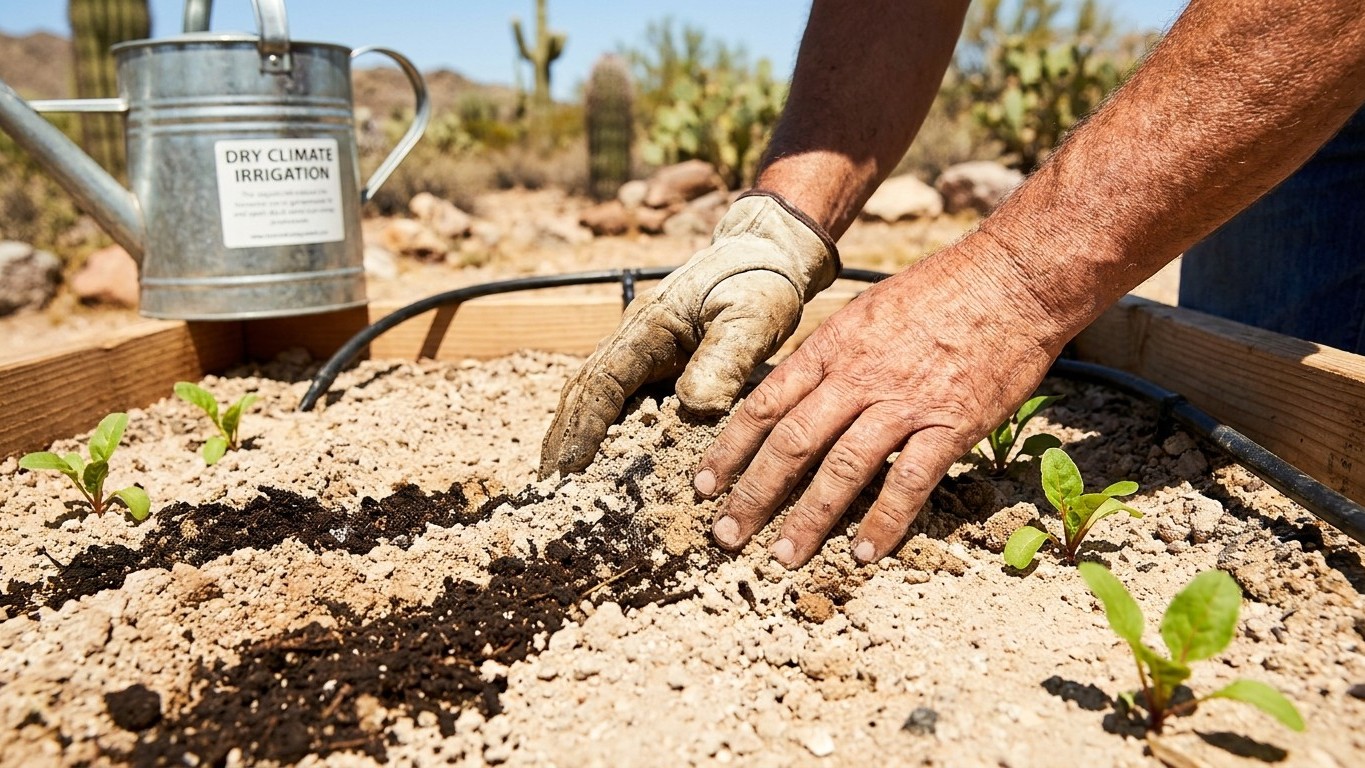

Arizona’s low desert can grow good beets, but the two threats aren’t cold and heat working together the way they do in most states. Here, frost barely exists, so the clock that matters starts the moment you drop seed into fast-draining, alkaline sand and depends entirely on how consistently you water it.
The short answer
The USDA lists the Casa Grande series as representative of Arizona soils. It’s an Aridisol, the kind of dry-climate ground that forms where rainfall is too scarce to leach salts and minerals out of the profile. The surface pH runs around 8.5, solidly alkaline. Texture-wise it’s 64 percent sand, 14 percent clay, and 22 percent silt, with well-drained internal structure and organic matter sitting at about 0.8 percent.
Beets, per Utah State University Extension, want deep, sandy, well-drained soil rich in organic matter. The texture side of that equation lines up reasonably well with Casa Grande sand. The organic-matter side does not. At 0.8 percent, this soil has almost none of the humus that helps a root crop hold onto moisture between waterings, and understanding Beet Soil in Arizona makes clear the recommended fix is modest: no more than 1 inch of composted organic matter per 100 square feet worked into the bed before sowing. Overdo it and you risk forked, hairy roots instead of the smooth taproot you’re after.
Then there’s heat. Phoenix doesn’t carry a meaningful frost season. Only 6 of the last 30 recorded springs even reached 32°F, and NOAA lists the frost-free season for the reference station at 365 days. That number alone tells you the growing calendar here isn’t built around a last-frost date the way it is in states with real winters. The exact count of days per year the low desert crosses 90°F isn’t part of the dataset cited for this page, but the general pattern is well established: warm days arrive early in the calendar and don’t let up for months. Utah State’s research is specific on what that means for a beet root: temperatures above 85°F combined with water stress make the root woody. Woodiness and bolting are separate failures with separate causes, and Arizona’s climate can produce either one depending on what a grower does with the hose.
None of this is a diagnosis for a specific backyard. Arizona spans hundreds of mapped soil series, from riverbottom silt to hillside caliche to whatever a builder scraped and backfilled during construction. Casa Grande is the state’s representative series, a useful starting point, not a stand-in for the dirt under a particular raised bed.
The six weeks that decide it here
When to Sow Beets in Arizona standard guidance calls for sowing 2 to 3 weeks before the last frost, which in most states pins the first six weeks of growth to a fairly predictable stretch of early spring weather. Arizona’s low desert breaks that model because there usually isn’t a last frost to count backward from. With a frost-free season effectively covering the whole year and only rare cold snaps dipping to 32°F between late December and mid-January, the planting window here is really governed by something else: getting the crop established and mostly grown before the heat that causes woodiness takes over.
That shifts the six-week establishment period into Arizona’s cool, dry season rather than a frost-defined spring. And dry is the operative word. The low desert doesn’t get reliable rainfall during this stretch the way a Midwest or Southeast garden might in April. A beet seeded into Casa Grande-type sand, which is well drained almost by definition and holds very little of the season’s moisture thanks to that 0.8 percent organic matter figure, depends on the grower’s irrigation schedule far more than on the sky.
This is exactly where the Utah State finding about water stress in the first six weeks becomes the central risk factor for Arizona growers specifically. It’s not frost skipping a beat and it’s not heat spiking early. It’s a missed irrigation cycle, or a soil that drains a scheduled watering away before the root zone actually absorbs it, during the exact window when premature flowering gets triggered. A grower in a state with heavier clay soil and regular spring rain might get away with an inconsistent watering habit during establishment. Sandy, fast-draining Casa Grande-type ground and an arid six-week window don’t offer that same margin.
Once the plants make it through establishment, the second clock starts ticking, the one tied to the 85°F-plus threshold and woodiness. But that’s a separate problem from what happens in weeks one through six, and treating both as “just keep it watered” misses which failure you’re actually managing at which point in the season.
What goes wrong here
- Bolting from irrigation gaps during establishment. In an arid low-desert climate without reliable spring rain, a skipped or delayed watering during the first six weeks after sowing is enough to trigger premature flowering, per Utah State’s research on water stress. Set a fixed irrigation schedule for this window rather than watering by feel, and check that water is actually reaching the root zone in fast-draining sand rather than running past it.
- Woody roots from heat plus water stress. Once temperatures climb past 85°F, any water stress on top of that heat coarsens the root’s texture, according to Utah State Extension. Given how early and how long Arizona’s warm season runs, the practical fix is timing: aim to have roots finishing their growth before the heat arrives, and keep soil moisture even rather than letting beds dry out between waterings during that stretch.
- Poor or uneven germination in a low-organic, alkaline surface. Casa Grande’s surface horizon carries only about 0.8 percent organic matter and a pH near 8.5, conditions that can crust over and resist even moisture penetration for tiny beet seed. Working in up to 1 inch of composted organic matter per 100 square feet, as Utah State recommends, and keeping the seedbed evenly damp during germination addresses this directly.
- Micronutrient lockout in alkaline ground. Aridisols like Casa Grande often run alkaline with salts present in the profile, and high pH can tie up nutrients like iron before a plant can use them. A soil test through the local extension office is the reliable way to find out whether this is happening in a specific bed rather than guessing from surface symptoms alone.
Checking this against your own county
Everything above describes what Arizona’s representative soil series and its low-desert climate tend to do, not what’s happening in one particular yard. The state’s soil map runs to hundreds of series, and a garden a few miles from a Casa Grande-mapped area can sit on completely different ground. The most reliable next step is a soil test through the reader’s own county office rather than assuming the state averages apply directly.
University of Arizona Cooperative Extension maintains county offices across the state that can run or direct soil testing, confirm local pH and salinity conditions, and give planting guidance calibrated to a specific elevation and microclimate rather than a statewide average. Given how much Arizona’s growing conditions shift between the low desert, transitional zones, and higher elevations, that local check is worth doing before committing a season’s worth of water and compost to a bed based on state-level figures alone.
Common questions
When should I sow beets in Arizona’s low desert?
Because the low desert rarely sees a true last frost (only 6 of 30 recent springs even reached 32°F, and the reference station’s frost-free season runs 365 days), the planting window should be built around the cool, dry season rather than a frost date, with the goal of getting roots through their 60-to-80-day growth from seeding before sustained heat above 85°F sets in.
Do beets need a frost to grow well in Arizona?
No. Beets are seeded directly in place and don’t require frost exposure to develop; the concern in Arizona is the opposite problem, avoiding water stress during the first six weeks and avoiding heat above 85°F later in the root’s development.
How can I tell if my beet roots are turning woody?
Woodiness develops when temperatures exceed 85°F while the plant is also under water stress, according to Utah State University Extension. Roots grown through a stretch of heat with inconsistent watering are the most likely candidates, and the practical response is to finish the crop before that combination occurs rather than trying to reverse texture in an already-woody root.
Should I amend my soil before planting beets in Arizona?
If the local soil resembles the state’s Casa Grande series, low in organic matter at around 0.8 percent and alkaline near pH 8.5, working in up to 1 inch of composted organic matter per 100 square feet matches Utah State’s guidance for beets without overdoing it. A soil test through the county extension office confirms whether a specific bed actually needs this before adding amendments blindly.