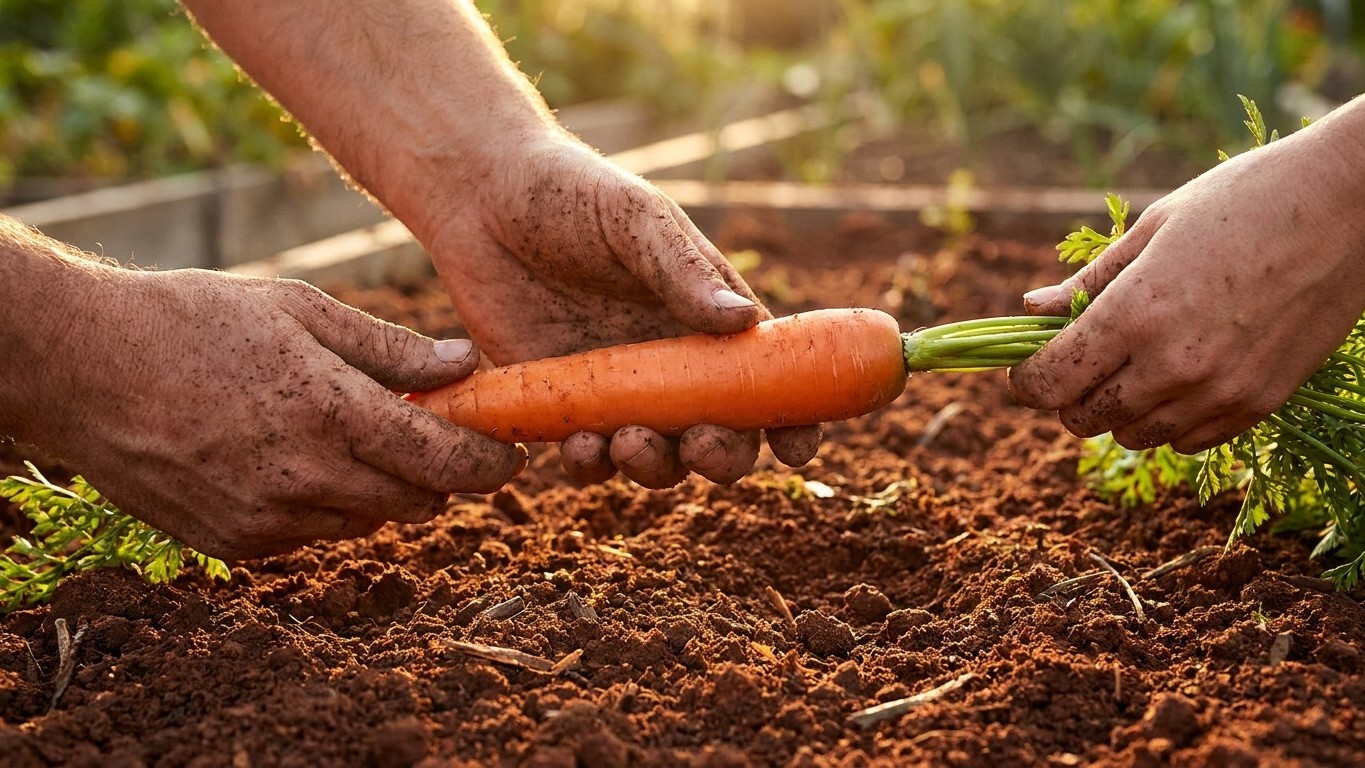

Maryland’s state-representative soil, the Sassafras series, is sandy and well drained, which is good news for carrots that hate wet feet and forked tips. But Will Carrots Fork in Maryland Soil? That same soil runs strongly acid and short on organic matter, so the real work here is feeding it and raising the pH, not fighting drainage. For specifics on timing, see When to Sow Carrots in Maryland: sow from seed 2 to 3 weeks before your local last frost.
The short answer
The soil USDA lists as representative of Maryland is the Sassafras series, an Ultisol, which is a fancy way of saying it’s old, heavily weathered, and leached of a lot of what plants want. The surface horizon runs 67 percent sand, 10 percent clay, and 23 percent silt, with organic matter around 1.6 percent and a surface pH near 5.3, which counts as strongly acid. It’s classified as well drained.
For a carrot, that texture is mostly a friend. Roots fork and stub out when they hit clay pans, compacted layers, or stones, and a soil that’s two-thirds sand with only 10 percent clay gives a taproot room to push straight down without much resistance. Drainage is the other half of the forking problem, since carrots sitting in soggy ground rot at the tip or split their shoulders, and a well-drained series like Sassafras doesn’t hold water against the root the way a silty clay loam does.
The catch is fertility. Organic matter at 1.6 percent is thin, and a pH of 5.3 sits well below where most vegetables, carrots included, do their best feeding. Nutrients like phosphorus lock up in soil that acid, and roots grown in low-organic-matter sand can end up thin, pale, and short on the sugars that make a carrot worth pulling. The fix isn’t a raised bed to escape forking, since this soil’s texture rarely causes that here. It’s building fertility: working in compost before you sow, and if a soil test comes back acid, adding lime according to that test’s recommendation rather than guessing.
None of this is a diagnosis of your own dirt. Maryland spans hundreds of mapped soil series, from the sandy Eastern Shore to the rockier piedmont soils around Baltimore and Frederick to the mountain soils of Garrett County. Sassafras is the series USDA holds up as representative of the state as a whole, under the NRCS State Soils programme, not a survey of every backyard. A lot with heavy fill from construction, a low spot that collects runoff, or a garden cut into a hillside can behave nothing like the numbers above. Treat this section as the starting point for what your region’s ground tends to do, then check your own ground before you plan the bed.
The test that settles it in your own garden
State-level numbers can point you in a direction, but only digging in your own bed tells you what a carrot will actually meet on its way down. None of the steps below need lab equipment, just a shovel, a bucket of water, and a little patience.
- Dig a test hole at least a foot deep. Note where the soil changes color or gets noticeably harder to dig through, since that’s often where a taproot will hit resistance.
- Check for stones and rubble. Pull out anything bigger than a marble as you go. A carrot growing straight down into a pebble or old brick fragment is a carrot that forks around it.
- Feel the texture between your fingers. Grab a moist handful from the top 6 to 8 inches. Sandy soil feels gritty and falls apart. Clay feels sticky, smears when rubbed, and holds a ribbon shape when squeezed. Loam sits somewhere in between and crumbles loosely.
- Run a simple drainage check. Dig a hole roughly a foot deep and a foot wide, fill it with water, let it drain once, then fill it again and time how long it takes to empty. Water that lingers for hours points to a heavy or compacted layer below the surface, exactly the kind of ground that forks a root.
- Look at what’s already growing. Weeds and grass that struggle, moss in low spots, or standing water after rain all tell you something about drainage and compaction before you ever plant a seed.
If that hole comes back sandy, loose, and quick to drain, you’re likely close to what the state’s representative soil suggests, and your main job is feeding it. If it comes back heavy, sticky, and slow to drain, you’re dealing with different ground than the state average, and a raised bed or heavy compost and double digging becomes the more useful answer, following the same principle Utah State University Extension lays out for any garden soil too dense or rocky for a straight root.
When to sow here
Carrots go into the ground as seed, straight into the bed where they’ll grow to harvest. There’s no transplanting step to count from, so every date below runs off the sowing date itself.
- Start with your last frost window. NOAA’s 1991-2020 climate normals put Maryland’s last spring 32 F freeze probability between April 3 and April 16 for the station on record, though western Maryland counties like Garrett and Allegany, being mountainous, typically run weeks later, and the Eastern Shore tends to run milder than that window.
- Count backward 2 to 3 weeks. Carrots tolerate a light frost as young seedlings, so gardeners sow 2 to 3 weeks before that last-frost date rather than waiting for it to pass. Working from an April 3 to April 16 window, that puts sowing somewhere in the second half of March for much of the state, earlier on the milder Eastern Shore and later in the cooler mountain counties.
- Check your soil temperature before you drop seed. Carrots need soil at a minimum of 40 F to germinate at all, and a soil thermometer pushed a couple inches down is the only honest way to know that number in your own bed rather than guessing from the calendar.
- Aim for the germination sweet spot. Seeds come up fastest and most evenly when the soil sits between 55 and 65 F. Early sowings in a still-cool Maryland spring may germinate slowly at the 40 F floor; a second, slightly later sowing once soil warms into that 55 to 65 F range often fills in gaps faster and more evenly.
- Count maturity from the seed, not a transplant. Most carrot varieties run 70 to 100 days from sowing to harvest, so a mid to late March sowing puts many varieties ready sometime between early June and late June, depending on the variety and how warm the season runs.
What goes wrong here
- Forking in heavy ground. Even where the region’s representative soil is sandy and forgiving, plenty of Maryland yards sit on compacted subsoil, construction fill, or a hidden clay layer a foot down. A forked, stubby root is the classic sign. The remedy is loosening the bed a full 12 to 15 inches down with a fork or spade, working in generous compost, and removing stones as you go, or building a raised bed filled with looser soil if the native ground won’t cooperate.
- Poor germination during a hot, dry stretch. Carrot seed is small and sits near the surface, and a sudden warm spell in April or May can dry that top inch of soil before the seed has a chance to take up water. Keeping the seedbed lightly and evenly moist, sometimes with a light board or damp burlap laid over the row until sprouts appear, keeps that surface layer from crusting over or drying out.
- Splitting roots from uneven watering. A dry spell followed by a heavy rain or a big watering session makes roots swell too fast and crack. Keeping moisture steady with a regular watering schedule, rather than letting the bed swing from bone-dry to soaked, is the more reliable fix than any variety choice.
- Thin, pale roots from low fertility. Ground low in organic matter, like the roughly 1.6 percent figure recorded for the state’s representative surface soil, tends to grow spindly carrots short on flavor. Working in compost ahead of sowing, and testing pH rather than assuming it, addresses this more directly than switching seed.
Checking this against your own county
Everything above is a regional starting point, built from a soil series USDA treats as representative of Maryland as a whole and from statewide climate normals. Your own county’s frost dates, soil map, and planting calendar can differ enough to matter, especially given how much the state’s terrain shifts from the coastal plain to the mountains.
University of Maryland Extension, at extension.umd.edu, is the state’s land-grant extension service and the right place to check county-level frost dates, soil testing options, and vegetable planting calendars against what’s written here. A soil test through your local extension office will give you an actual pH and nutrient reading for your bed, rather than the state’s representative number, and that’s the figure worth acting on before you add lime or fertilizer.
Common questions
Do carrots need full sun in Maryland?
Carrots generally do best with as much direct sun as a bed can offer through the growing season. Nothing in the state or extension data here addresses shade tolerance specifically, so check with University of Maryland Extension for guidance suited to a particular site.
Can I sow carrots again in late summer for a fall harvest?
Many gardeners in similar climates do sow a second round in mid to late summer, counting back from the first fall frost the same way spring sowing counts from the last spring frost. Maryland’s fall frost dates aren’t part of the facts covered on this page, so check that date with University of Maryland Extension before planning a second sowing.
Does lime alone fix Maryland’s acidic soil for carrots?
Lime raises pH, and the state’s representative surface soil runs strongly acid at about 5.3, but the right amount depends on your own soil test results, not a blanket recommendation. A local soil test through your extension office is the only way to know how much your bed actually needs.
Why do my carrots come up patchy even after sowing on time?
Patchy germination is often about soil temperature and moisture at the surface rather than timing. Seed sown before soil reaches the 40 F minimum, or left to dry out during a warm spell, will come up unevenly no matter how well the calendar date lines up with frost windows.