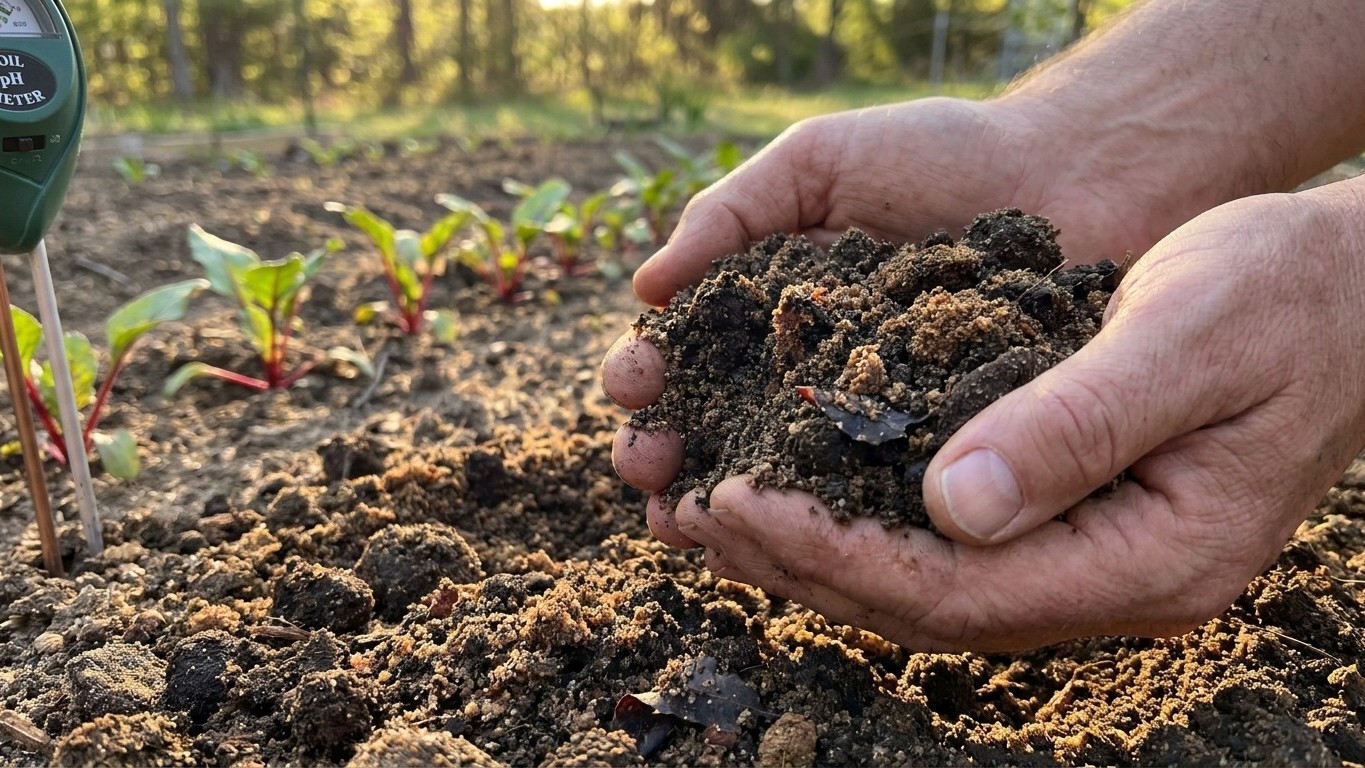

Virginia’s representative topsoil, the Pamunkey series, is a well-drained loam to silt loam running 50 percent sand, 39 percent silt and only 11 percent clay, with a slightly acid surface pH near 6.2 and thin organic matter around 1.2 percent. That structure drains fast enough to avoid rot but holds too little organic matter to buffer a beet root through a dry spell, which is exactly the failure point in the first six weeks after sowing.
The short answer
The Pamunkey series is what USDA NRCS lists as representative of Virginia soils, an Alfisol formed under forest cover with moderate natural fertility. Its surface horizon runs sandy for a mid-Atlantic soil (50 percent sand against 11 percent clay and 39 percent silt), which is why it’s classed well drained rather than poorly drained. For a root crop, that’s mostly good news: beets want deep, sandy, well-drained ground, and Pamunkey clears that bar structurally. Where it falls short is fertility. Organic matter sitting near 1.2 percent is lean, and Utah State University Extension’s guidance caps amendment at no more than 1 inch of composted organic matter per 100 square feet worked into the bed before sowing. More than that, on a soil already light in clay, risks a bed that drains too fast to hold the even moisture a beet root needs.
The pH reading of 6.2 sits on the acid side of neutral. It’s not extreme, but it’s a data point worth checking against a home soil test rather than assumed, since the Pamunkey figure describes the mapped series, not any individual garden. For a closer look at what this means specifically for root crops, see Beet Soil in Virginia.
On the heat side, the mechanism that matters is straightforward even without a local day-count: Utah State University Extension’s research notes that temperatures above 85 F combined with water stress is what turns a beet root woody. No day-count of readings above 90 F for a specific Virginia reference city is published in the sources behind this page, so that figure isn’t stated here rather than guessed at. What the soil and the heat mechanism together suggest is a bed that drains quickly, in a state where summer heat above the 85 F woodiness threshold is common enough to matter, which puts the burden on the gardener’s watering schedule rather than on the soil itself.
None of this describes every garden in Virginia. The commonwealth spans hundreds of mapped soil series, and a Piedmont clay flat, a Shenandoah Valley limestone soil, or a Tidewater sandy loam near a river will each behave differently from the Pamunkey series described here. Treat this as the starting assumption to test, not the final word on any one plot.
The six weeks that decide it here
Beet seed goes in the ground directly. There’s no transplant step, so the 60 to 80 days to harvest that most guidance quotes runs from the day seed touches soil, not from a seedling set out later. When to Sow Beets in Virginia comes down to sowing 2 to 3 weeks before the last spring frost, which means the first six weeks of a Virginia beet crop land in a fairly predictable window. At the coastal reference station used by NOAA’s 1991-2020 climate normals (NAS Oceana, near Virginia Beach), the last spring freeze falls between March 20 and April 3, in the 30 to 70 percent probability band for a 32 F freeze. Sowing 2 to 3 weeks ahead of that puts seed in the ground in early to mid-March along the coast, with the critical six-week window running from early March into mid-April.
Inland and upland, that calendar slides later. The Blue Ridge and southwest Virginia run their last frost weeks behind the coastal plain, which pushes both the sowing date and the six-week risk window later into spring for those gardens. A gardener in the Shenandoah Valley or the mountains working off a coastal Virginia planting guide is working off the wrong calendar.
Why the six weeks matter so much: Utah State University Extension is specific that water stress during this early stage is what triggers premature flowering, meaning bolting, in beets. Early spring in this part of the mid-Atlantic tends to swing rather than settle, cold, wet fronts moving through followed by drying stretches, sometimes within the same week. That variability is exactly the kind of interruption to steady soil moisture that pushes a beet toward bolting rather than root formation. A young beet plant doesn’t distinguish between a drought and a two-week dry spell between fronts. It reads both as a signal to flower and set seed rather than bulk up a root, and once that switch flips there’s no reversing it for that planting.
What goes wrong here
- Bolting from a dry seedbed in the first six weeks. A sandy-leaning, well-drained soil like Pamunkey sheds water quickly between rains, and an early spring dry spell during the critical window is enough to trigger premature flowering. The remedy is consistent moisture from sowing onward, not just watering when the seedbed looks visibly dry, plus a light mulch to slow evaporation on quick-draining ground.
- Woody roots from summer heat layered on top of water stress. This is a separate failure from bolting, striking later in the season once temperatures push past 85 F. A root that’s been kept evenly watered right through hot stretches stays tender; one that dries out during a heat spell toughens even if it survived the early weeks without bolting. Harvesting on the 60- to 80-day schedule from seeding, rather than letting roots sit in the ground through a heat wave, limits the exposure.
- Crusting over a silty surface after heavy rain. With silt at 39 percent of the surface texture, a hard rain on bare soil can cap the seedbed before germination, which is a mechanical barrier a beet seedling struggles to push through. Keeping the surface loose with a thin mulch layer and sowing at the correct depth reduces the odds of a capped, spotty stand.
- Thin organic matter limiting nutrient and moisture holding. At roughly 1.2 percent organic matter, the representative soil doesn’t hold much reserve. Utah State University Extension’s cap of 1 inch of composted organic matter per 100 square feet is the ceiling here, not a floor to exceed; overdoing it on an already sandy-leaning soil can loosen structure further rather than fix the moisture problem.
Checking this against your own county
A statewide soil series and a single coastal weather station describe a starting point, not the reality of any specific backyard. The most useful next step is a soil test through Virginia Cooperative Extension, which will return an actual pH and organic matter reading for the plot in question rather than the representative Pamunkey figures used above. The same office can also confirm local frost dates for a specific county, since the coastal window of March 20 to April 3 shifts meaningfully once a garden sits west of the fall line or up into the mountains. Treat the numbers on this page as the question to bring to that office, not the answer to skip it.
Common questions
What Virginia soil type should I expect for beets?
The state’s representative soil, the Pamunkey series, is a well-drained loam to silt loam (50 percent sand, 11 percent clay, 39 percent silt) with a slightly acid surface pH near 6.2 and organic matter around 1.2 percent. It’s a reasonable structural starting point for beets, but a home soil test will give the actual reading for a given garden.
When should I sow beet seeds in Virginia?
Beets are sown 2 to 3 weeks before the last spring frost. At the coastal reference station near Virginia Beach, that frost date falls between March 20 and April 3, which places sowing in early to mid-March. Gardens in the Blue Ridge or southwest Virginia should expect that window weeks later.
What causes beets to bolt in Virginia gardens?
Bolting is triggered by water stress specifically in the first six weeks after sowing, according to Utah State University Extension. On a quick-draining, sandy-leaning soil like Virginia’s representative Pamunkey series, an early spring dry spell during that window is the most likely trigger, separate from later heat problems.
What beet varieties are commonly grown?
Utah State University Extension’s beet guide lists five varieties without attaching season, color or use data to any of them: Detroit Dark Red, Early Wonder, Ruby Queen, Cylindra and Bolivar. Choosing among them comes down to preference and availability rather than any documented performance difference in that source.