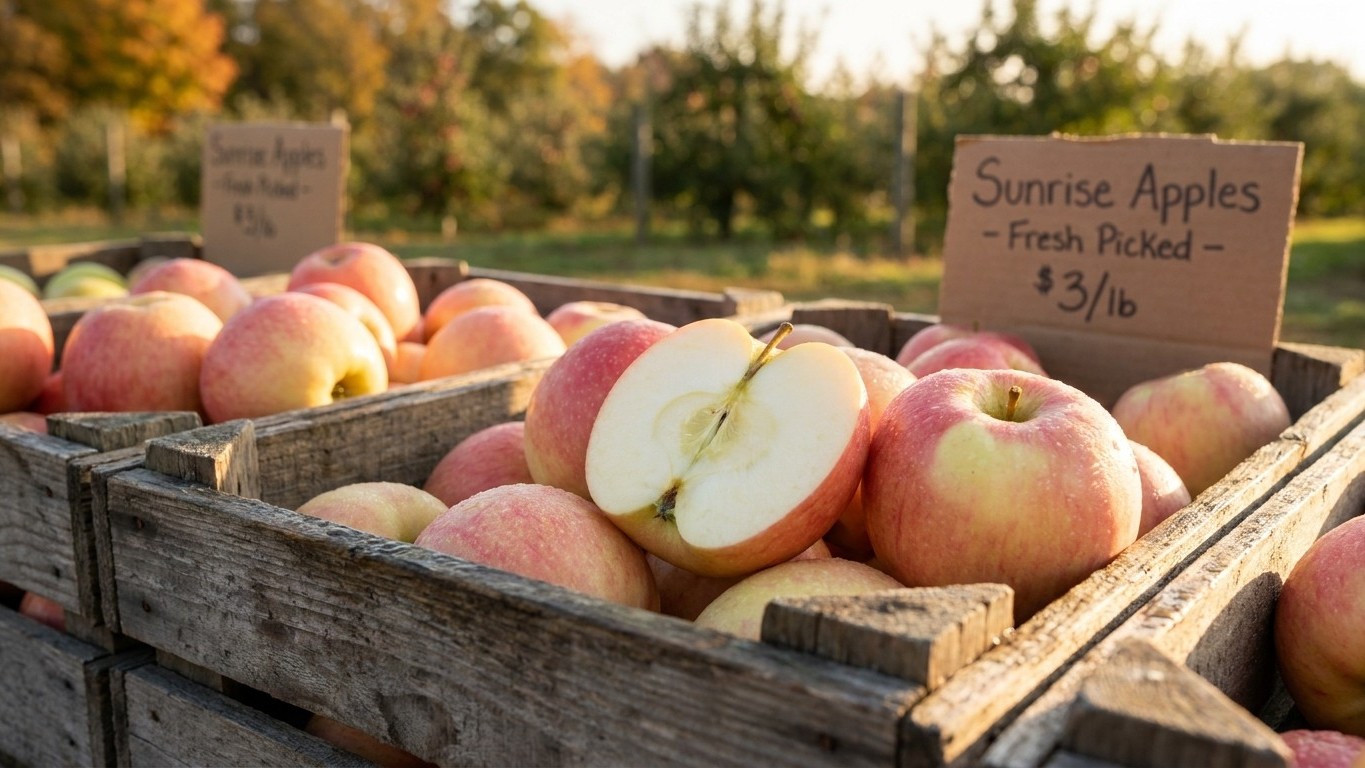

Sunrise apples ripen from mid-August to early September, weeks before most dessert varieties even start coloring up. That early timing is also the reason growers rarely see them in cold storage: the fruit doesn’t hold, so it moves from tree to table (or roadside stand) within a matter of weeks rather than months.
What Sunrise apple actually is
- When it ripens: Mid August to early September
- What it tastes like: Sweet and sub-acid, with white to cream flesh
- What it’s good for: A dessert apple, meant for fresh eating rather than long cooking or cider
- How long it keeps: Very short storage life; eat it within weeks
The fruit itself is medium to large, with a pinkish-red blush laid over a cream to yellow background, so it reads as a classic bicolor apple rather than a solid-red one. Bite into it and the flesh runs white to cream, sweet with just enough acidity to keep it from tasting flat. That balance puts it closer to a snacking apple than a baking apple, and there’s no mention anywhere in the catalog data of it holding up in pie filling or sauce the way a tarter, firmer variety would.
What sets Sunrise apart from most of the varieties sold at the big grocery chains is timing, not flavor. It comes off the tree while summer is still going, which is exactly why home growers and small orchards prize it: it fills the gap between early summer stone fruit and the main apple harvest in October. The tradeoff is that the fruit does not sit around waiting. This is a variety built for direct sale, farm stand traffic, and kitchens that plan to use it fast, not for a bin in the back of the pantry.
Will it grow where you are
Hardiness range
There’s no published USDA hardiness range specific to Sunrise apple in the catalog data behind this page, so rather than guess at a zone number, it’s worth saying plainly: that figure isn’t published here. If you’re shopping for a tree, check the tag or the nursery’s own listing for the hardiness range they’re selling under, since rootstock and regional sourcing can shift what a given supplier states for the same variety name.
Winter chill
The same goes for chill hours, the number of cumulative hours below about 45°F a tree needs over winter to break dormancy properly and flower on schedule. No chill-hour figure is published for Sunrise in the facts available here. This matters more than most home growers realize: an apple tree planted where winters run too warm to satisfy its chill requirement will flower unevenly, or not at all, even if the USDA zone on the tag looks fine. Since this variety ripens unusually early, some growers assume that means it also needs less winter chill than a fall apple, but that’s an assumption, not a documented fact, and it’s not one this page will make for you. If chill hours matter to your planting decision, ask the nursery directly rather than relying on the ripening date as a proxy.
What to plant beside it
This is usually the section readers care about most, and here the honest answer is that no pollination partners are named in the catalog data for Sunrise apple. That’s not the same as saying it doesn’t need one. Nearly all apple varieties crop better with a compatible partner nearby, flowering at the same time and carrying pollen the first variety can actually use. A handful of varieties are partly self-fertile and will set some fruit alone, but even those tend to produce a heavier, more reliable crop with a neighbor tree in bloom at the same time.
Because no specific partner varieties are published for Sunrise, this page won’t invent a list. What you can do instead is treat this as a bloom-time question rather than a name-matching one: find out when Sunrise flowers relative to other apples you’re considering, since two trees only pollinate each other if their bloom periods overlap. A local nursery that stocks Sunrise will usually know which varieties in their own inventory bloom alongside it, and that’s a more reliable answer than a generic list pulled from a different region’s growing conditions.
It’s also worth remembering the rule that catches a lot of home orchardists off guard: a parent variety generally cannot pollinate its own seedling, even when the two trees flower together and look like a perfect match on paper. If Sunrise has a known parentage in your particular nursery’s records, ask whether that relationship rules out any variety you were already planning to plant. For a fuller walkthrough of how bloom groups and pollen compatibility actually work, see our apple pollination guide.
Growing it well

Disease pressure
No disease resistances are published for Sunrise apple in the catalog data, including fire blight. That’s useful information on its own: it means you should not assume any built-in protection and should manage the tree as if it’s susceptible until you learn otherwise from a local source. In practice that means watching new growth each spring for the blackened, “shepherd’s crook” wilting that signals a fire blight strike, cutting out infected wood well below the visible damage, and avoiding heavy nitrogen fertilizer that pushes soft, vulnerable new shoots right when blight pressure is highest.
Habit and cropping pattern
The catalog data doesn’t specify a growth habit (upright, spreading, or otherwise) or whether Sunrise tends toward biennial bearing, the pattern where a tree swings between a heavy crop one year and a light one the next. Since neither is documented here, the practical move is to observe your own tree over its first several bearing years. If you notice a heavy year followed by a sparse one, thinning the fruit in the heavy year, pulling extras so remaining apples sit a hand’s width apart, is the standard way growers even out that cycle regardless of variety.
- Watch spring growth for fire blight symptoms and remove struck wood promptly
- Avoid over-fertilizing with nitrogen, which encourages blight-prone soft growth
- Track your tree’s cropping pattern year to year and thin fruit if it swings heavy-light-heavy
Picking it and keeping it
The harvest window for Sunrise runs mid-August to early September, but that’s a planning window, not a calendar reminder. The safest way to know a given fruit is actually ready is to check it directly, in this order:
- Lift and twist a sample apple gently. If it separates from the spur with a light twist, it’s likely ripe; if you have to yank it, give it more time.
- Cut one open and check the seeds. Ripe apples generally show seeds that have turned from pale green to brown.
- Look at the ground color, the background shade under the blush. As Sunrise ripens, that cream to yellow base tends to deepen, a visual cue worth checking alongside the twist test rather than on its own.
Storage
Once picked, Sunrise doesn’t give you much runway. Storage life is very short, and the fruit is typically sold direct rather than shipped or held in long-term cold storage the way a late-season keeper apple would be. Plan to eat it within weeks of harvest, refrigerated to slow things down if you need a short buffer, rather than counting on it to last through fall the way a storage variety would.
Common questions
Is Sunrise the same apple as any late-season variety I already grow?
No. Sunrise is a dessert apple defined by its early ripening window, mid-August to early September, which sets it apart from the fall storage varieties most home orchards are built around.
Can I grow just one Sunrise tree and still get apples?
Possibly a light crop, since some apple varieties are partly self-fertile, but nearly all varieties crop better with a compatible pollinator nearby. No specific partner is published for Sunrise, so check bloom timing with your local nursery before assuming one tree alone will crop well.
How long can I actually keep a Sunrise apple after picking?
Only a matter of weeks. Its storage life is documented as very short, which is why it’s typically sold direct to consumers rather than shipped or warehoused like a longer-keeping variety.
Does Sunrise have any resistance to fire blight or other diseases?
No resistances are published for this variety, so it’s best managed as susceptible: monitor new growth each spring and remove infected wood promptly.
What does Sunrise apple taste like compared to a typical grocery-store apple?
It’s sweet and sub-acid with white to cream flesh, closer to a balanced snacking apple than a sharply tart one, and the medium to large fruit carries a pinkish-red blush over a cream to yellow background.
Related guides
- Idared Apple: Worth Growing, If Fire Blight Is Not Your Problem
- Jonagold Apple: A Fine Apple That Cannot Pollinate Anything
- Jonamac Apple: Ripening Late September, and What to Plant Beside It
- Woolly Apple Aphid
- Knowing When an Apple Is Ready, Without a Calendar
- Golden Supreme Apple
- Yellow Transparent Apple: Ripening Late July, and What to Plant Beside It