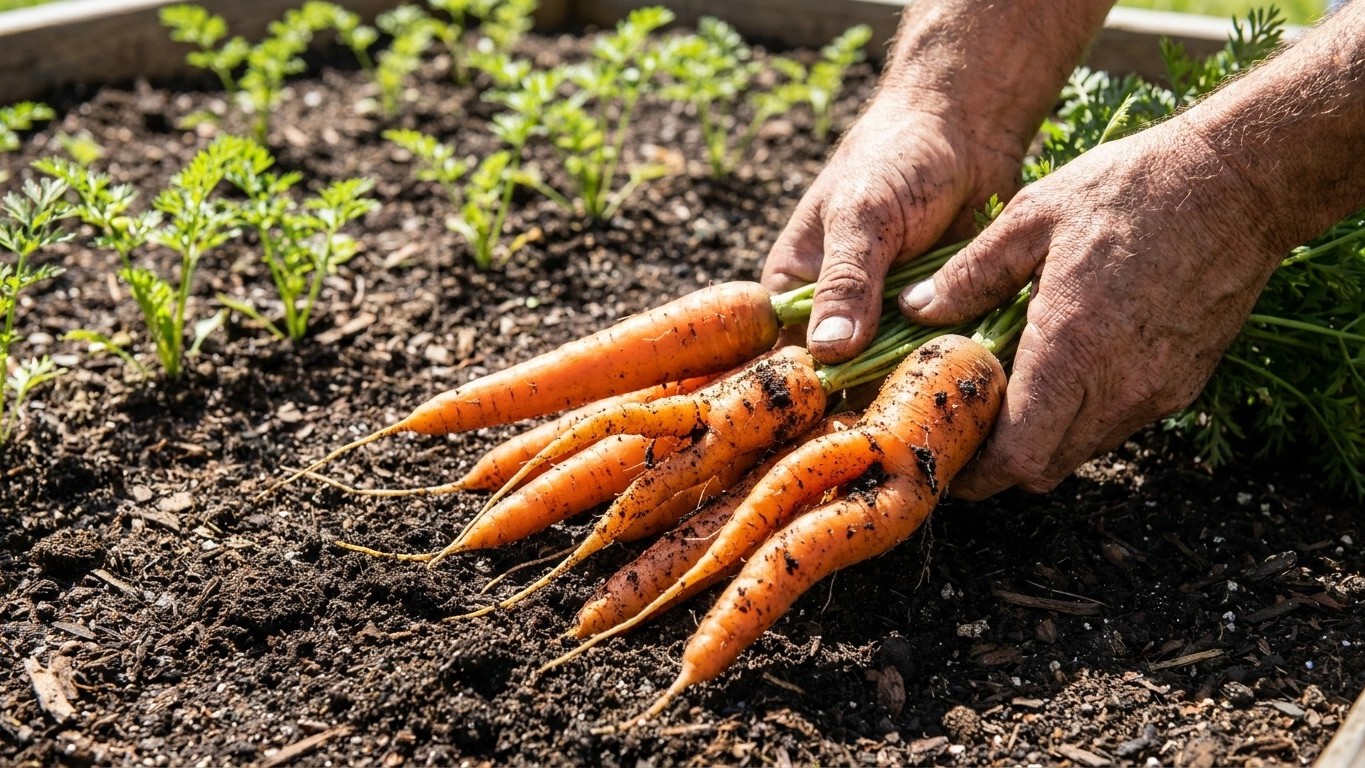

Carrots in Vermont go into the ground as seed, not as transplants, so the count that matters is days from sowing to harvest, not days from a nursery start date. That count runs 70 to 100 days depending on variety and growing conditions. The bigger question for most Vermont gardeners isn’t the calendar at all, it’s whether the ground under their feet will let a carrot grow straight in the first place.
The short answer
Vermont’s official state soil is the Tunbridge series, a Spodosol formed under conifer stands across the state’s hill country. Where it’s mapped, the surface horizon runs about 79 percent sand and 21 percent clay, with no measurable silt fraction, and it drains well. The surface pH sits around 3.5, which is strongly acid, closer to black coffee than to the neutral range most vegetables prefer. Organic matter in that mapped surface layer runs around 75 percent, a figure that reflects a natural forest litter layer, not a worked garden bed.
On paper, that sand-heavy texture is good news for carrots. Utah State University Extension is blunt about what carrots need: deep, sandy, well-drained soil rich in organic matter. Heavy or rocky ground makes the root fork, splitting into two or three legs instead of growing down as one clean taproot. A soil built mostly of sand, with strong drainage and no silt to compact it, is roughly the shape a carrot wants.
The acidity is the catch. A pH of 3.5 is well below what most root vegetables tolerate, and it’s not a number you fix with a bag of compost alone, it usually calls for lime worked into the bed over a season or more, checked against an actual soil test rather than assumed from a state average. And that 75 percent organic matter figure isn’t something to replicate in a raised bed; it describes an undisturbed forest floor, not cultivated ground, and a garden bed with that much undecomposed matter would behave nothing like a vegetable plot.
None of this tells you what’s actually under your own carrot bed. Vermont spans hundreds of mapped soil series, from river-bottom silt loams in the Champlain Valley to shallow, stony ground on hillsides, to whatever mix of subsoil and fill got pushed around when a house lot was graded. The Tunbridge series is the state’s symbolic soil, named by state law, not a prediction for any one backyard. If your garden turns out to be heavier than that sandy profile suggests, the fix Utah State names directly is compost worked in generously and double digging to loosen the root zone, or building up rather than digging down with a raised bed filled with a lighter mix.
The test that settles it in your own garden
Skip the guesswork and check the bed itself before you sow. None of this requires a lab, just a shovel, a bucket of water, and a few minutes of attention.
- Dig a hole about 12 inches deep in the spot you plan to sow. Carrots need loose ground to that depth or more, depending on the variety, so this tells you right away whether roots have room to run straight down.
- Look at what comes out of the hole. Note how deep the loose, dark topsoil goes before you hit denser subsoil, clay, or a layer of stones and rocks. A shallow topsoil layer over hardpan or ledge is the classic setup for forked and stunted carrots.
- Pick up a handful of the soil from that hole and rub it between your fingers. Sand feels gritty and falls apart. Clay feels smooth, sticky when wet, and holds together in a ribbon when you squeeze it. Most garden soil is somewhere between the two, and that middle ground is what you’re trying to place.
- Fill the hole with water and time how long it takes to drain. Water that sits for hours points to compacted or clay-heavy ground that will need amending or a raised bed. Water that disappears almost immediately suggests sandy, fast-draining soil that may need extra organic matter to hold moisture for germination.
- Repeat the dig-and-feel check in two or three spots around the planned bed, not just one. Soil texture can shift within the same small garden, especially near a foundation, a driveway, or an old fill area, so one hole isn’t always representative of the whole plot.
What goes wrong here
The combination of variable Vermont ground and a short, sometimes erratic growing season produces a handful of predictable carrot failures. Here’s what tends to happen, and what actually fixes it.
- Forked or split-legged roots in heavy ground. When a carrot’s growing tip hits a rock, a clay lens, or compacted subsoil, it splits around the obstacle instead of pushing through. Utah State University Extension points to the direct fix: work in plenty of compost and double dig the bed to loosen soil well below the depth the root will reach, or skip the native soil issue entirely with a raised bed filled with a lighter, stone-free mix.
- Poor or patchy germination during a hot, dry stretch. Carrot seed is small and sits close to the surface, so it dries out fast once the sun and wind get going. A bed that crusts over in a heat spell can block germination almost completely, leaving bare patches where a full row was sown. Keeping the top inch of soil consistently damp until seedlings emerge, with light watering rather than one heavy soak, is what gets a stand up evenly.
- Splitting roots from uneven watering later in the season. A carrot that grows through a dry spell and then gets hit with a heavy rain or a deep watering can swell faster than its skin can stretch, cracking the root lengthwise. Steady, moderate watering through the growing season, rather than letting the bed dry out and then flooding it, keeps that growth rate even.
- Slow, stunted growth in strongly acid, low-fertility ground. Where native soil runs closer to the acidity typical of the state’s forested hill soils than to a neutral vegetable bed, carrots can come up thin and short even without any physical obstruction. A soil test, not a guess, is what tells you whether lime and added organic matter are needed before the next sowing.
Common questions
Do I count the 70 to 100 days from when I sow the seed or from when seedlings come up?
The count runs from the day you sow the seed in the ground. Carrots aren’t transplanted, so there’s no separate transplant date to track, germination time is simply part of the total days-to-maturity window, which is why cool or dry soil that slows sprouting can push the harvest date back even if the calendar count hasn’t changed.
Is Vermont’s official state soil a good match for growing carrots?
The texture is promising: the Tunbridge series runs sandy and well drained, which is close to what carrots want. The strong acidity of its mapped surface layer is the part that would need correcting with lime, and the very high organic-matter figure reflects an undisturbed forest floor rather than a tilled garden bed, so it shouldn’t be read as a target to match at home.
My garden doesn’t look anything like that sandy profile. Does that mean I can’t grow carrots?
No. It means your particular soil series differs from the state’s representative one, which is common : Vermont has hundreds of mapped soil types. Dig a test hole, check depth and texture, and watch how water drains before deciding whether you need compost and double digging or a raised bed instead.
What’s the single biggest cause of forked carrots?
Physical obstruction in the root zone: rocks, compacted subsoil, or a clay layer that the growing tip can’t push through cleanly. Utah State University Extension names loosening that ground with compost and double digging, or bypassing it altogether with a raised bed, as the fix.