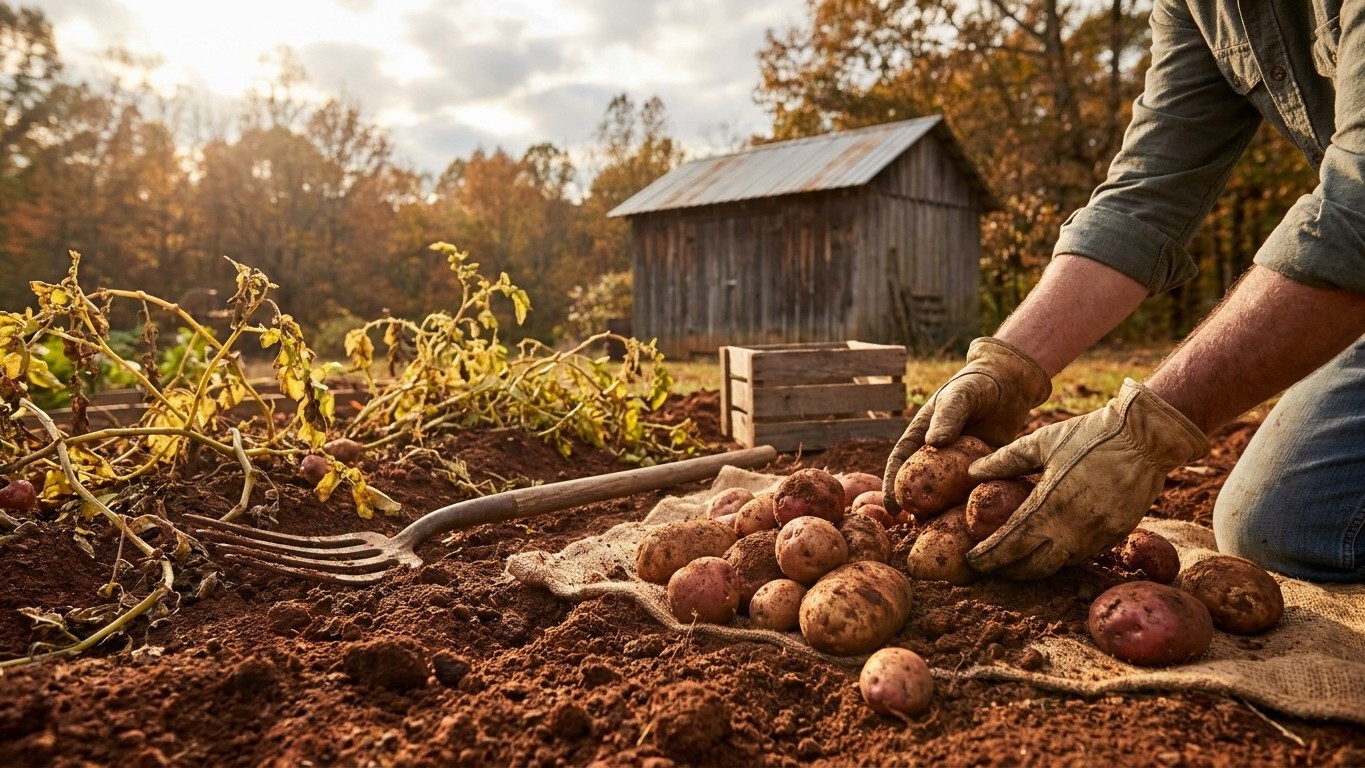

Wyoming’s growing season closes fast, and its winters run cold enough to freeze anything left unprotected. Dig your potatoes before the first fall frost window hits between September 24 and October 5, cure them for two to three weeks somewhere that holds 55-60°F, then move them into storage at 40-45°F and dark. The catch: most unheated structures here won’t hold that storage range once the coldest month settles in.
The short answer
Two numbers define this whole operation. The first fall frost window for this region, based on NOAA NCEI’s 1991-2020 Climate Normals, falls between September 24 and October 5. The second is the mean daily minimum temperature for the coldest month, which sits at 18.1°F. That second figure isn’t a record low or some worst-case scare number. It’s the average low a storage space has to survive, night after night, all winter long.
Those two figures together tell you almost everything about timing. Potatoes need to come out of the ground before that frost window closes, which means harvest realistically happens in the back half of September for most growers, sooner at higher elevations. Waiting past early October gambles the crop against a freeze that damages tubers still sitting in cold soil. At elevations above 6,000 feet, the growing season runs close to 130 frost-free days, and frost has been recorded in every month of the year at the higher spots in this state. Season extension tools like row cover or cold frames aren’t a bonus here. They’re often what gets a potato crop to a harvestable size at all.
Now the storage question. Utah State University Extension puts the ideal potato storage temperature at 40-45°F in a dark space. The University of Maine Cooperative Extension gives a slightly different target of 38°F at 95 percent humidity. Either way, both numbers sit well above 18.1°F. An unheated garage, shed, or porch in this climate will not hold steady in the low 40s through the coldest stretch of winter. It will track outdoor temperatures far more closely than most people expect, and once night lows are averaging 18.1°F, an uninsulated structure is going to dip into the 20s or lower on plenty of nights. That’s cold enough to freeze tubers solid, turning them to mush once they thaw.
So the short answer has two parts. Harvest timing is dictated by the frost window: get the crop out of the ground before late September to early October. Storage location is dictated by the cold month minimum: an unheated space in most of this state cannot be trusted to hold 40-45°F on its own. It needs insulation, a heat source, or placement below the frost line, like a basement or true root cellar, to keep from freezing the crop it’s supposed to protect.
Curing, and where
Curing is the step that toughens potato skins and heals small nicks from digging, and both university sources that matter here, Utah State University Extension and the University of Maine Cooperative Extension, agree the target is 55-60°F with high humidity, held for two to three weeks. The challenge in this state is finding a spot that actually sits in that range during a September or early October harvest, when daytime highs can still climb but nighttime lows are already dropping fast toward that 18.1°F winter average.
A shaded porch is usually too exposed here. Nights swing too cold too early in the season, and the humidity a porch offers is close to zero. An open garage without insulation tracks outdoor air closely enough that it’s more of a gamble than a plan. What works, for most growers in this climate, is an insulated basement corner, a partially below-grade room, or an insulated garage bay that stays buffered from the outside swings. The steps:
- Dig potatoes on a dry day, before the first fall frost window arrives, and brush off loose soil without washing the tubers.
- Move them immediately out of direct sun into the coolest indoor space available that still reads in the 55-60°F range, avoiding anything closer to outdoor temperatures.
- Spread tubers in a single layer, or in shallow crates, so air reaches all sides and humidity stays high without pooling moisture on the skins.
- Hold that temperature and humidity for two to three weeks, checking a thermometer in the space rather than guessing from how the room feels.
- Sort out any tubers with soft spots or cuts that haven’t sealed before moving the rest into winter storage.
An insulated basement is the most reliable curing spot in most of this state, since it buffers against the sharp day-to-night swings that hit in late September. A detached, uninsulated garage is the least reliable, because once nights start approaching that 18.1°F average, there’s no thermal mass keeping the space in the 50s.
Storing through this winter
Once curing wraps up, the crop needs a home that holds 40-45°F and stays dark, per Utah State University Extension, or 38°F at 95 percent humidity, per the University of Maine Cooperative Extension. Both ranges sit far above the 18.1°F mean minimum this state’s coldest month delivers, and that gap is the entire storage problem. A space that tracks outdoor air too closely will freeze the crop. A space that’s sealed and heated too much will push temperatures up into the 50s or 60s, and that triggers sprouting long before spring.
Basements below the frost line tend to be the most workable option here, since soil around a foundation moderates temperature swings even when the air above ground is deep into the teens. A root cellar dug into a hillside or bermed with earth on multiple sides does the same job, often better, because more soil mass sits between the stored crop and outside air. An attached garage with some insulation and a small supplemental heat source, even something as modest as a heat lamp on a thermostat, can bridge the gap between an uninsulated structure and true storage-grade conditions.
What doesn’t work reliably in this climate is an unheated shed, an uninsulated detached garage, or any space with a single wall between the crop and outside air. Once the coldest month’s nightly average sits at 18.1°F, those spaces will spend weeks below freezing, and a potato that freezes even briefly turns soft and eventually rots, whether it thaws slowly or fast. On the other end, a heated utility room or a spot near a furnace runs the opposite risk: temperatures creeping past 50°F wake the tubers up, and sprouted potatoes lose eating quality and storage life fast.
The safest bet is a space that can be checked with an actual thermometer through the winter, not judged by feel, since a room that seems merely brisk to a person standing in it can still be sitting well under 40°F.
What goes wrong here
- Harvesting after the frost window closes. Waiting past early October risks a hard freeze hitting tubers still in the ground, which softens them and shortens storage life dramatically. Dig on the early side of the September 24 to October 5 window rather than the late side.
- Curing in a cold garage. An uninsulated garage in late September often can’t hold 55-60°F once nights start dropping. Move the harvest to an insulated basement or interior room instead, and verify the temperature with a thermometer rather than assuming.
- Storage space freezing solid. Once the coldest month’s average low hits 18.1°F, any storage area without insulation or supplemental heat will freeze the crop outright. A basement below the frost line, a true root cellar, or a heated garage corner avoids this.
- Storage space running too warm. The opposite mistake, placing potatoes near a furnace or in a heated room above roughly 50°F, causes early sprouting and softens the crop well before winter ends. A dedicated cool space, monitored with a thermometer, avoids both extremes.
- Low humidity shriveling the skins. A dry basement or garage pulls moisture out of stored tubers over months, leaving them soft and wrinkled even if the temperature stayed in range. Covering crates loosely or adding a shallow water source nearby helps hold humidity closer to the 95 percent the University of Maine Cooperative Extension recommends.
Common questions
How early should potatoes go in the ground to be ready before the first frost window here?
Planting dates aren’t covered by the figures used on this page, but growers should back-plan from the September 24 to October 5 frost window using days-to-maturity information on the seed potato package itself, since that number varies by variety and isn’t published by the sources cited here.
Can potatoes handle a light frost still in the ground?
The FACTS available here only establish the 32°F freeze probability window from NOAA NCEI; no separate light-frost threshold is published for this page, so the safest approach is treating that late September to early October window as the cutoff for digging.
Is a garden shed ever good enough for winter storage?
Only if it’s insulated and includes some form of supplemental heat. Given the 18.1°F average low in the coldest month, an uninsulated shed will drop well below the 40-45°F range that Utah State University Extension recommends, and the crop will freeze.
What happens if potatoes freeze in storage?
They turn soft and eventually break down into a watery, unusable mass, whether the thaw happens slowly over days or quickly near a heat source. There’s no recovering a tuber once it’s frozen through, which is why matching storage location to the 18.1°F cold-month minimum matters more here than in milder climates.