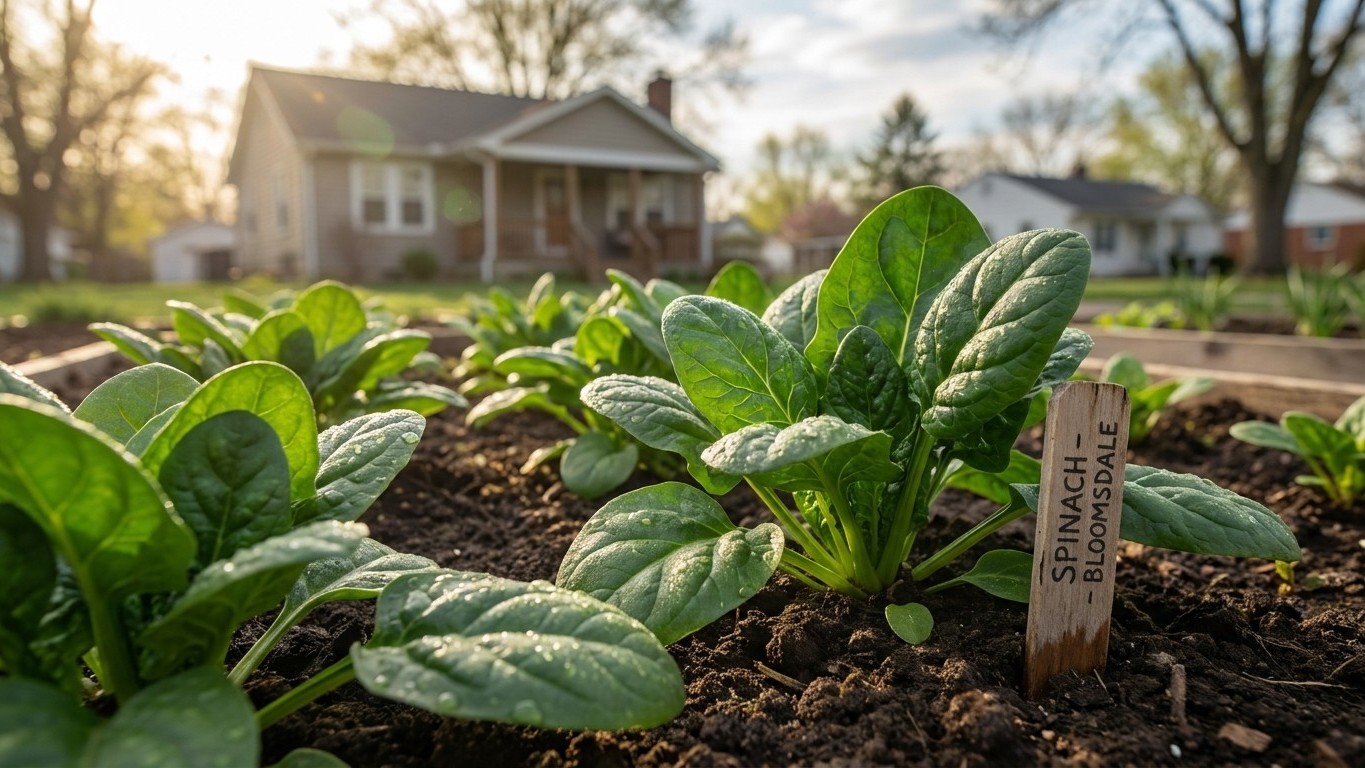

In and around Huntsville, spring-sown spinach typically starts bolting by late April to mid-May, once daytime highs climb past the mid-70s and daylight stretches past 13 hours. Fall-sown spinach dodges that trigger because days are shortening, but it runs into a different wall: soil too warm to germinate until deep into September. Same crop, same clock, opposite ends of the year.
The short answer
On the longest day of the year, Huntsville sees 14 hours and 19 minutes of daylight. For spinach, that number is bad news. Long days push spinach toward flowering, a process gardeners call bolting, and they do it regardless of how mild the temperature happens to be. A cool, cloudy summer will not slow the clock down here. Once the days stretch long enough, the plant reads that signal and starts sending energy into a seed stalk instead of leaves, whether the thermometer says 70 or 90.
That is the opposite of what happens to onions, which use those same long days to build a bulb. Spinach uses the identical signal to end its leafy stage and rush toward seed. It’s a useful reminder that day length is not a universal “good” or “bad” in the garden; it depends entirely on which crop is reading the calendar.
In Alabama, the limiting factor is not just day length. Heat piles on at almost the same moment. Spinach grows best where temperatures stay under 75°F, and Huntsville averages 58.5 days a year at 90°F or hotter, a number that shows how fast and how far summer heat builds once it arrives. By the time daylight hours are long enough to trigger flowering, the region is usually also warm enough to push the plant past its comfort zone. The two pressures arrive together, not one after the other, which is why the spring spinach season in Alabama feels short even to gardeners who plant early.
So the direct answer to Will Spinach Bolt Early in Alabama? is this: expect bolting once both conditions line up, generally in the stretch from late April into the first half of May for a spring crop. There is no trick planting date that avoids the day-length trigger, and there is no shade cloth that fully cancels it either, since the plant is responding to hours of light, not just intensity of sun. Shade and mulch can buy a few extra days by keeping soil and air temperatures down, but they cannot change how many hours the sun is above the horizon.
This is why Alabama gardeners who want a longer harvest usually stop fighting the spring calendar altogether and shift their attention to the other end of the year, when day length is working in the plant’s favor instead of against it. For guidance on timing that fall crop correctly, see When to Sow Autumn Spinach in Alabama.
How long the spring window really is
- Sow spinach 2 to 3 weeks before the last spring frost. Huntsville’s last spring frost falls between March 19 and April 3, which puts the earliest sowing dates around February 26 through March 13.
- Germination and the first few weeks of growth happen while soil and air are still cool, which is exactly the environment spinach prefers. This is the easiest stretch of the whole season for the crop.
- Growth stays productive only while temperatures remain under 75°F. That ceiling is doing double duty: cross it and growth slows, cross it further and the leaves start turning bitter.
- Alabama’s spring does not stay cool for long. With Huntsville averaging 58.5 days a year at 90°F or hotter, warm spells often start building well before summer officially arrives, and daytime highs above 75°F become common ahead of that.
- Because day length and heat climb at roughly the same pace, the practical spring window tends to close within six to eight weeks of sowing, generally landing somewhere between late April and mid-May.
That leaves a workable but genuinely short spring season, not the two or three months a gardener in a cooler, shorter-summer-day climate might expect. Anyone planning succession sowings in spring should count on squeezing them into that same six-to-eight-week stretch rather than spacing them out across the whole season.
The autumn crop, and when the soil lets you sow
Fall spinach solves the day-length problem automatically, since daylight is shrinking rather than growing through September and October. The obstacle in autumn isn’t the calendar’s light meter. It’s the ground itself.
Soil too warm to germinate
Spinach seed germination drops once soil temperatures climb above 80°F. In north Alabama, early September soil is often still holding onto summer heat, especially in beds that get full afternoon sun. There’s no published soil-temperature schedule for this specific region, so the practical approach is a simple soil thermometer pushed a couple of inches into the bed. Once readings settle consistently below 80°F, usually as September days shorten and nights cool, the seed has a real chance to sprout evenly instead of sitting dormant or rotting.
The frost that ends the season
Huntsville’s first fall frost arrives between November 2 and November 16. Utah State University Extension’s guidance for a fall crop is to sow 50 to 75 days before the date you want to harvest, not a fixed number of days to maturity for any particular variety. Counting back from a harvest target right around that first frost puts sowing somewhere between September 8 and September 27, depending on how close to frost a gardener wants the harvest to land.
That window overlaps neatly with the soil-cooling period described above, which is why early-to-mid September tends to be the sweet spot for Alabama’s fall crop: late enough for soil to have started cooling, early enough to get 50 to 75 days of growth before frost shuts things down. Four spinach varieties commonly show up in seed catalogs and extension guides, Bloomsdale, Melody, Teton, and Olympia, but there is no published days-to-maturity data for any of them from the source behind these figures. The 50-to-75-day planning window applies regardless of which variety a gardener chooses.
Checking this against your own county
Every date in this article comes from a single weather station at the Huntsville airport, which means gardens elsewhere in Alabama, especially those at higher elevation, in a low frost pocket, or well outside the Tennessee Valley, will see their own last spring frost and first fall frost land on different days, sometimes by a week or two in either direction. A backyard in the hills can lag well behind an open field a few miles away.
The most reliable way to pin down local numbers is the Alabama Cooperative Extension System, which tracks frost data and planting guidance at the county level. A quick call or visit to a local county extension office will confirm whether the spring window described here needs to shift earlier or later for a specific address, and whether fall soil temperatures in that county typically cool down sooner or later than the Huntsville reference point.
Common questions
Can spinach survive a full Alabama summer?
No. Once day length and heat both cross spinach’s thresholds, the plant bolts and stops producing usable leaves. There is no summer-hardy way around this for standard spinach; gardeners wanting greens through summer typically switch to a heat-tolerant substitute crop instead.
Which spinach variety bolts slowest in Alabama?
Bloomsdale, Melody, Teton, and Olympia are commonly available varieties, but the source behind these figures publishes no bolt-resistance or days-to-maturity data comparing them. Choosing among them is more about leaf texture and personal preference than a documented bolting advantage in this climate.
How do I know if my fall soil is still too warm to sow?
Push a soil thermometer about two inches into the bed. Germination rates drop once that reading sits above 80°F, so wait until it settles consistently below that mark, which usually happens as September days shorten and nights cool off.
Does fall spinach taste better than spring spinach here?
The 75°F threshold that slows spring growth is the same number tied to bitterness in the leaves. A fall crop grown as temperatures fall through that range, rather than climb through it, tends to stay under that ceiling for a longer stretch of its growth, which favors milder-tasting leaves.