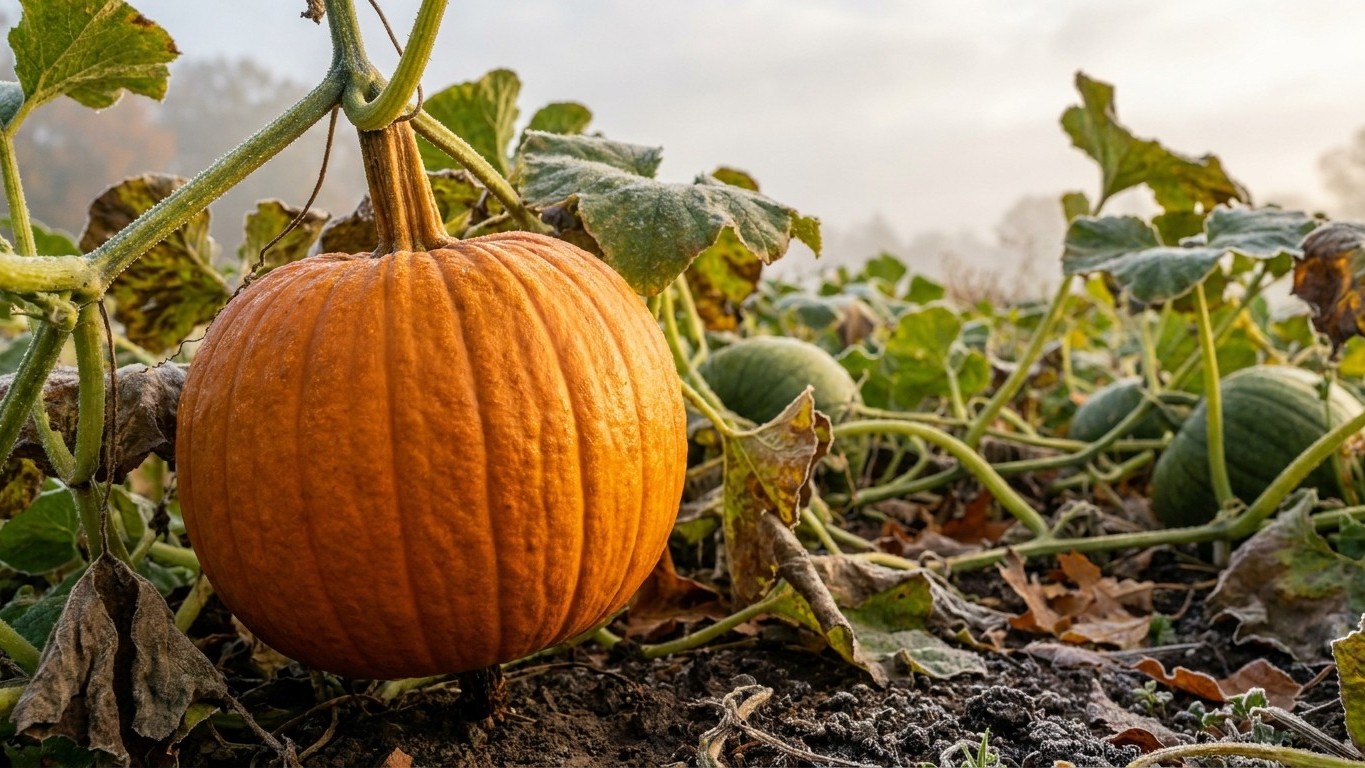

Manitoba pumpkins can ripen, but the window is unforgiving. Will Pumpkins Ripen Before Frost in Manitoba? Between the province’s short frost-free stretch and a fruit that needs 45 to 55 days of clear weather after its flower opens, there’s little room for a late start, a cool July, or a frost that arrives ahead of schedule. Get the timing right and you’ll have orange pumpkins on the vine by late September. Miss it by two or three weeks and you’re left with green fruit on a dying vine.
The short answer
Start with the number that matters most: Environment and Climate Change Canada’s climate normal for Winnipeg Richardson International Airport puts the average first fall frost at September 22. That’s a mean, not a promise. In one year out of two, the actual frost lands later than that date, and in the other half it lands earlier. Treat it as the middle of a range, never as a date you can plan around with confidence.
Now work backward. A pumpkin flower needs 45 to 55 days after it opens, not after the seed goes into the ground, to finish turning into a mature, hard-skinned fruit. Count back 45 days from September 22 and you land around August 8. Count back 55 days and you land around July 29. That gives a working window: for a pumpkin to have a real shot at ripening before an average frost, its flowers need to open somewhere between the last days of July and the first week of August.
That’s a tight target for a plant that also needs weeks of warm soil before it even germinates, then more weeks of vine growth before it flowers at all. Any delay at the start, whether from a cool spring, a late-warming garden bed, or seed sown a week later than planned, pushes flowering past that early-August cutoff and puts the whole crop at risk.
The safest approach is to treat late July as the deadline for flowering, not early August. That gives a buffer against the very real chance that frost arrives before September 22 rather than after it. Working backward from that deadline is exactly what determines When to Sow Pumpkins in Manitoba. Gardeners who count on the average date as a floor rather than a midpoint are the ones who find a green pumpkin frozen on the vine.
None of this is unique to pumpkins grown near Winnipeg. The same arithmetic, average frost date minus 45 to 55 days, applies anywhere gardeners grow this crop. What makes Manitoba’s version of the calculation tight is how early that fall frost date sits compared to warmer growing regions, which leaves less margin for a slow start in spring.
When to sow here
- Ignore the frost date as a sowing trigger. Pumpkins are sown once the soil itself reaches 65 F, not once the air stops freezing. Manitoba’s average last spring frost falls around May 23, but soil doesn’t warm at the same pace as air. In most years, the ground needs several additional weeks of sun before it holds steady at 65 F, meaning direct sowing typically isn’t safe until well into June, even though the frost risk in the air has already passed.
- Check soil temperature directly rather than guessing from the calendar. A simple soil thermometer pushed a few inches down gives a far more reliable answer than counting days from the last frost. Two gardens a few miles apart, one shaded and one in full sun, can warm at noticeably different rates.
- Use row covers to buy roughly two weeks. Clear or fabric row covers trap solar heat and can bring soil up to planting temperature about two weeks earlier than bare, exposed ground would reach it on its own. That head start matters enormously here, since it shifts the flowering window earlier and gives the fruit extra days of margin before the average frost date.
- Work backward from the late-July flowering deadline. If flowers need to open by late July to early August, and it typically takes several weeks from sowing to first bloom, sowing needs to happen as early as the 65 F soil threshold allows, with row covers used deliberately to pull that date forward rather than left as an afterthought.
- Harvest with the stem attached, and do it before frost touches the fruit. Utah State University Extension’s guidance on pumpkins is direct about this: the stem stays on, and the harvest happens ahead of frost, not after it. A fruit still attached to a stem that’s cut cleanly stores far better than one that’s been snapped off.
What goes wrong here
- A late flower that never colors up. When sowing slips past the ideal window, either because the soil was slow to warm or the gardener waited for a calendar date instead of checking the soil, flowering pushes into mid-August or later. With only 30 to 40 days left before the average frost, the fruit stays green and never finishes ripening. The remedy is sowing as early as the 65 F threshold and row covers allow, not waiting for a fixed date on the calendar.
- A fruit caught by an early frost. Because September 22 is a mean and not a guaranteed cutoff, a frost arriving even a week or two early can catch a pumpkin mid-ripening. Watching a local forecast closely through September and having row covers or old sheets on hand to throw over the patch on a cold night buys extra days for borderline fruit to finish.
- A vine that dies back before the skin hardens. Vines weakened by pests or disease often collapse before the fruit’s rind has toughened, leaving pumpkins with soft, thin skin that won’t store. Squash bugs and cucumber beetles are common culprits behind this kind of vine failure, and both already have dedicated pages on this site covering identification and control specific to squash bugs and cucumber beetles in this climate.
Checking this against your own county
Winnipeg’s climate normals are a useful benchmark, but Manitoba isn’t one climate zone. Northern districts and areas at higher elevation typically run behind the Winnipeg dates by a week or more, both for the last spring frost and the first fall frost, which shrinks the flowering window even further. Before committing to a sowing date, check current-season conditions and local frost guidance with Manitoba Agriculture, the provincial extension service. They track regional variation that a single airport weather station simply can’t capture, and that local read is worth more than any provincial average when it’s your own garden bed on the line.
Common questions
Can I still get a ripe pumpkin if my flowers open in mid-August?
It’s possible but marginal. Mid-August flowering leaves roughly 35 to 40 days before the average frost date, short of the 45-day minimum. The fruit may still color if frost arrives later than average, but it’s a gamble rather than a plan.
Does the 65 F soil threshold apply to transplants too?
Utah State University Extension’s guidance centers on soil temperature at sowing. Transplants started indoors and moved out still need that same warm soil to establish and grow on without stalling, so the threshold matters regardless of how the seed was started.
Should I cut the vine back once fruit sets to speed ripening?
The sourced guidance here doesn’t cover vine pruning as a ripening technique, so no figure or timeline can be offered on that point. What is clear from the source is that harvest should happen with the stem attached and before frost reaches the fruit.
How long will a Manitoba-grown pumpkin store after harvest?
The available guidance doesn’t publish a storage temperature, humidity level, or keeping time, only the instruction to store the harvested fruit somewhere it won’t freeze. Beyond that general rule, no specific storage duration is published here.