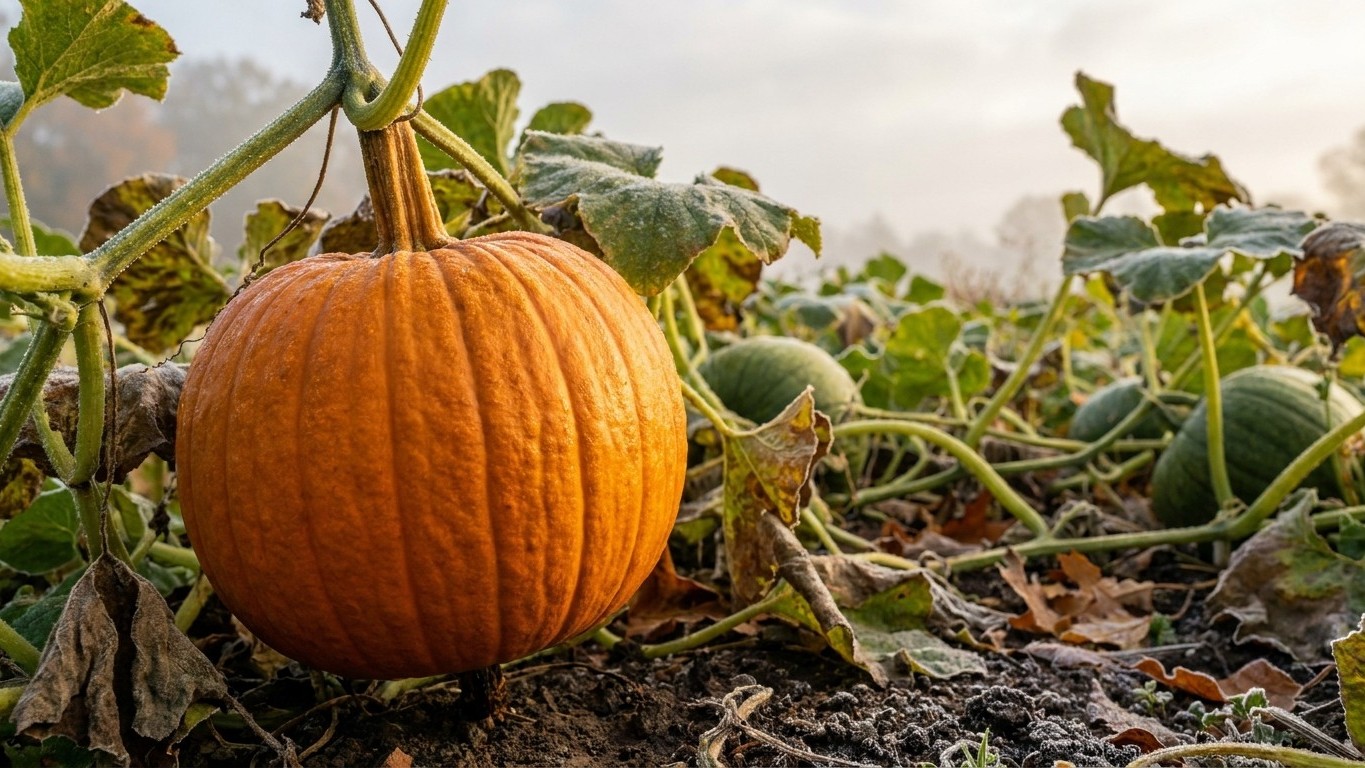

Yes, but only if you count backward from the right end of the calendar. Will Pumpkins Ripen Before Frost in Nebraska? Nebraska’s first fall frost typically lands between October 15 and October 26, depending on where in the state you garden. Pumpkins need 45 to 55 days from the moment a female flower opens, not from the day you drop the seed, to finish coloring up. Subtract the two and you get a narrow but workable flowering deadline that decides whether this year’s crop turns orange or stays green on the vine.
The short answer
Counting backward from frost
Nebraska’s first fall frost falls somewhere between October 15 and October 26, based on 1991-2020 climate normals from NOAA’s National Centers for Environmental Information. That’s the hard stop. Everything about growing a pumpkin here works backward from whichever end of that window your garden lands closest to.
Pumpkins need 45 to 55 days after a flower opens, not after the seed germinates, to finish ripening, according to Utah State University Extension. That distinction trips up a lot of first-time growers who count from planting day and end up disappointed. A pumpkin plant can sit in the ground for weeks putting out leaves and vines before it ever produces a flower worth tracking, and none of that time counts toward the ripening clock.
Why the range spans three weeks
Run the subtraction and the picture gets clearer. Take the earliest frost date, October 15, and subtract the full 55 days some varieties need, and the last flower with a real shot at ripening has to open by August 21. Take the latest frost date, October 26, and subtract the shorter 45-day minimum, and that deadline stretches to September 11. Depending on which end of the frost window your county sits closer to, and which maturation length your variety runs, the safe flowering cutoff falls somewhere between August 21 and September 11.
That’s not a small range to hedge against. Three weeks separate the conservative estimate from the generous one, and a gardener who assumes the generous end applies to their yard is taking a real risk if the season runs short. Anyone gardening in the western or northern reaches of the state, where frost tends to arrive earlier within that window, should plan around August 21 rather than September 11.
Flowers that open after that cutoff can still set fruit, but the pumpkin inside runs out of warm days before the skin hardens and the color finishes turning. Vines don’t stop blooming on their own once the calendar gets tight; they’ll keep throwing flowers right up until frost kills the plant, which means a gardener has to do the math instead of trusting the plant to know when to quit.
When to sow here
Two frost dates, one soil rule
Working backward from the flowering deadline only helps if the planting date lines up too, and When to Sow Pumpkins in Nebraska is exactly the question that’s where soil temperature, not the frost calendar, takes over. The last spring frost in Nebraska falls between April 12 and April 23, and the first fall frost between October 15 and October 26, both from NOAA’s climate normals. Those two dates mark the outer edges of the growing season, but neither tells you when to actually put seed in the ground.
The sowing sequence
- Know the two frost dates first, and treat them only as the season’s outer boundaries, not as a planting signal.
- Wait for the soil, not the air. Utah State University Extension puts the sowing threshold at 65 F soil temperature, a soil reading, not an air temperature and not a frost date. Bare ground in Nebraska warms far slower than the air above it, so the soil can lag weeks behind that April frost date before it climbs into the mid-60s. Sowing the week after the last frost, treating that date as a stand-in for soil warmth, often means planting into ground still too cold for the seed to do anything but sit and rot.
- Use row covers to close the gap. A layer of row cover traps daytime heat against the soil and can buy roughly two weeks, according to Utah State University Extension, moving the practical sowing date earlier than bare, uncovered ground allows. That two-week cushion matters most for anyone hoping to land on the earlier, safer end of the flowering deadline described above.
- Count forward from sowing to flowering, then to frost. Once seed goes in, the plant still needs its own run of weeks to grow, vine out, and finally flower before the 45-to-55-day ripening clock even starts. Sowing later, waiting for perfectly warm soil with no row cover help, eats into the margin needed to hit the August 21 to September 11 flowering window with room to spare.
- Match the sowing date to your own risk tolerance. A gardener aiming for the safer end of the season plants as early as row covers and soil temperature allow; one willing to gamble on a long, mild fall can push sowing later and hope frost lands on the late side of its window.
What goes wrong here
Three ways the clock runs out
The gap between how long a Nebraska pumpkin needs and how long the state actually gives it creates a short list of predictable failures, all traceable to the same clock problem.
- A late flower that never colors. Any female flower that opens after the season’s safe cutoff, roughly September 11 at the latest even in a mild year, is racing a clock it can’t win. The fruit swells but stays hard and green because it runs out of the 45 to 55 warm days it needs after pollination. The remedy is pruning: once you’re past that cutoff, pinch off new flowers and any small, obviously late fruit so the plant redirects its energy into the pumpkins that still have a chance, rather than wasting sugar on ones that never will.
- A fruit caught by frost before the skin hardens. A pumpkin that started right on schedule can still get caught if the season’s actual frost lands on the early side of the October 15 to October 26 window. Skin that hasn’t fully hardened is thin and vulnerable, and a freeze can turn a nearly-finished pumpkin into mush overnight. Watching the extended forecast in early October and having a sheet or blanket ready to throw over the vines on a cold, clear night can buy an extra day or two when a fruit is close but not quite there.
- A vine that dies back before the skin hardens. Powdery mildew, cool nights, or plain end-of-season exhaustion can kill the foliage before the fruit is fully cured, even without a frost involved. Once the vine collapses, the pumpkin stops getting fed and its skin stays soft. Cutting the pumpkin free with several inches of stem attached, then moving it somewhere dry and out of direct sun, lets it finish hardening off the vine, though it won’t develop any color it hadn’t already started.
Checking this against your own county
Every date in this article comes from a single weather station, the one behind the NOAA climate normals used here, and that station doesn’t sit in your backyard. Suburban and rural gardens routinely see their last spring frost arrive later, and their first fall frost arrive earlier, than the airport-based figures suggest, sometimes by one to two weeks, and more if your garden sits at higher elevation or in a low-lying frost pocket.
That gap is exactly why Nebraska Extension exists as a resource separate from national climate data. The university’s extension service tracks local frost trends, soil conditions, and variety performance specific to Nebraska counties, and its county offices can tell you how your particular microclimate tends to compare to the statewide averages used here.
Before committing to a sowing date based on the ranges above, a call or visit to your county extension office, reachable through Nebraska Extension, is worth the ten minutes it takes. Local staff have seen how the season actually plays out on the ground, year after year, in a way no statewide average can capture.
Common questions
Can I still plant pumpkins in Nebraska in July?
It depends on the variety’s maturation length and which end of the frost window your garden tends toward. If a plant sown in July can flower by roughly August 21 to September 11, per the flowering deadline described above, a July planting is still workable for many gardens, though it leaves little room for a slow start or a stretch of cool weather that delays flowering.
What happens if a pumpkin flower opens too late to ripen?
The fruit will still form and swell, but it runs out of the 45 to 55 warm days it needs after pollination, per Utah State University Extension, and stays green and hard through to frost. There’s no fix once that clock has run out; the best move is removing the fruit early so the plant’s energy goes toward pumpkins that still have a chance.
Does soil temperature matter more than the frost date for sowing?
Yes. The last spring frost date only marks when the air stops freezing; the soil itself takes longer to warm and needs to reach 65 F before pumpkin seed will germinate reliably, according to Utah State University Extension. Sowing by the frost date alone, without checking soil temperature, is a common way to lose seed to cold, wet ground.
How should I store a pumpkin harvested close to frost in Nebraska?
Harvest with the stem attached and get it out of the field before frost, per Utah State University Extension guidance, and keep it somewhere it won’t freeze. That guidance doesn’t publish a specific storage temperature or humidity target, only that general instruction, so beyond avoiding freezing conditions, exact keeping times aren’t established here.