
Nebraska gardeners work backward from two numbers: the state’s first fall frost window and the 45 to 55 days a pumpkin flower needs to turn into a ripe fruit. Soil has to hold at 65°F before seed goes in the ground, and that point lands well after the last spring frost has passed. Get either end wrong and you’re left with green pumpkins on dying vines in October.
The short answer
Nebraska’s first fall frost arrives somewhere between October 15 and October 26, depending on where you sit in the state, according to NOAA’s 1991-2020 climate normals. That date is the wall. Everything about sowing pumpkins in Nebraska gets built backward from it, because a pumpkin needs 45 to 55 days after its flower opens, not after the seed goes in the ground, to finish ripening into something you’d actually want on a porch.
Run the math both directions and you get a window, not a single deadline. Take the earliest frost date, October 15, and subtract the longer maturity span of 55 days, and you land around August 21. Take the latest frost date, October 26, and subtract the shorter span of 45 days, and you land closer to September 11. That means the last pumpkin flower on your vine needs to open somewhere between the third week of August and roughly the second week of September, depending on your exact location and which variety you’re growing.
Miss that window and the fruit that sets is racing a clock it can’t win. A flower that opens after mid-September in most of the state is gambling on a late frost that the climate record doesn’t favor. This is also why counting backward from seeding date alone is the wrong move: flowering happens weeks after the seed sprouts, and that gap varies by variety and by how the season treats the plant early on. The flowering date is the number that matters, and it’s the one growers most often skip past.
One more wrinkle worth flagging before anything else: the frost dates above come from an airport weather station, the kind of open, flat site that tends to run warmer than a shaded backyard or a low-lying rural lot. Suburban and rural gardens typically see frost arrive earlier in fall and linger later in spring, sometimes by one to two weeks, more if you’re at higher elevation in the Panhandle or the Sandhills. Treat October 15 to October 26 as a reference point for the general area, not a guarantee for your specific yard, and check what your own county extension office or a local frost log says before you commit a planting date to memory.
When to sow here
Nebraska’s last spring frost falls between April 12 and April 23 on average, per the same NOAA climate normals. That date tells you when the air stops freezing. It tells you almost nothing about when the soil is ready, and pumpkin seed does not care what the thermometer on your porch says at 6 a.m. It cares what’s happening four inches down.
- Start from the last spring frost window. April 12 to April 23 is your reference point for when the air danger passes in most of the state, with the usual caveat that low-lying or rural sites often run later.
- Expect the soil to lag behind. Ground takes weeks longer than air to hold steady warmth. In much of Nebraska, garden soil doesn’t settle at a reliable 65°F until well after that frost window has closed, sometimes several weeks later, because soil releases heat slowly and spring cold snaps keep resetting the clock.
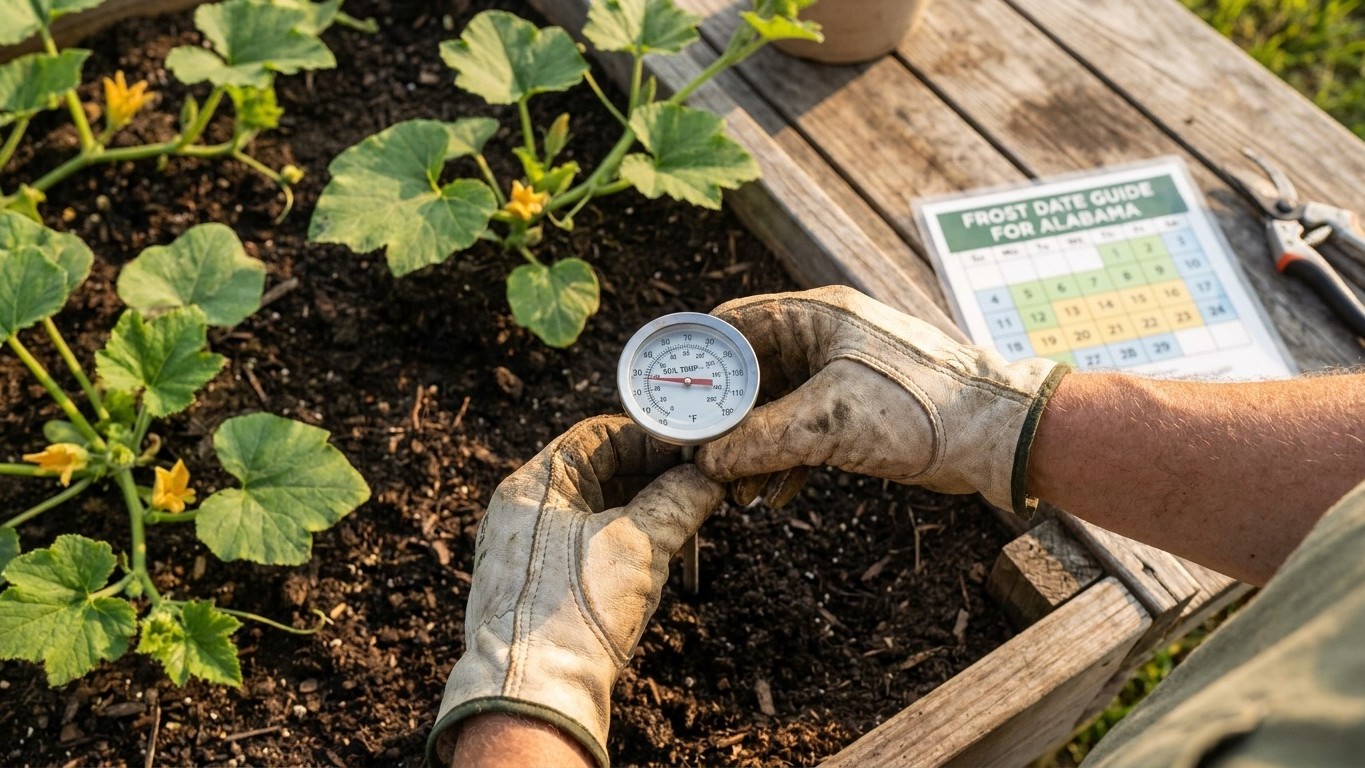
- Check the dirt, not the calendar. A simple soil thermometer pushed to seed depth beats guessing from the date on a seed packet. Pumpkin seed sitting in cold, damp soil is far more likely to rot than to sprout.
- Use row covers if you want to move earlier. Covering the bed traps daytime heat in the soil and can buy roughly two weeks over bare, uncovered ground, which matters in a state where the growing season is already working with a tight margin at both ends.
- Sow direct once 65°F holds. Pumpkins don’t transplant well; their root systems resent disturbance, so most Nebraska growers wait for the soil number and put seed straight into the bed rather than starting indoors and moving plants later.
What goes wrong here
Nebraska’s frost bracket, October 15 to October 26, gives less room for error than it looks like on paper. These are the failures that show up most often when the timing slips.
- A late flower that never colors up. If the last blooms open in mid-September or beyond, the fruit is still green or pale when frost hits, because it simply hasn’t had its 45 to 55 days. The remedy is to pinch off new flowers and vine tips once you’re within that window of the frost date, so the plant stops starting fruit it can’t finish and puts its energy into what’s already set.
- A fruit caught by frost before the rind hardens. A soft rind bruises, cuts easily, and won’t keep. If frost is close and the skin still gives under a thumbnail, harvest anyway rather than risk losing it outright, leaving several inches of stem attached, and move it somewhere it won’t freeze. Utah State University Extension notes only that pumpkins need to be kept where they won’t freeze; it doesn’t publish a storage temperature or a keeping time, so don’t assume a fridge or a heated garage is automatically fine.
- A vine that collapses before the fruit finishes. Foliage can die back early from disease pressure or a stretch of hard weather well before the calendar frost date, cutting off the leaves that were still feeding the fruit. If that happens, cut the vine at the soil line but leave the fruit attached to its stem and let it sit in a dry, protected spot as long as possible before a hard freeze forces the issue.
- Pest pressure shortening the effective season. Squash bugs and cucumber beetles both weaken vines mid-summer in Nebraska, and a stressed vine flowers later and ripens slower, squeezing an already tight window even tighter. Nebraska growers dealing with either should check the site’s dedicated pages on squash bugs in Nebraska and cucumber beetles in Nebraska rather than treating them as a footnote here.
Common questions
Can I still get a pumpkin if I sow late?
It depends on how late. If the flowers can still open within that August-to-early-September window worked out above, there’s still time. Past that, you’re relying on a frost date later than the climate record typically delivers.
Does variety change the timing?
Yes, though this page doesn’t attach specific day counts or sizes to named varieties, since Utah State University Extension’s guidance covers the crop broadly rather than variety by variety. What matters for scheduling is the 45- to 55-day flower-to-harvest range and where your particular plant’s bloom time falls inside it.
Should I count from seeding or from the first flower?
From the flower. Seeding date matters for getting the plant established, but the 45- to 55-day ripening clock starts when a flower opens, not when the seed goes into the soil. Confusing the two is the most common way this calculation goes wrong.
What if my yard is colder than the airport station’s numbers suggest?
Shift your planning earlier. Rural and low-lying Nebraska sites often see frost arrive a week or two before the reference dates and linger a week or two past them in spring, so build in that buffer rather than planting to the exact dates listed here.