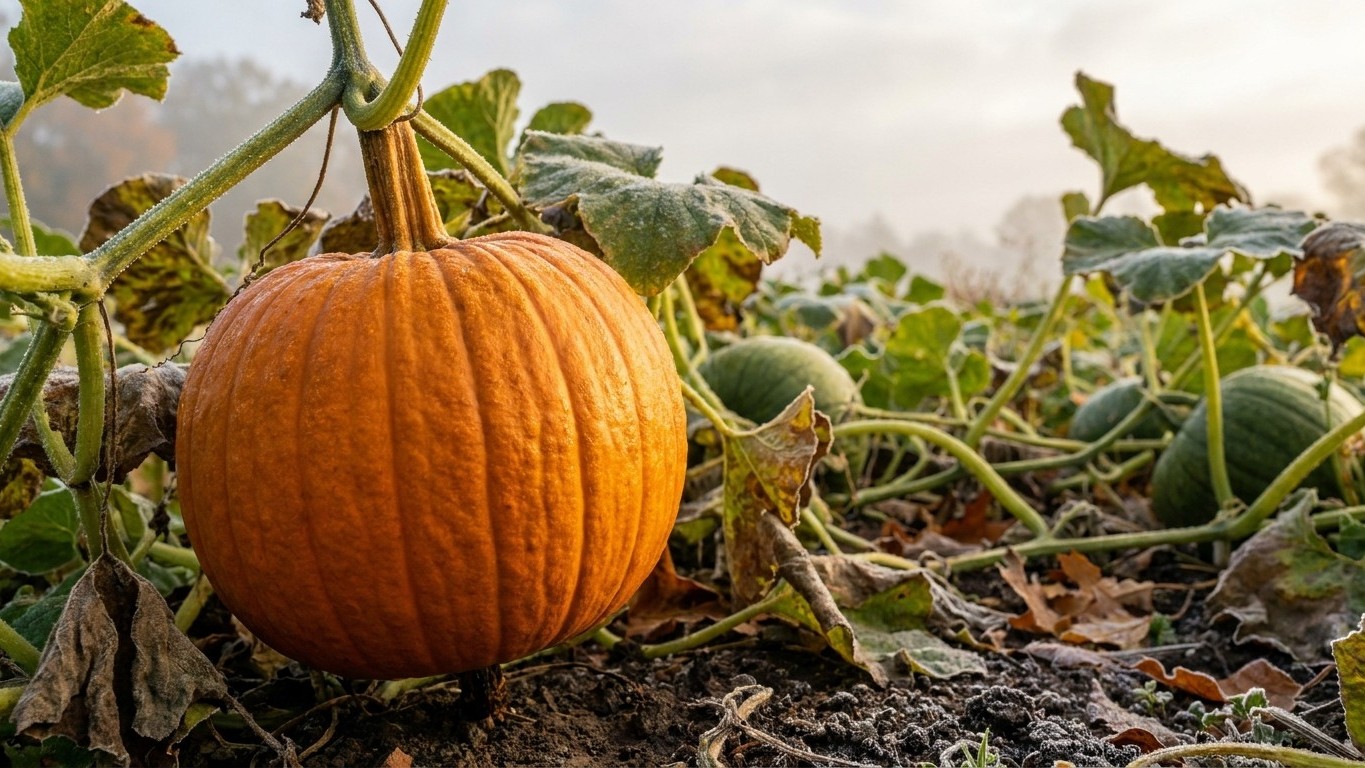

Yukon’s average first fall frost lands around August 25, and pumpkins need 45 to 55 days after their flowers open to ripen. Counting backward, the last flowers with a real shot at coloring up need to open somewhere between the first and second week of July. That’s a narrow window in a territory where the growing season itself is short, so the honest answer to Will Pumpkins Ripen Before Frost in Yukon? is: yes, but only if you push flowering as early as the calendar allows.
The short answer
Start with the frost date itself. Environment and Climate Change Canada’s multi-decade climate normals for the Whitehorse A station put the average first fall frost at August 25. That’s a mean, not a guarantee. In roughly half of all years, the actual frost arrives later than that date, and in the other half, it comes sooner. Treat August 25 as the midpoint of a range, not a line you can plan against with confidence.
Working backward from frost
Utah State University Extension’s pumpkin research puts the maturation window at 45 to 55 days measured from flowering, not from the day you drop a seed in the ground. Subtract 45 days from August 25 and you land on July 11. Subtract 55 days and you land on July 1. That gives a rough window: a flower opening around July 1 has the fuller 55-day cushion, while one opening as late as July 11 is banking on the fast end of that range and a frost that behaves exactly on schedule.
What this means for Yukon gardeners
Any flower that opens after roughly the second week of July is racing a clock that may already be lost. Given that half of all years bring frost after August 25, some slack exists, but it’s not slack worth counting on. The safer read is to treat July 1 as the real target for that first female flower, and to see July 11 as the outer edge rather than the plan. Since flowering itself depends on the plant having weeks of healthy vegetative growth behind it first, this pushes everything upstream, meaning When to Sow Pumpkins in Yukon and soil temperature become the real decision points, not the fall frost.
When to Sow Pumpkins in Yukon
The instinct is to sow the moment the last spring frost passes, but that’s the wrong trigger for pumpkins. Seeds and young roots need soil that has actually warmed, not just air that has stopped freezing. Whitehorse’s average last spring frost falls around June 5, also a midpoint figure from the same climate normals, and also one where roughly half of all years run later. Soil temperature lags well behind that date.
The sowing sequence
- Mark the frost baseline, not a safe date. June 5 is the average last spring frost for the Whitehorse area. Because it’s a mean, plan for it to run later in a good number of years rather than treating it as fixed.
- Wait for the soil, not the air. Utah State University Extension’s guidance is that pumpkin seed wants soil at 65 F before it goes in the ground. Soil doesn’t warm on the same schedule as air; the top few inches typically take extra weeks past the last frost to climb into that range, and in a cool northern spring like Yukon’s, that lag can stretch longer still.
- Use covers to buy time. Black plastic mulch or floating row covers laid down ahead of sowing can warm the soil faster, commonly pulling that 65 F threshold about two weeks earlier than bare, unprotected ground would reach it.
- Count forward from the adjusted sowing date. Even with covers shaving two weeks off the wait, sowing in the Yukon often doesn’t happen until deep into June. From there, the plant still needs weeks of vine and leaf growth before its first female flower opens.
- Check that flowering lands inside the window. Line up your expected flowering date against the July 1 to July 11 target established above. If the arithmetic pushes flowering past that window, the fruit set from that flower is unlikely to color before frost.
Run the numbers for your own garden rather than borrowing someone else’s date. A raised bed with dark mulch warms faster than open clay soil, and a south-facing slope in Whitehorse behaves differently than a shaded yard a few miles out. The 65 F soil threshold is fixed; the calendar date you hit it is not.
What goes wrong here
Yukon’s compressed season doesn’t leave much room for error, and the same three failures show up season after season. Each one traces back to the flowering window running too tight against the fall frost.
Three ways the clock runs out
- A late flower that never colors. A female flower opening in late July might still set a fruit, but it never gets the full 45 to 55 days before frost cuts growth short, leaving a pale, unripe pumpkin on the vine. The remedy is to push sowing as early as soil temperature allows, using covers to gain that two-week head start, so flowering happens closer to July 1 than July 11.
- A fruit caught by frost before harvest. Because August 25 is only a mean date, some years bring frost well before it, catching fruit that was otherwise on track. Utah State University Extension’s guidance is to harvest with the stem attached, and to do it before frost rather than after, since a frozen pumpkin degrades quickly even if it looked ripe the day before.
- A vine that dies back before the skin hardens. Cool, wet Yukon nights stress vines late in the season, and foliage can collapse before the rind has fully cured. Watching the vine’s condition, not just the calendar, matters here; a fruit that has reached full color but sits on a failing vine should be harvested rather than left for a few more days of hoped-for hardening.
Vine health through the season also depends on keeping pests in check early, since damaged foliage speeds up that late-season collapse. Yukon gardeners dealing with squash bugs or cucumber beetles will find the full detail on identifying and managing both on this site’s dedicated pages.
Checking this against your own county
Whitehorse’s frost dates are a starting point, not a forecast for every corner of the territory. Higher elevations, river valleys, and communities well north or south of Whitehorse can run weeks behind or ahead of the station data used here. Before locking in a sowing date, check current guidance through Agriculture and Agri-Food Canada, the federal department overseeing agricultural resources across Canada. Yukon’s own territorial agriculture branch is worth a call too, since local staff often have a better feel for how frost behaves in your specific district than any regional average can capture. Climate normals smooth out a lot of local variation, and a garden tucked against a south wall in one town can beat these numbers by a week or more, while an open field a short drive away might lag behind them just as much.
Common questions
Can I start pumpkin seeds indoors to get ahead of Yukon’s short season?
Starting seeds indoors and transplanting after the soil has warmed can shift the flowering window earlier, which matters given how tight the July 1 to July 11 target is here. Just remember that transplants still need soil in the 65 F range to take off; setting them out into cold ground defeats the purpose.
Is August 25 a safe date to plan my harvest around?
No. It’s a mean date from Environment and Climate Change Canada’s climate normals for the Whitehorse A station, meaning frost arrives later than that in about half of all years and earlier in the other half. Use it as a midpoint for planning, not a deadline you can count on.
What if my pumpkin flower opens in mid-July instead of early July?
It’s not automatically a lost cause, but it is banking on the faster end of the 45-day maturation window and a frost that arrives later than the August 25 average. Watch the fruit closely and be ready to harvest at the first sign of color change, even if it hasn’t reached full size.
Does the source give a storage temperature for harvested pumpkins?
Utah State University Extension’s guidance only specifies storing harvested pumpkins somewhere they will not freeze. No specific storage temperature or keeping time is published, so plan storage around avoiding frost exposure rather than hitting a precise number.