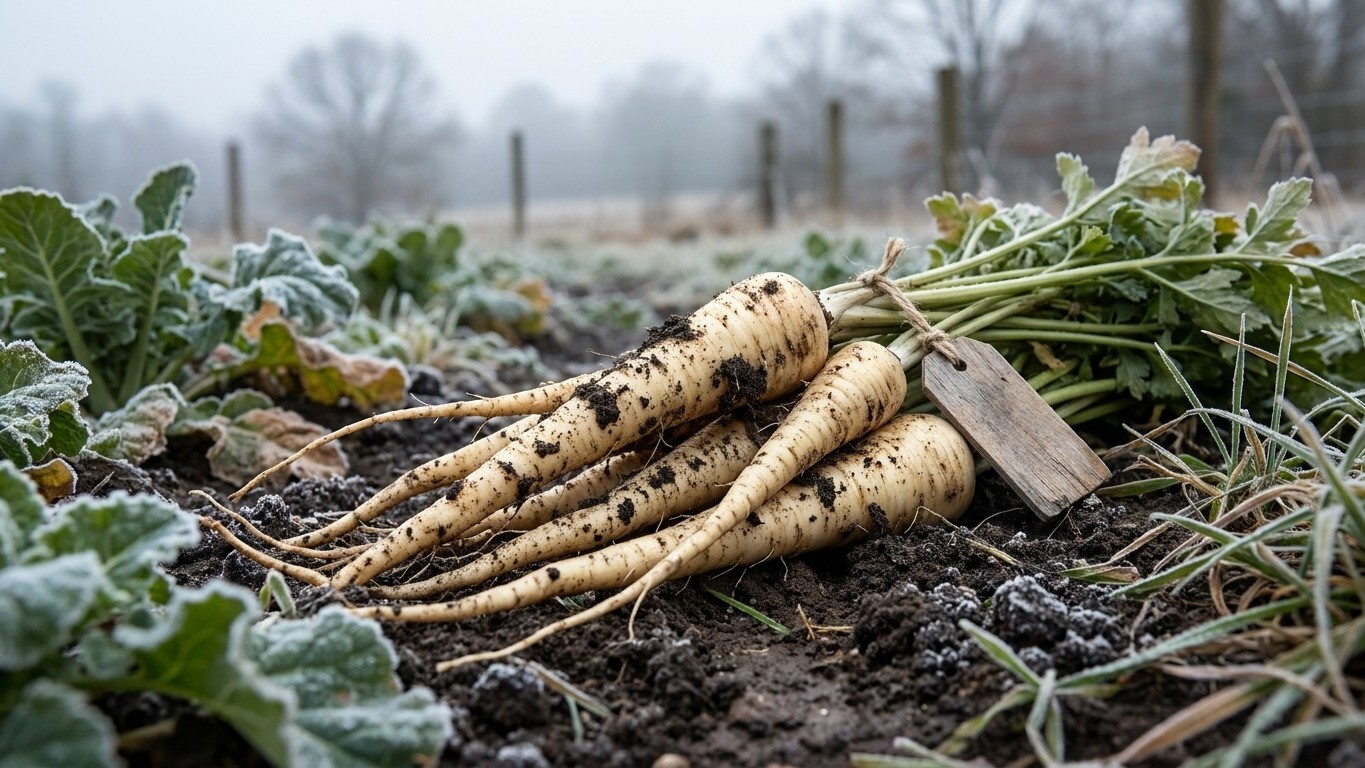

Yes, but the frost has to actually reach the roots before the ground locks up for the year. Anchorage’s coldest month averages a nightly minimum of 11.0°F, cold enough to guarantee several weeks of hard, repeated freezing rather than a single glancing frost. That’s the mechanism that converts stored starch into sugar. The real question for an Alaska gardener isn’t whether cold arrives, it’s whether the roots have grown to size in time to catch it before the soil freezes solid.
The short answer
Start with the number that actually decides this, not the hardiness zone printed on a seed packet. Hardiness zones describe the coldest the ground gets over a whole winter, which matters for perennials that have to survive underground for years. Parsnip sweetening is a different, narrower question: does the plant get several consecutive weeks of frosty nights while it’s still sitting in the garden, mature but unharvested? Anchorage’s answer is yes, and the data backs it up. The reference station used by NOAA NCEI’s 1991-2020 Climate Normals shows a mean daily minimum of 11.0°F for the coldest month, a figure that only happens in a climate where freezing nights are the rule, not the exception, for weeks on end.
That 11.0°F figure is a mean of the daily lows across an entire month, which means it isn’t describing one unlucky cold snap. It’s describing a pattern: night after night below freezing, repeated over the coldest stretch of the year. Parsnips don’t need that kind of depth of cold to sweeten. What they need is repetition, several weeks where temperatures drop enough to stress the root and trigger the starch-to-sugar conversion. A climate that averages 11.0°F on its coldest nights has already proven it can deliver that kind of sustained cold well before it gets anywhere near its harshest point.
So a parsnip grown around Anchorage isn’t just going to grow. Left in the ground through the first weeks of fall frost, it’s going to sweeten in the way gardeners actually plant parsnips for. The caveat is timing, not climate. The frost has to arrive after the root has reached a usable size, and it has to arrive while the ground is still workable enough to dig the harvest out. A parsnip that’s still pencil-thin when the first hard freeze hits hasn’t failed because of cold; it’s failed because the season ran out before the root did its growing. That’s a scheduling problem, not a climate problem, and it’s the one worth solving here rather than worrying about whether Alaska gets cold enough. It does.
Does the season fit?
- Set the sowing date. Parsnips go into the ground directly, seeded where they’ll grow, timed 2 to 3 weeks before the average last spring frost. With Anchorage’s last frost falling between May 3 and May 12, that points to a sowing window in the second half of April, though many Alaska gardeners wait until the soil has actually thawed and dried, which can push real-world sowing closer to early May.
- Account for slow germination. Parsnip seed is notoriously slow, taking 14 to 21 days to show any green at all. A gardener who sows in late April may not see a single seedling until mid-May, and that delay is normal, not a sign the seed failed. Digging up the row and resowing during that window is the single most common way this crop gets set back before it even starts.
- Count the full 100 to 120 days. That span runs from the seeding date, not from germination, and it covers everything from the slow sprouting through full root development. Sown in late April, a parsnip reaches maturity somewhere between early August and mid-September, depending on where in that 100-to-120-day range the particular crop lands.
- Measure that against the frost window. Anchorage runs roughly 143 frost-free days between the last spring frost (May 3-12) and the first fall frost (September 22 to October 1). A root that matures by early or mid-September still has two to six weeks of frost-free and then frosty weather ahead of it before the ground becomes unworkable.
- Read the verdict. Even sown at the later end of the window and taking the full 120 days, the math lands comfortably inside the frost-free season, with room left over for the roots to sit through the first weeks of fall frost, which is exactly the exposure that sweetens them. This is a season that fits with margin, not one that fits by a matter of days.
What goes wrong here
- Forked roots from heavy or stony ground. Southcentral Alaska’s silty, compacted, sometimes gravelly soils are exactly the kind of ground that splits a taproot as it pushes down. Utah State University Extension recommends deep, sandy soil for parsnips, and where the native ground is heavy, double digging the bed before sowing, working it loose to at least 12 to 15 inches so the root has nothing to deflect off of.
- Forked roots from overwatering. This is a separate cause from heavy soil, not the same problem in disguise. Inconsistent, heavy watering pushes the root to grow erratically, sending out side branches instead of one straight taproot. The fix is steady, moderate moisture rather than deep soaks followed by dry stretches, which matters in a climate where summer rainfall in Southcentral Alaska can arrive in uneven bursts.
- A late start eating into the season. Because parsnip seed germinates slowly and Alaska soil often stays cold and wet into spring, a sowing pushed back to accommodate the ground can eat weeks off the growing window. The remedy is warming and drying the bed early where possible, using raised rows or covered soil to get a workable seedbed as close to the recommended sowing date as the ground allows, rather than waiting for ideal conditions that may not arrive until the window has already tightened.
- Ground freezing before the harvest happens. The same frost that sweetens the root also locks up the soil, and Alaska’s ground can go from workable to solid within a short stretch once the first hard freezes settle in. The remedy is watching the weather rather than the calendar, planning to dig once several frosty nights have passed but before a deep, prolonged freeze sets in, and mulching over the row if a short delay in harvesting is unavoidable.
Common questions
Do parsnips need a hard freeze to taste sweet in Alaska?
No single hard freeze does it. What sweetens a parsnip is several weeks of repeated frosty nights while the root sits in the ground, which is exactly the pattern Anchorage’s fall delivers well before its coldest winter temperatures arrive.
When should parsnips be sown for an Alaska garden?
Utah State University Extension’s guidance points to 2 to 3 weeks before the last spring frost, which in Anchorage falls between May 3 and May 12. That puts sowing in the second half of April, adjusted for how quickly the soil actually thaws and dries that year.
How long before Alaska-grown parsnips are ready to dig?
Figure 100 to 120 days from the seeding date, not from when seedlings first appear. Germination alone can take 14 to 21 days, so the visible growing season looks shorter than the full maturity clock actually running underground.
What soil problems cause forked parsnip roots in Alaska?
Two separate issues, not one. Heavy, compacted, or stony native soil deflects the taproot as it grows, which double digging and loosening the bed can correct. Overwatering, especially uneven watering, is a second and unrelated cause, fixed by keeping moisture steady rather than heavy and irregular.