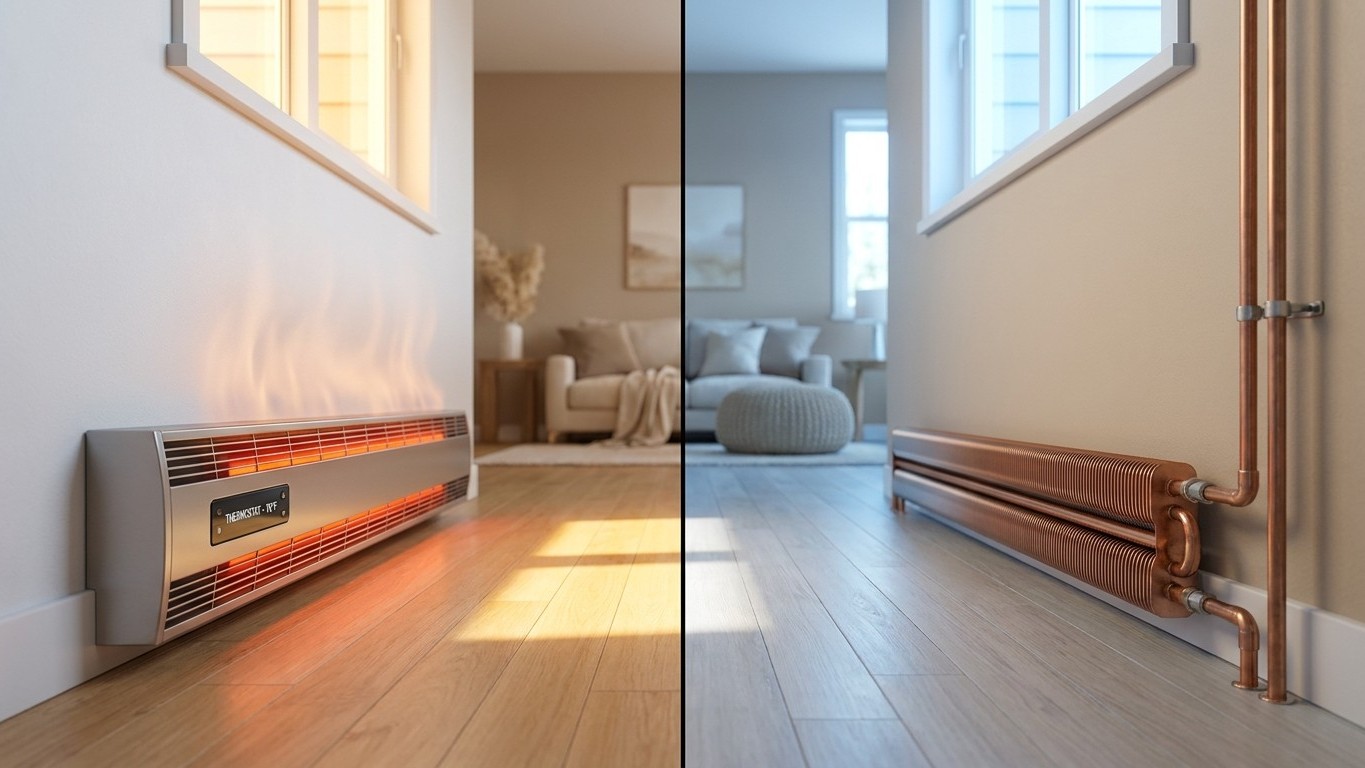

Two appliances share this name, and they don’t fail the same way, they don’t get serviced the same way, and only one of them carries line voltage. An electric baseboard heater is a resistance element in a metal case, wired directly into your home’s circuits. A hydronic baseboard is a radiator fed by a boiler, no different in principle from a old cast-iron radiator except for its shape. Knowing which one lines your wall changes every troubleshooting step that follows, including how you diagnose Clicking, Ticking and Banging Baseboard Heat, and if you’re still unsure, Electric or Hydronic? Telling Your Baseboard Heater Apart walks through the visible differences before you touch anything.
One name, two appliances
Before any repair instruction makes sense, you need to know which appliance is bolted to your wall. An electric baseboard heater is a resistance element sealed inside a metal enclosure, wired at 120 or 240 volts and controlled by one of the Line-Voltage Thermostats that sit right on the line, not on a low-voltage circuit like a furnace stat. Turn it on and the metal itself heats up. There’s no boiler, no pump, no pipe running anywhere. It’s a standalone electric appliance, room by room.
A hydronic baseboard is something else entirely: an emitter connected to a boiler loop, with hot water passing through a finned copper tube that runs the length of the unit, and those fins collect dust fast enough that How to Clean a Baseboard Heater Properly, Fins and All is worth a look before you assume a heating problem is electrical or mechanical. The heat you feel comes from water heated somewhere else in the house, usually a basement mechanical room, and circulated through pipe to every room on that loop. Cut power to a hydronic system and the water in the loop can still hold heat for a while. Cut power to an electric baseboard and it’s dead instantly, the same second, because there’s no reservoir of stored heat anywhere in the unit, which is part of Why Electric Baseboard Heat Has the Reputation It Has among homeowners comparing the two systems.
Here’s where it gets confusing on purpose, or at least through sloppy labeling. Some units sold as “hydronic baseboard heaters” are actually electric: they’re filled with a fluid that helps distribute heat evenly along the element, but the heat itself still comes from an electric resistance coil, and the whole thing plugs into or wires into your electrical system exactly, which matters when you’re trying to diagnose a Baseboard Heater Not Working situation and need to know which repair path actually appliesly like a standard electric baseboard. If it doesn’t connect to a boiler and a piping loop, it’s electric, regardless of what the box calls it or what liquid sits inside it, and knowing that distinction matters just as much once you’re Moving or Removing a Baseboard Heater rather than just diagnosing it.
Why does this matter enough to open a pillar page with it? Because the failure modes split cleanly along this line. Electric baseboard problems are wiring problems, thermostat problems, element problems, and they involve line voltage, which means shutting off a breaker before you touch anything internal. Hydronic baseboard problems are plumbing and boiler problems: air in the line, a stuck valve, a circulator pump losing prime. Diagnosing one as if it were the other wastes time at best and creates a shock hazard at worst.
One more clarification, since it trips up plenty of searches: the wooden or vinyl strip running along the bottom of a wall where it meets the floor is also called baseboard. That’s trim carpentry, a finishing detail with zero relation to heating. Nothing on this page, or anywhere in this guide, concerns that piece of wood.
Where this kind of heat is found
Electric resistance heat, the category that includes baseboard units, shows up unevenly across the country, and the pattern tracks electricity prices and climate more than anything else. The U.S. Energy Information Administration’s Residential Energy Consumption Survey (RECS 2020) tracks which fuel households name as their main heating source, and the spread between states is wide. In Washington state, 55% of homes report electricity as their main heating fuel. In Maryland, that figure is 41%. In Maine, it drops to just 10%.
Fuel share is not equipment share
That Washington number needs a caveat, because “electricity as main heating fuel” covers several different pieces of equipment, not baseboard heaters specifically. The same RECS data shows that in Washington, 47% of homes report a furnace as their heating equipment, and 9% report a central heat pump. Both of those can run on electricity. A furnace with an electric resistance coil counts as electric fuel. So does a heat pump. Neither of those is a baseboard heater.
Here’s the important gap: RECS does not publish a separate share for built-in electric units like baseboard heaters. There’s no line in the survey that isolates “homes with electric baseboard heat” as its own category. It would be tempting to subtract the furnace and heat pump percentages from the overall electric-fuel percentage and call the remainder “baseboard heaters,” but that math doesn’t hold up. A gap between two published figures is not itself a published figure, it’s just a gap, and it can include other equipment types, mixed systems, or homes the survey didn’t break down further. The honest answer is that this specific share simply isn’t reported.
What the state comparison does tell you, reliably, is where electric heat in general is common enough that baseboard units are a familiar sight in older homes and multifamily buildings. States with historically low electricity rates and cooler, humid winters, including much of the Pacific Northwest and parts of the South, adopted electric resistance heating more heavily during decades when it was cheap to run. Maine’s low number reflects heavy reliance on other fuels, particularly heating oil and wood, which have long dominated that state’s housing stock.
What goes wrong
Baseboard heater complaints tend to cluster into a short list of symptoms, and most of them point toward a specific cause once you know which type of unit you’re dealing with. Use the table below as a starting sort, then follow the linked guide for the actual fix.
| Symptom | What it usually means | Where to go next |
|---|---|---|
| Heater stays completely cold | Electric: tripped breaker, failed thermostat, or open element. Hydronic: closed valve, air lock, or a circulator pump that isn’t running. | Guide to a baseboard heater that won’t heat |
| Ticking, popping, or banging sounds | Metal expanding and contracting as it heats, often worse on electric units with a loose element or a hydronic pipe rubbing against a bracket. | Guide to ticking and banging baseboard heaters |
| Heat feels weak or uneven along the unit | Dirty fins blocking airflow on electric models, or trapped air and mineral buildup reducing flow through a hydronic loop. | Guide to weak baseboard heat output |
| Burning smell or odd odor when running | Dust burning off after a long idle period is normal briefly; a persistent smell can mean a failing element or overheated wiring. | Guide to baseboard heater smells |
| Cover is dented, bent, or missing sections | Physical damage that blocks the top or bottom opening, which interferes with airflow even if the heating element itself is fine. | Guide to a damaged baseboard heater cover |
A cold heater is the most urgent of these because it’s the symptom most likely to involve a genuine safety issue on the electric side, tripped breakers don’t trip for no reason, and it deserves its own diagnostic path before anyone reaches for a tool. Noise complaints, by contrast, are often harmless thermal expansion and mostly a matter of tolerance rather than repair. Weak or uneven heat is frequently the easiest fix of the five, since it’s often no more than a fin full of dust or a pinch of air trapped in a loop. Damaged covers get dismissed as cosmetic more often than they should be, since a bent panel can choke off the very airflow the unit depends on to work at all.
Living with it
Three habits decide, more than anything else, whether baseboard heat performs the way it’s supposed to over the life of the appliance, electric or hydronic. None of them require tools, and all three get ignored constantly.
The first is keeping the fins clean. Both types of baseboard heaters rely on fins, thin metal blades that increase surface area so heat transfers efficiently into the air passing over them. Dust, pet hair, and lint settle into those fins over a season and choke the airflow long before anyone notices a drop in output. A vacuum brush attachment run along the fins a couple of times a year keeps that airflow path open, and it’s the single easiest thing an owner can do for either type of unit.
Two openings, not one
The second habit is keeping both the bottom and top openings clear. A baseboard heater works by drawing cool air in at the bottom, passing it across the heated fins, and releasing warm air out the top. Block either opening, whether with a piece of furniture pushed flush against the unit, a curtain hanging in front of it, or bedding draped over the top, and two things happen at once: the heater stops moving air effectively, so the room doesn’t warm up, and heat builds up against whatever is blocking it. That second part is the one worth taking seriously. The exact clearance distance that’s safe for your unit is printed on the appliance’s own label or in its manual, and that’s the only number worth trusting, since it accounts for the specific wattage and design of that model. No general rule of thumb substitutes for reading the label that came with your specific heater.
The third habit is controlling each room individually rather than treating baseboard heat like a whole-house furnace system. Because baseboard units are typically wired or plumbed with a thermostat per room or per zone, the comfort payoff of that setup only shows up if you actually use it that way, setting bedrooms cooler at night, closing off a room you rarely use, and letting the living areas run warmer during the day. Treat every thermostat in the house as if it should match every other one, and you lose the one advantage this kind of distributed heating offers over a single central system.
Common questions
Can I tell electric and hydronic baseboard apart just by looking?
Usually, yes. Electric units have a visible power cord or hardwired electrical connection and a thermostat mounted at line voltage, often right on the unit or on the wall nearby. Hydronic units connect to copper or PEX pipe running into and out of the enclosure, feeding from a boiler elsewhere in the house. If you see pipe rather than wire entering the unit, it’s hydronic.
Do electric baseboard heaters need any yearly maintenance?
Cleaning the fins and checking that the cover isn’t damaged covers most of it. Beyond that, electric units have few moving parts to service, which is part of their appeal, though the thermostat and internal wiring can still fail over many years of use.
Why does my hydronic baseboard heater make a gurgling sound?
That’s usually trapped air in the loop, a common issue after the system has been drained and refilled or after a long summer shutdown. It often requires bleeding air from the system rather than any repair to the baseboard unit itself.
Is it normal for a baseboard heater cover to feel warm on the outside?
Yes, the cover is designed to get warm since it’s part of how heat radiates and convects into the room. What isn’t normal is a cover that’s hot enough to be uncomfortable to touch briefly, which can point toward restricted airflow or an internal fault worth checking.
Guides by state
- Electric or Hydronic? Telling Your Baseboard Heater Apart
- Baseboard Heater Not Working: One Room That Stays Cold
- How to Clean a Baseboard Heater Properly, Fins and All
- Clicking, Ticking and Banging Baseboard Heat
- Replacing a Dented or Rusted Baseboard Heater Cover
- Line-Voltage Thermostats: Why Baseboard Heat Is Controlled Differently
- What Can and Cannot Sit in Front of a Baseboard Heater
- Moving or Removing a Baseboard Heater: What It Actually Involves
- Why Electric Baseboard Heat Has the Reputation It Has
- Hydronic Baseboard: The Boiler Loop Along Your Wall
- Electric or Hydronic? Telling Your Baseboard Heater Apart
- Baseboard Heater Not Working: One Room That Stays Cold
- How to Clean a Baseboard Heater Properly, Fins and All
- Clicking, Ticking and Banging Baseboard Heat
- Replacing a Dented or Rusted Baseboard Heater Cover
- Line-Voltage Thermostats: Why Baseboard Heat Is Controlled Differently
- What Can and Cannot Sit in Front of a Baseboard Heater
- Moving or Removing a Baseboard Heater: What It Actually Involves
- Why Electric Baseboard Heat Has the Reputation It Has
- Hydronic Baseboard: The Boiler Loop Along Your Wall