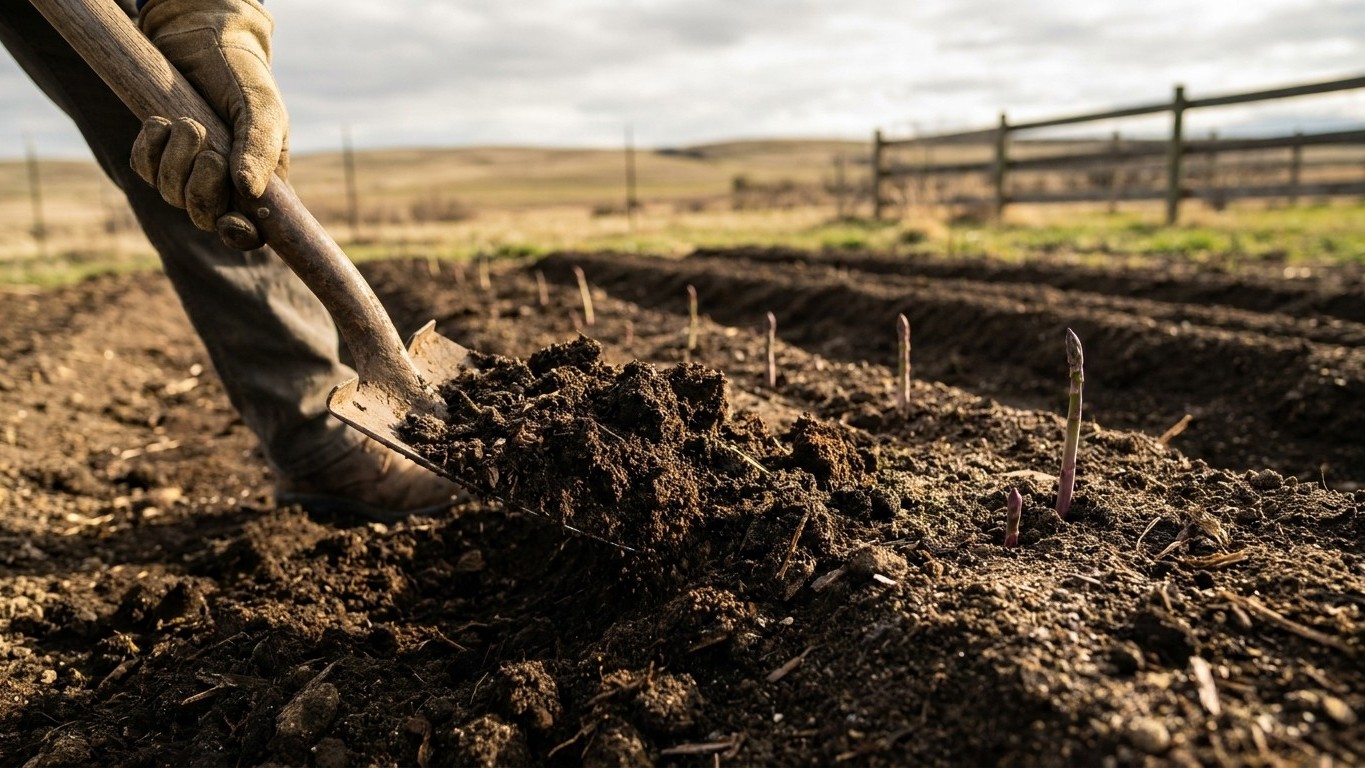

North Dakota’s representative soil, the Williams series, drains well enough for asparagus, so the bigger question isn’t whether the crop will grow here. It’s whether you’re ready to commit a patch of ground for a decade or more, water it through the state’s driest month, and wait three full seasons before cutting a single spear.
The short answer
Asparagus is a plant-once, harvest-for-a-generation crop. A bed put in this spring can still be producing spears fifteen years from now, and the only real soil condition attached to that promise, according to Utah State University Extension, is drainage. Most soils will grow asparagus fine as long as water doesn’t sit on them. That single requirement matters more here than it does for something you replant every year, because a poor choice of spot isn’t a season’s mistake. It’s a decade’s mistake.
North Dakota’s representative soil, the Williams series, checks that box. USDA soil survey data describe it as well drained, a loam to silt loam mix running roughly 38 percent sand, 22 percent clay and 40 percent silt, with a surface pH near neutral at about 7.2 and organic matter around 4 percent. That’s the kind of structure that lets water move through instead of pooling around the crowns, which is exactly what a plant expected to sit in one spot for fifteen years needs, and it’s the core question behind Will North Dakota Soil Hold an Asparagus Bed for Fifteen Years?
None of that is a guarantee for your own yard. The Williams series is what USDA lists as representative of North Dakota overall, not a soil test of the patch behind your garage. River bottoms, hill country, and any ground that’s been graded, filled, or compacted during construction can behave nothing like the state average. If you dig a test hole, fill it with water, and it’s still standing after an hour, don’t plant asparagus there. Raised beds or berms solve that problem by lifting the crowns above the slow-draining layer, and they’re the standard fix wherever a homeowner suspects heavier clay than the county average.
The timeline itself asks for patience beyond what most vegetable gardeners are used to. There’s no harvest at all in year one or two. Year three brings a first, short harvest window of about 4 weeks. Year four stretches to about 6 weeks, and from year five onward you can cut for about 8 weeks each spring. The rule for when to stop each season isn’t a date on the calendar. It’s a visual cue: once most of the spears coming up are thinner than a pencil, the plant needs its energy for foliage, not for you, and cutting should stop.
Crowns go into an 8-inch furrow, but that furrow isn’t backfilled all at once. Soil gets added gradually across the season, about 2 inches every other month, so the crown is buried in stages as the young ferns grow taller. Getting the timing right matters just as much as the planting method itself, and When to Plant Asparagus Crowns in North Dakota depends largely on soil temperature and the last frost date. As for which crown to buy, the published record is thin. Utah State names four varieties by sex alone: Jersey Giant and Jersey Knight are all-male, while UC 157 F1 and Purple Passion carry both male and female plants. No flavor comparison, no yield figure, and no stated reason to prefer one over another appears in that source, so treat variety choice as a sex decision, not a taste test.
Will the summer here water it for you?
An asparagus bed has a fairly specific thirst. For its first two years it wants 1 to 2 inches of water every other week. Once established, that eases to roughly the same amount every three weeks. Compare that against what actually falls from the sky in North Dakota, and a pattern shows up worth planning around.
- Summer as a whole runs close to dry-average. Normals from the reference weather station used for these figures put June, July and August combined at about 10.0 inches, out of 23.9 inches for the full year. That’s a meaningful share of the annual total packed into three months.
- June is the wettest of the three, averaging 4.29 inches. For a young bed needing roughly 2 to 4 inches every four weeks, June rainfall alone can cover most or all of that demand in a typical year, assuming it falls in useful amounts rather than one flash storm that mostly runs off.
- July eases back to about 3.07 inches, still enough to carry an established bed’s every-three-week need most years, though a young bed in its first two seasons may need a supplemental soak if July turns dry.
- August is the gap month. At about 2.6 inches, it’s the driest of the summer, and it’s also when heat and evaporation are working hardest against the soil. This is the point in the season most likely to need a hose, particularly for a bed still in its first two establishment years.
- None of this is a substitute for a rain gauge on your own property. These are 1991-2020 normals from one reference station; a rain shadow, a slope, or simply a dry summer can leave your actual totals well under these averages, and a wet summer can push them well over.
The practical takeaway is that North Dakota’s summer rainfall carries an established asparagus bed through most of June and July without much help, but August is worth watching closely, and a first- or second-year bed shouldn’t be left to rainfall alone in any month that comes in under an inch or so of measured moisture.
When to put the crowns in
Crowns go into the ground in early spring, timed to land after the ground has thawed and worked but before the plant has to fight through a late freeze while it’s trying to establish roots. In North Dakota, that window sits around the last spring frost date, which the National Centers for Environmental Information’s 1991-2020 climate normals place somewhere between May 4 and May 15 at the reference station used for these figures.
That’s a mean date, not a promise. Frost probability is exactly that, a probability, calculated from three decades of station data, and it can arrive earlier or later in any given year. It’s also a single reference station’s figures, and gardens outside that immediate area, especially in low-lying or rural spots away from the moderating effect of a city, commonly see their last frost run later than the reference number by a week or two. Treat the May 4 to May 15 window as the target to aim for, then watch your own local forecast and soil temperature before you actually dig the furrow, rather than committing to a fixed calendar date months in advance.
Crowns aren’t the only way in. Asparagus can also be started from seed, and that route exists as a genuine alternative for gardeners who want to raise their own plants rather than buy dormant crowns. What the seed route doesn’t come with, at least not from the source behind these figures, is a published timeline of its own for North Dakota conditions, so gardeners choosing that path are working from general vegetable-seed-starting practice rather than a state-specific date. Crowns remain the faster, more predictable route to a bed that’s counting down toward its first harvest in year three, and they’re the method the core planting guidance here is built around.
One more thing the source is quiet on: winter chilling. North Dakota’s hardiness zone tells you how cold winters get, but nothing in this data set converts that into a chilling requirement for asparagus dormancy, and turning a hardiness zone into a chilling number would be a guess dressed up as a fact. If chilling hours matter for a bed this far north, that’s a question for a source that actually publishes the figure, not one to invent here.
Checking this against your own county
Everything above describes North Dakota in general terms: a representative state soil, a reference weather station’s rainfall normals, and a mean frost date built from three decades of records at one airport. None of it replaces a soil test dug from your own bed site or a frost date pulled from a station closer to your actual address.
NDSU Extension is the land-grant service for North Dakota, and it’s the resource built to answer questions at the county level rather than the state level, from soil testing options to localized planting calendars. Before committing a permanent bed to Fifteen Years in One Spot, it’s worth a call or a visit to NDSU Extension to confirm drainage, frost timing, and any local variety guidance specific to where you actually garden.
Common questions
Can I harvest any spears in the first two years?
No. The published guidance is clear that no harvest happens until year three, when the bed produces for about 4 weeks. Cutting earlier weakens the crowns before they’ve built the root reserves the plant needs for its long production life.
How do I know when to stop cutting each spring?
Watch the spears, not the calendar. Once most of what’s coming up is thinner than a pencil, stop harvesting and let the plant put its energy into ferns for the rest of the season.
Does it matter which of the four named varieties I plant?
The published source distinguishes them only by sex, all-male (Jersey Giant, Jersey Knight) versus male and female (UC 157 F1, Purple Passion). No flavor, yield, or suitability difference is published, so there’s no documented reason to prefer one over another based on that source alone.
What if my soil doesn’t drain as well as the state average?
Test it before you commit. If water sits in a test hole for an extended period, a raised bed or mounded row lifts the crowns above the slow-draining layer, which is the standard workaround wherever drainage is in doubt.