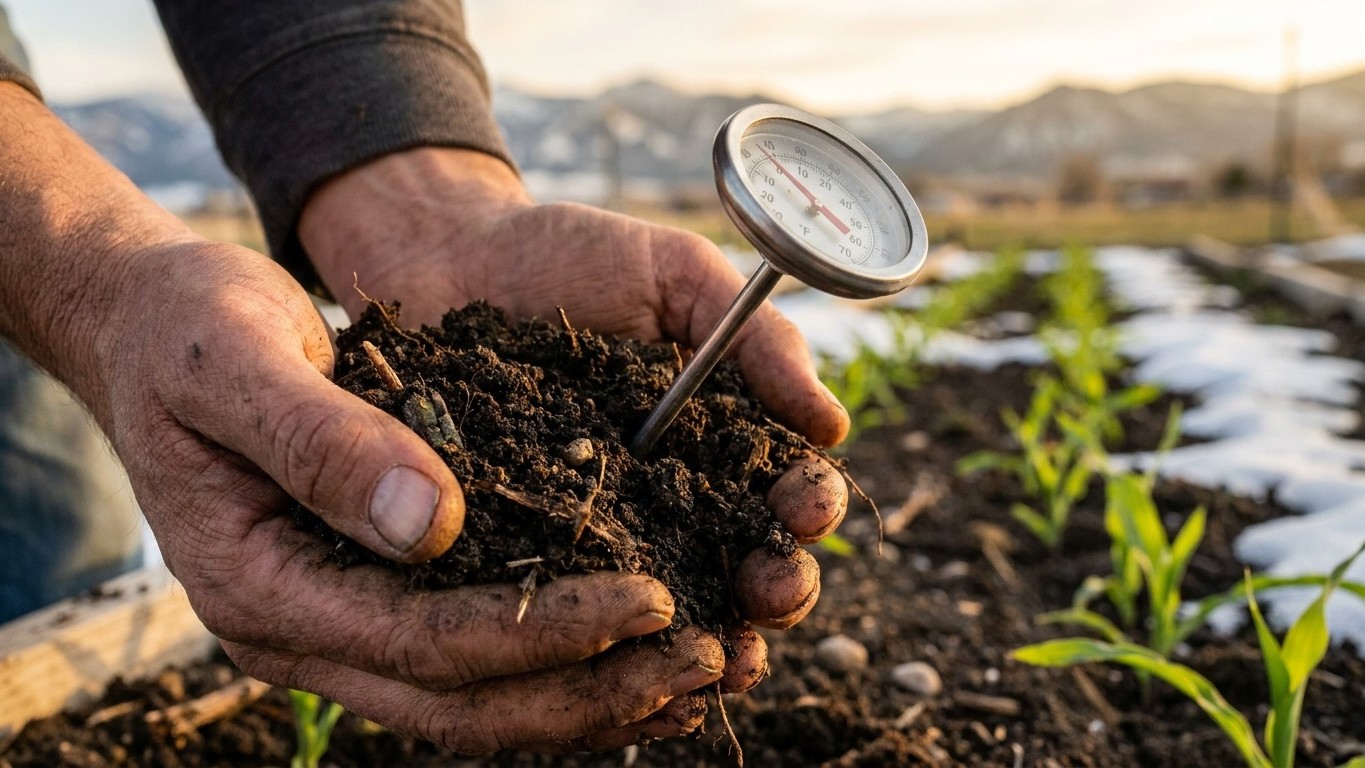

In most of Utah’s valley towns, sweet corn ripens just fine, but only if the calendar is read correctly. Answering Will Sweet Corn Ripen in Utah? starts with the soil: it has to warm past 60 F before you plant, not just clear the last frost, and that gap changes everything about when the 60 to 90 day countdown actually begins.
The short answer
Start with the frost dates, because that’s where most gardeners go wrong. Across the reference station used for Utah climate normals, the last spring frost falls somewhere between April 12 and April 29. That sounds like a green light to plant corn. It isn’t. Knowing When to Sow Sweet Corn in Utah means understanding that sweet corn needs soil temperatures above 60 F to germinate reliably, and that threshold arrives weeks after the air stops freezing, not on the same day. A garden bed can be frost-free and still be too cold underground for a corn seed to do anything but sit there and rot.
So the real planting window opens later than the frost-free window suggests. Once the soil does hit 60 F, the clock that matters starts: sweet corn needs 60 to 90 days from planting to harvest, depending on the variety. The question is whether that stretch fits before the first fall frost, which lands between October 18 and October 29 at the same reference station.
Run the numbers and the picture is reassuring for most valley gardens. Between the earliest last frost and the latest first frost, the frost-free season stretches to roughly 200 days. Even in the tighter scenario, a late last frost paired with an early first frost, the window still runs around 172 days. Subtract several weeks for the soil to climb from freezing-adjacent temperatures to 60 F, and gardeners are still left with well over 100 days of usable growing time in a typical valley location. That’s more than enough room for even the slower end of the sweet corn clock.
Heat matters here too. The reference station averages 52.1 days a year at 90 F or hotter, a heavy summer heat load that pushes water demand up and speeds up growth once the plants are established. Corn actually likes that kind of heat; it’s a warm-season crop bred for exactly these conditions. The risk isn’t summer heat killing the crop. It’s a gardener planting on the calendar date of the last frost instead of waiting for the soil itself to tell them it’s ready.
Does a late variety fit here?
Not every sweet corn variety runs the same clock, and the difference between a fast one and a slow one matters more in some parts of Utah than others.
A 60-day variety
A variety bred to mature in 60 days from planting is the safest bet almost anywhere in the state. Even accounting for a late last frost and a slow soil warm-up, a 60-day window fits comfortably inside the frost-free stretch calculated above, whether a gardener is working from the milder end of the frost range or the tighter one. There’s slack left over, too, which is useful, because Utah’s weather doesn’t always follow the average. A cool, wet spring that delays soil warming by a week or two still leaves a 60-day variety with room to finish before the first fall frost arrives.
A 90-day variety
A 90-day variety asks more of the season, and here the picture depends heavily on where in Utah the garden actually sits. Salt Lake Valley, and similar low-elevation valley locations, still have enough frost-free days to carry a 90-day corn to maturity, based on the window worked out above. But that reference station sits in a comparatively mild valley. Most of Utah is higher and colder, and a shorter, harsher growing season at elevation can squeeze a 90-day variety out of contention entirely, especially if a late spring pushes planting back and soil takes longer to warm. Southern Utah runs the opposite direction, milder and with more room to spare. The honest answer for a 90-day variety is that it fits in the state’s warmer valleys, gets tight at moderate elevation, and likely does not fit in the colder mountain valleys found across much of Utah. Anyone gardening above the mild valley floor should treat a 90-day sweet corn as an ambitious choice, not a default one.
What goes wrong here
- Soil sown too cold: Planting on the frost-free date rather than waiting for 60 F soil is the most common mistake. Seeds sit in cold, damp ground, rot before they sprout, or germinate so unevenly that the stand never fills in. The fix is patience: check the soil itself, not the calendar, and hold off until it’s genuinely warm.
- A variety too late for the season: Choosing a 90-day corn in a higher, colder part of Utah runs the real risk of the first fall frost arriving before the ears finish filling out. Matching variety length to elevation and local frost dates, rather than picking whatever looks good on a seed rack, avoids a crop that never quite gets there.
- Sweetness lost to timing, not weather: This one has nothing to do with climate. Sweet corn types (su, se, and sh2) lose their sweetness if they tassel at the same time as each other nearby. Utah State University Extension doesn’t publish an isolation distance for this, so the fix isn’t measured in feet. It’s a matter of timing and planting shape: stagger planting dates so different types don’t tassel together, and grow each type in its own block of three or more rows rather than a single skinny row, which also improves pollination.
Checking this against your own county
Everything above is built on one reference station, and Utah’s terrain doesn’t hold still. A backyard in a canyon town or a high mountain valley can run weeks behind a valley floor garden on both frost dates and soil warm-up, which shifts the whole planting calculation. Before locking in a variety, check local conditions with Utah State University Extension, which runs county offices across the state and can speak to the specific elevation and microclimate a garden sits in. That local check matters more for a 90-day variety than a 60-day one, since the margin for error shrinks fast once elevation climbs.
Common questions
What’s the difference between the 60-90 day clock and a shorter countdown near harvest? The 60 to 90 day figure runs from planting and tells you whether the crop fits the season at all. A separate, much shorter countdown of 17 to 24 days runs from silk emergence and tells you which week to actually pick. They answer different questions and shouldn’t be confused with each other.
How do I know sweet corn is actually ripe? No single sign is enough on its own. Look for all three together: silks that have dried and turned brown, husks that are still moist and green, and juice that runs milky, not clear or thick, when a kernel is punctured.
Can sweet corn be grown in Utah’s higher mountain valleys? Yes, but stick to a fast, 60-day variety. The colder, shorter season at elevation leaves little room for a 90-day corn to finish before the first fall frost.
Do I need to worry about corn growing on a neighboring property? What matters is whether it tassels at the same time as your own planting, not how far away it sits. If timing overlaps, sweetness can suffer regardless of distance.