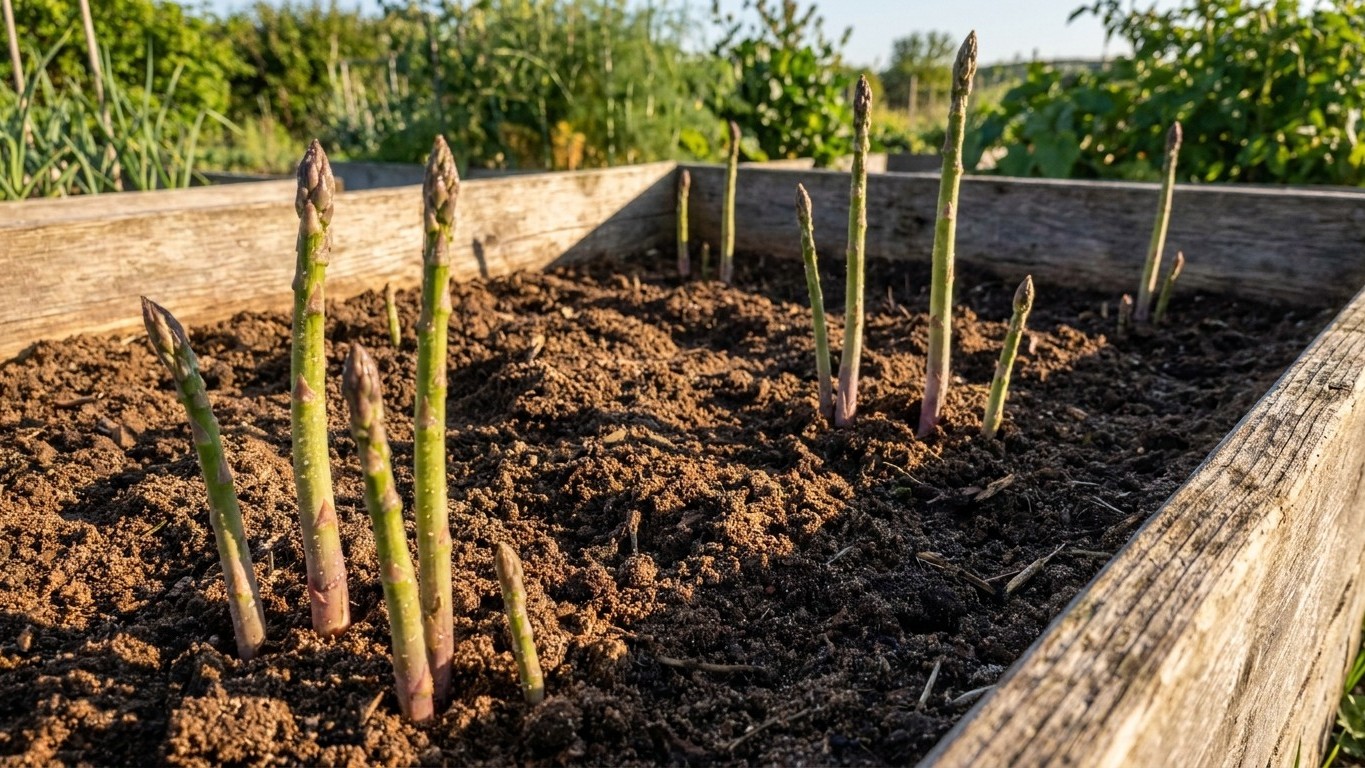

Yes, provided the ground drains water away instead of holding onto it. A fifteen-year asparagus bed doesn’t ask for rich soil or a particular pH: it asks for drainage, three fallow springs of patience, and a spot the household won’t need to dig up for a fence post or a sprinkler line in year seven. Maryland’s representative soil profile answers the drainage question in the reader’s favor. “Representative” is doing a lot of work in that sentence, though.
The short answer
The soil the USDA lists as representative of Maryland is the Sassafras series, an Ultisol, which is a fancy way of saying it’s old, weathered, and leached of a lot of what it started with. The surface horizon runs about 67 percent sand, 10 percent clay, and 23 percent silt, with organic matter around 1.6 percent. That sand content is the part that matters most for a fifteen-year planting: the series is classified well drained, and drainage is the one soil condition Utah State University Extension flags as necessary for asparagus. Most soils will grow it. Wet feet won’t.
The surface pH on this series runs about 5.3, which is strongly acid. That number is worth knowing for general gardening, but the source describing asparagus culture doesn’t publish a pH requirement, so there’s no honest way to say the crop needs a different number or that 5.3 is a problem to fix before planting. Treat the pH figure as background, not as an instruction.
Here’s the caution that matters more than any of those numbers: the Sassafras series is what USDA records as representative of the state as a whole, not a measurement of any one backyard. A state this size spans hundreds of mapped soil series. River bottoms hold water longer than the ridges above them. A lot that a builder scraped and regraded ten years ago may have nothing in common with an undisturbed field a mile away. If a shovel test after a rain shows standing water an hour later, or if the ground stays sticky and dark two days after a storm, that’s a clay-heavy or compacted spot, whatever the state soil says.
The fix for a poorly drained spot isn’t to skip asparagus altogether. It’s to raise the bed, mounding soil eight to ten inches above grade, or to pick higher ground elsewhere in the yard where water visibly moves through rather than sitting. A raised bed on a base of well-drained fill will outperform native clay every time, and it costs a weekend of digging rather than fifteen years of a struggling planting.
Will the summer here water it for you?
- What the bed asks for. For the first two growing seasons, the young planting wants 1 to 2 inches of water every other week, roughly 2 to 4 inches a month depending on heat and how fast the soil drains it away. After that establishment period, the schedule relaxes to every three weeks.
- What the region typically delivers. The 1991-2020 climate normals for the region put summer rainfall at about 12.6 inches across June, July, and August, broken down as 3.98 inches in June, 4.48 in July, and 4.09 in August. Averaged out, that’s roughly 4.2 inches a month, which sits close to the top end of what a first-year bed needs.
- Where the gap shows up. June is the driest of the three summer months on paper, and it’s also when a newly planted bed is doing its most vulnerable early growth. On a sandy, fast-draining profile like the Sassafras series, a single week without rain can leave the root zone dry even in a month with a decent total, because the water that falls doesn’t linger.
- How rain actually arrives. Summer totals in this region tend to come as thunderstorms rather than steady soaking rain. A 1.5-inch downpour that runs off a sandy surface in twenty minutes doesn’t count the same as 1.5 inches spread over two slow days, even though the rain gauge reads identically.
- The practical move. Treat the 12.6-inch summer normal as a rough baseline, not a guarantee, and keep a rain gauge on the bed itself. In a dry stretch, especially in June of the first two years, plan to run a hose or soaker line to make up the difference between what falls and the 1 to 2 inches every other week the planting actually needs.
When to put the crowns in
Crowns go into the ground in early spring, set into furrows about 8 inches deep. The last spring frost for the reference station used in these normals runs around April 3 to April 16, and that window is the natural anchor for timing: crowns are typically planted once that stretch has passed and the soil has warmed and dried enough to work. Say “around” deliberately here, because a mean frost date is an average built from thirty years of records, not a promise about any single spring. Western Maryland, up in Garrett and Allegany counties, runs weeks later than that window because of elevation, and the Eastern Shore tends to run milder, so a gardener in either place should treat the date as a starting point for their own observation rather than a fixed calendar entry.
Once the crowns are in the furrow, the covering soil isn’t dumped in all at once. It gets backfilled gradually, about two inches every other month across the first year, filling the trench in stages as the new shoots grow up through it. That gradual method gives the developing root system room to spread before it’s buried under a full eight inches of soil.
Variety choice is simpler than it looks, mostly because there isn’t much published to choose from. Utah State University Extension names four: Jersey Giant and Jersey Knight, both all-male hybrids, and UC 157 F1 and Purple Passion, which are male-and-female types. The source doesn’t rank them by flavor, yield, or any other reason to prefer one over another, so there’s no honest recommendation to make beyond naming the four options that exist in that reference.
The alternative to buying crowns is starting from seed, though the timeline and technique for that route aren’t detailed in the source used here, so it’s mentioned as an option rather than a set of instructions. Whichever route a gardener takes, the harvest clock doesn’t start moving until the planting is well established: no spears get cut in year one or two, and the first harvest, in year three, runs about four weeks before the bed is left to grow undisturbed again. That window stretches to about six weeks the following year, then to about eight weeks in year five and beyond. The stopping point each season isn’t a date on a calendar, it’s a look at the spears themselves: once most of them come up thinner than a pencil, cutting stops for the year and the bed is left to store energy for the next spring.
Common questions
Does the acidic pH of Maryland’s representative soil mean I should add lime before planting asparagus?
The surface pH on the Sassafras series runs about 5.3, strongly acid, but the source describing asparagus culture doesn’t publish a pH requirement for the crop. There’s no documented basis here for recommending lime or any other pH adjustment specifically for asparagus; a general soil test through a local extension office is the way to get an answer tailored to one garden rather than a statewide average.
My yard is heavier clay than what’s described here. Is a fifteen-year bed still realistic?
The one soil requirement the source gives for asparagus is drainage, not sand content or pH. A heavier, slower-draining soil can still work if water doesn’t pool and sit around the roots. Where it does pool, raising the bed above grade with well-drained fill solves the problem better than trying to permanently amend native clay.
How much watering does a mature bed, past year two, actually need?
Once the planting is established, the requirement drops to roughly 1 to 2 inches every three weeks, a much lighter schedule than the every-other-week routine of the first two seasons. In a summer running close to the regional normal of about 4.2 inches a month, a mature bed on decent drainage often needs little supplemental water beyond keeping an eye on it during any stretch without rain.
Can I harvest a few spears in year two if the bed looks strong?
No. The source is explicit that harvest doesn’t begin until year three, regardless of how vigorous the foliage looks in year one or two. Cutting early pulls energy the crown needs to build its root system for the following decade of production, which is the entire point of waiting.