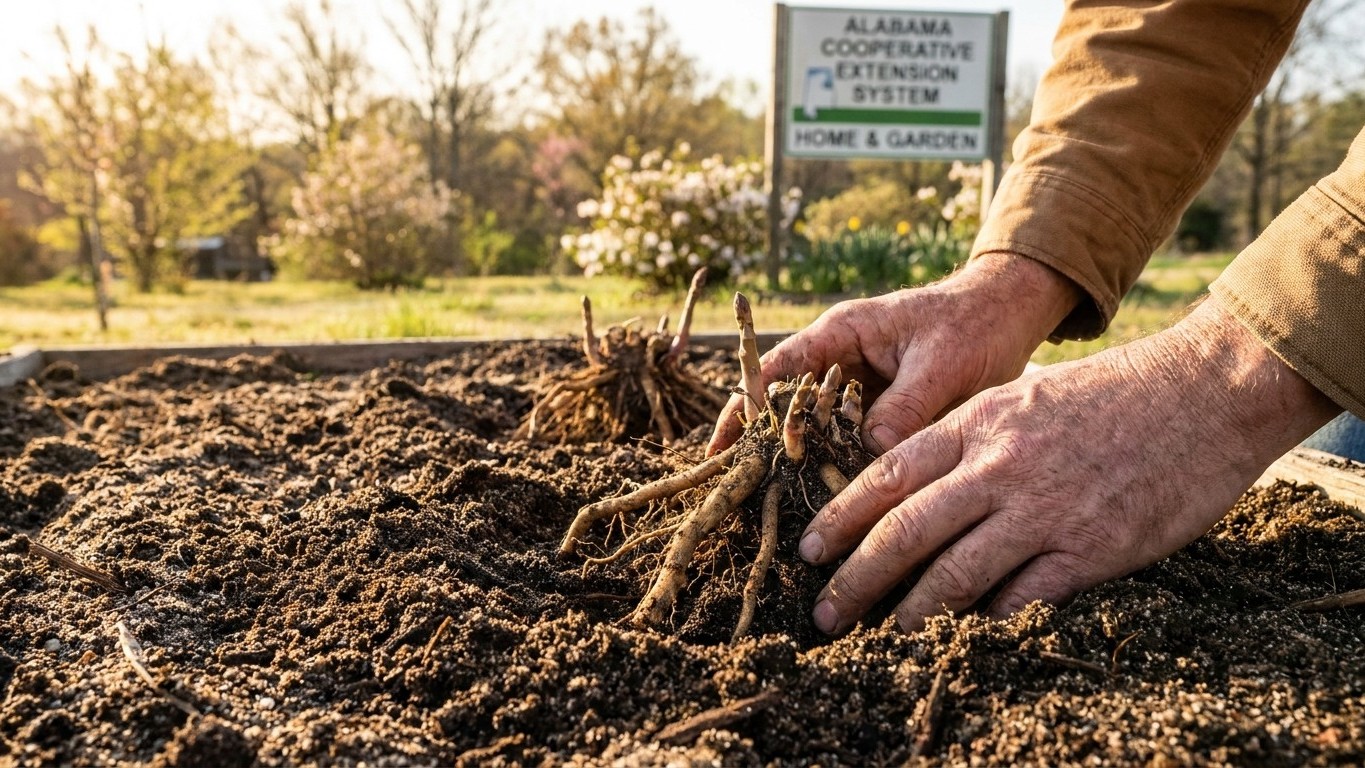

The short answer: Plant Asparagus Crowns in early spring, timed to North Dakota’s last frost window of around May 4 to May 15. Get the crowns into the ground while the soil is still cool and workable, before summer heat sets in, so the roots can settle before three years of patient waiting begin.
The short answer
Once those crowns go into the ground, the decision is largely made. Asparagus isn’t a crop you rotate or rethink next season. Utah State University Extension notes the bed produces for 10 to 15 years once it gets going, which means the spot picked this spring is the spot a household will be walking past for a decade and a half. That single fact should shape where the bed goes more than almost anything else in the vegetable garden.
The one soil requirement that source gives is blunt: the ground has to drain. Not rich, not sandy, not any particular pH, just drained. That’s where North Dakota’s own dirt becomes relevant. The soil USDA lists as representative of the state is the Williams series, a Mollisol, the kind of deep, dark prairie soil that built the Corn Belt further south and east. Its surface runs 38 percent sand, 22 percent clay, 40 percent silt, a loam-to-silt mix with organic matter around 4.0 percent and a surface pH near neutral at about 7.2. USDA classifies it as well drained.
On paper, that’s good news. A well-drained loam is close to what a fifteen-year asparagus bed wants. But the Williams series is a statewide representative sample, not a survey of any one backyard. A garden sitting in a river bottom, on a hillside with heavier clay, or on ground a builder graded and filled years ago can behave nothing like it. Standing water an hour after a hard rain, or soil that stays soggy into a second day, is the practical test. If that describes the planting site, the fix isn’t to abandon asparagus, it’s to raise the bed: a mounded or raised planting area, sometimes built up a foot or more, lets excess water shed away from the crowns instead of sitting around them.
Choosing a variety, without much to go on
Utah State University Extension names four varieties, distinguished only by their sex, with no note on flavor or yield differences published in that source.
| Variety | Type |
|---|---|
| Jersey Giant | All-male |
| Jersey Knight | All-male |
| UC 157 F1 | Male/female |
| Purple Passion | Male/female |
All-male varieties tend to put energy into spear production rather than seed production, which is why gardeners often favor them, though the source doesn’t rank them on taste or output. Whichever is chosen, the crowns still go into the same well-drained furrow this territory’s soil and the fifteen-year clock demand.
Will the summer here water it for you?
Establishing an Asparagus Bed is thirsty work for the first two years, and North Dakota’s summer sky won’t cover the whole bill on its own. The reference station used for the state’s climate normals shows about 10.0 inches of rain falling across June, July, and August, with June the wettest month at 4.29 inches and August the driest at just 2.6 inches. Utah State University Extension calls for 1 to 2 inches of water every other week during the first two years, then a lighter schedule of every three weeks once the bed is established.
- Do the math for the establishment years. An every-other-week schedule at 1 to 2 inches works out to roughly 2 to 4 inches a month. Over the three summer months that’s somewhere near 6 to 12 inches of total need, against the roughly 10 inches the summer normally delivers. On paper the totals aren’t far apart.
- Watch where the shortfall lands. The problem isn’t the seasonal total, it’s the timing. August is the driest month at 2.6 inches, exactly when heat and evaporation are highest and young crowns are working hardest to establish roots. That’s the month most likely to need a hose even in an average year.
- Ease off once the bed matures. After the first two years, the schedule stretches to every three weeks, a lighter overall demand that North Dakota’s June and July rainfall (4.29 and 3.07 inches respectively) can often cover on their own in a typical year.
- Treat the normals as a starting point, not a guarantee. These figures come from 1991-2020 climate normals at one reference station, not a forecast and not a reading from any particular yard. A rain gauge staked next to the actual bed, checked weekly through summer, is what tells a gardener whether that week needs supplemental water or not.
When to put the crowns in
Early spring is the window Utah State University Extension gives for setting crowns into 8-inch furrows, and in North Dakota that lines up with a last spring frost that falls, on average, around May 4 to May 15 at the reference weather station used for the state’s climate normals. That average date isn’t a hard line the calendar snaps to every year, it’s a mean drawn from three decades of records, so treat it as a guide for the general window rather than a promise about any single spring.
Practically, that means getting crowns into the ground as soon as the soil can be worked, often in the weeks bracketing that mid-May frost mark, rather than waiting for summer warmth. The furrow itself isn’t filled in all at once. The planting method calls for backfilling gradually across the season, adding about two inches of soil every other month as the young shoots grow, rather than burying the crown eight inches deep on day one. That gradual fill gives the emerging spears room to push upward without being smothered early.
Suburban and rural gardens away from the reference airport station often see their own last frost arrive later, sometimes by one to two weeks, and more at higher elevation. A gardener planting on the edge of a small town or out on open farmland should treat the state’s May 4 to May 15 window as a starting estimate and lean toward the later end, checking their own county’s typical pattern before breaking ground.
Seed is the alternative route, though it asks for more patience up front. Starting asparagus from seed means growing seedlings before they’re ever transplanted to the garden, adding time to an already long wait before harvest. Most home gardeners buy one-year-old crowns instead precisely to skip that extra seed-to-crown stage, since the three-year wait to first harvest is long enough on its own. Either way, whether crown or seed-grown transplant, the plant goes into the ground in that same early spring window, anchored to the region’s frost timing rather than a fixed date on the calendar.
Common questions
Can asparagus crowns handle a late frost after planting?
The source used here doesn’t publish a specific cold-tolerance figure for newly planted crowns, so no threshold number is given. What is clear is that crowns are planted in early spring precisely because they’re meant to establish before summer heat, and the practice of gradually backfilling the furrow over the season offers the emerging shoots some buffer as they push up.
How long until the first harvest?
None at all in the first two years. Utah State University Extension is specific that there’s no harvest until year three. In that third year, harvest is limited to about 4 weeks, extending to roughly 6 weeks the following year, then about 8 weeks once the bed is fully established.
How do I know when to stop cutting spears each season?
The stopping point isn’t a date, it’s a visual cue: stop harvesting once most of the spears coming up are thinner than a pencil. That signals the plant’s energy needs to shift toward growing ferns for the rest of the season rather than producing more spears.
Does soil pH matter for asparagus in North Dakota?
The source behind these planting guidelines doesn’t publish a pH requirement for asparagus, so none is given here. What is known is that the state’s representative Williams series soil runs near neutral, around 7.2 at the surface, and that the only stated soil requirement for asparagus is good drainage, not a particular acidity or alkalinity.