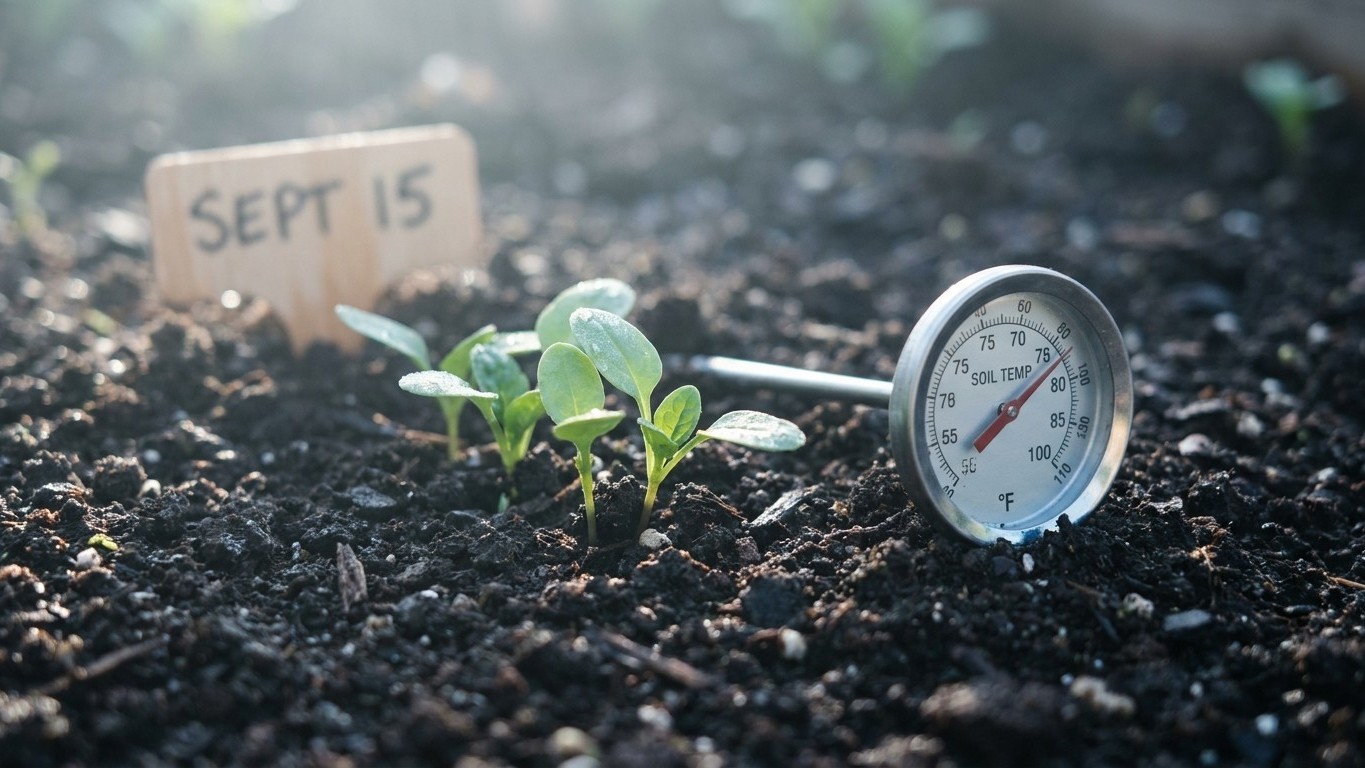

In most of Pennsylvania, autumn spinach goes into the ground somewhere between late August and late September, counted backward from the first fall frost. The exact date shifts by two to four weeks depending on where you garden in the state, and the real gatekeeper isn’t the cold at all. It’s the soil temperature in late summer.
The short answer
At the reference city for this state’s climate data, the longest day of the year carries 14 hours and 50 minutes of daylight. That number matters more than most gardeners realize, because spinach doesn’t respond to heat alone. It bolts, meaning it sends up a flower stalk and turns bitter, when days run long and temperatures climb together. A mild or cool summer in the mountains or the northern tier does not buy extra weeks of harvest if the calendar has already pushed the day length past the point where the plant switches into flowering mode. Long days push spinach toward seed production, full stop, regardless of how comfortable the air feels.
So which one actually limits the Pennsylvania grower: the day length or the heat? For the spring crop, both work against you at once, which is why spring spinach in this state has a narrow window that closes fast. For the autumn crop, the mechanics flip. Days are shortening after the summer solstice, which works in the gardener’s favor by early autumn. What blocks a September sowing isn’t day length at that point, it’s leftover summer heat sitting in the soil. Pennsylvania averages 24 days a year at 90 degrees Fahrenheit or higher, concentrated in July and August, and that heat load doesn’t vanish the moment Labor Day passes. Soil holds warmth for weeks after the air starts to cool.
That soil heat matters because spinach seed germination drops off sharply once soil temperature climbs above 80 degrees Fahrenheit. Sow into soil that’s still baking from August sun, and a meaningful share of the seed simply won’t sprout, or will sprout unevenly and weakly. So the practical answer for Pennsylvania is a two-part test, not a single date on a calendar. First, has the soil cooled enough to germinate the seed reliably? Second, does the remaining stretch of mild autumn weather, the 50 to 75 days before a hard frost ends things, give the crop enough time to reach a usable size? Get both right and you land somewhere in that late-August-to-late-September stretch, earlier if you garden in the Alleghenies or the northern counties, later if you’re gardening close to Philadelphia where frost holds off the longest.
Four named varieties commonly show up on Pennsylvania seed racks: Bloomsdale, Melody, Teton, and Olympia. Extension sources that cover this state’s fall-sowing guidance don’t publish maturity days or heat tolerance figures for any of the four specifically, so treat variety choice as a separate decision from timing rather than something that changes the sowing math below.
How long the spring window really is
Spring spinach in Pennsylvania runs on a tight, unforgiving schedule, and working through it step by step shows exactly why the window is as narrow as it is.
- Start with the last frost date. Across most of the state, the last spring freeze falls between March 29 and April 6, with the Philadelphia corner running mildest and the northern tier and the Alleghenies landing two to four weeks later than that.
- Back up two to three weeks for sowing. Spinach seed goes into the ground while frost risk is still present, so a Philadelphia-area gardener is sowing in mid-to-late March, while a grower in the state’s colder counties waits until mid-to-late April.
- Track how fast the days lengthen. Once sown, the crop is racing a clock that’s already ticking against it, since day length is climbing toward that 14-hour-50-minute peak in June, and every week that passes tips the plant closer to bolting territory.
- Watch the 75-degree ceiling. Spinach grows best where temperatures stay at or below 75 degrees Fahrenheit. In Pennsylvania, that ceiling typically gets breached repeatedly by late May or early June, well before the summer’s 24 annual 90-degree days even start piling up.
- Count the usable weeks. That leaves a spring harvest window of roughly six to nine weeks from sowing to the point where heat and lengthening days push the crop into bolting, shorter in a warm spring, slightly longer in a cool, cloudy one, but never open-ended.
The takeaway isn’t complicated: spring spinach in Pennsylvania is a sprint, not a season-long crop. That’s exactly why the autumn planting deserves its own separate calculation rather than an assumption that it mirrors spring in reverse.
The autumn crop, and when the soil lets you sow
Autumn sowing flips the spring problem on its head. Instead of racing lengthening days and rising heat, the fall grower is waiting out the tail end of summer heat while racing shortening days and an approaching frost. Two separate obstacles control the timing, and they don’t resolve on the same schedule.
Soil that’s still too warm to germinate
The first obstacle is invisible if you’re only checking the air temperature. Spinach seed germination drops once soil temperature climbs above 80 degrees Fahrenheit, and Pennsylvania soil in the first half of August is routinely sitting well above that mark, especially in full sun. With an average of 24 days a year hitting 90 degrees or higher concentrated in the peak of summer, the ground has typically absorbed weeks of heat by the time gardeners start thinking about a fall planting. The practical fix isn’t a calendar date, it’s checking the soil directly, ideally in early morning before the day’s heat builds, and waiting for a cooling trend rather than sowing on a fixed day regardless of conditions. Light mulch or afternoon shade over the seedbed can help nudge soil temperature down faster than bare, sun-baked ground would cool on its own.
The frost that ends the season
The second obstacle sits at the far end of the calculation: the first fall freeze. Across most of Pennsylvania, that date falls between November 5 and November 16, again with the Philadelphia area running latest and the northern tier and Alleghenies running two to four weeks earlier. The available guidance for a fall spinach crop calls for sowing 50 to 75 days before the date you actually want to harvest, not before the frost itself, since spinach tolerates a fair amount of cold once established and can often be harvested right up to or even after a light freeze.
Working backward from a target harvest date in late October or early November, in the Philadelphia area that puts sowing in the window running from roughly the third week of August through the third week of September, depending on whether you’re aiming for a 50-day or a 75-day crop. Gardeners in the colder northern and mountain counties should shift that entire window two to four weeks earlier, sowing as early as late July in the coldest pockets, to land a harvest before frost shuts things down. The two obstacles rarely line up perfectly. In a hot, late summer, the soil may still be too warm right when the calendar says it’s time to sow for a 75-day harvest, and the only real solution is watching the ground rather than the date on the wall.
Common questions
Can I sow autumn spinach too early in Pennsylvania?
Yes. Sowing while soil is still above 80 degrees Fahrenheit typically means poor, uneven germination, since the seed itself resists sprouting in hot ground regardless of how the air feels.
Does a cool summer in the mountains let me sow spinach earlier or later than in Philadelphia?
Cooler mountain air doesn’t change the day-length trigger for bolting, but it does mean the first fall frost typically arrives two to four weeks earlier there than in Philadelphia, so the whole fall sowing window shifts earlier to compensate.
Is there a difference in maturity time between Bloomsdale, Melody, Teton, and Olympia spinach?
These four varieties are commonly grown in Pennsylvania, but no maturity-day or performance data for any of them is published in the guidance this article draws from, so variety choice shouldn’t be treated as a substitute for checking soil temperature and counting back from your target harvest date.
Will autumn spinach survive a light frost in Pennsylvania?
The source behind this state’s fall-sowing guidance doesn’t publish a specific frost-tolerance threshold for spinach, so treat the first fall frost date as the outer boundary for planning your harvest rather than assuming the crop stops the moment that date arrives.