
The direct answer: Sow Autumn Spinach in Prince Edward Island roughly between August 3 and August 28, counting back 50 to 75 days from the average first fall frost of October 17. That’s the window Utah State University Extension’s fall planting rule gives for this territory. But the exact date within that range depends on two things working against each other: soil that’s still too warm to germinate seed well, and a frost that arrives sooner than you’d like some years.
The short answer
Prince Edward Island gets 15 hours and 36 minutes of daylight on the longest day of the year. That number matters more than most gardeners assume. Spinach bolts under long days combined with warm temperatures, and 15 hours 36 minutes is well past the point where a leafy crop starts pushing up a flower stalk instead of making leaves. A cool Island summer does not cancel this out. Day length triggers the shift on its own, independent of whether the thermometer is climbing.
Here’s where it gets interesting for PEI specifically. The station data shows zero days a year reaching 90 F at the reference point in Charlottetown. That’s about as mild a summer heat load as you’ll find on a farming map. So the usual argument, that hot summers cook spring spinach before it can be harvested, barely applies here. The Island’s problem isn’t scorching afternoons. It’s the clock, not the thermometer, that ends the spring crop.
Spinach also grows best where temperatures stay under 75 F, and that ceiling is doing double duty. It’s both a growth limit and a bitterness threshold, meaning leaves that mature past it tend to turn sharp and unpleasant even if the plant hasn’t bolted yet. With days_above_90 sitting at 0.0, PEI rarely pushes past 75 F for extended stretches in a way that would independently shut spinach down through heat stress alone. The bigger threat is that long daylight hours arrive whether or not the air is hot, and they arrive early enough in the season to end a spring planting well before summer’s warmest weeks would even be a factor.
So to be plain about it: in Prince Edward Island, the limiting factor for spring spinach is day length, not heat. The autumn crop faces a different obstacle entirely, covered below. Growers who assume a cool Maritime summer buys them extra weeks of spring spinach are working from the wrong variable. The days get long here just like anywhere else at this latitude, and that’s what closes the window, not a run of 90-degree afternoons that essentially never happens.
How long the spring window really is
Working out the usable spring stretch means stacking a few facts on top of each other rather than picking one number and calling it done.
- Start with the mean last frost. Environment and Climate Change Canada puts the average last spring frost at Charlottetown A at May 16, based on the 1981-2010 climate normals. That’s a midpoint, not a guarantee. In roughly half of all years, frost arrives later than that date, so treat May 16 as the center of a range rather than a line you can plant right up against.
- Sow two to three weeks before that date. Utah State’s guidance puts spinach sowing at two to three weeks ahead of the last frost, which lands the earliest reasonable sow date around late April to the first days of May for an Island garden going by the mean.
- Track how fast the days lengthen after that. The Island moves toward its June 21 daylight peak of 15 hours 36 minutes quickly through May and early June. Long days start pressuring spinach toward bolting well before the solstice itself, since the trigger builds gradually rather than snapping on at one specific date.
- Factor in that heat isn’t the bottleneck. With zero days above 90 F on average, there’s no scorching stretch forcing an early end the way there would be in a hotter province. The crop’s exit here is driven almost entirely by lengthening days.
- Land on the practical window. Sowing from roughly late April through the first half of June gives spinach enough cool, short-enough days to grow well before day length pushes it toward flowering. That’s a usable spring stretch of about six to seven weeks, shorter than gardeners in more southern latitudes get, but workable if you sow early and harvest promptly.
The autumn crop, and when the soil lets you sow
Fall spinach in PEI runs into a different pair of obstacles than the spring crop does, and both need separate handling.
Soil that’s still too warm
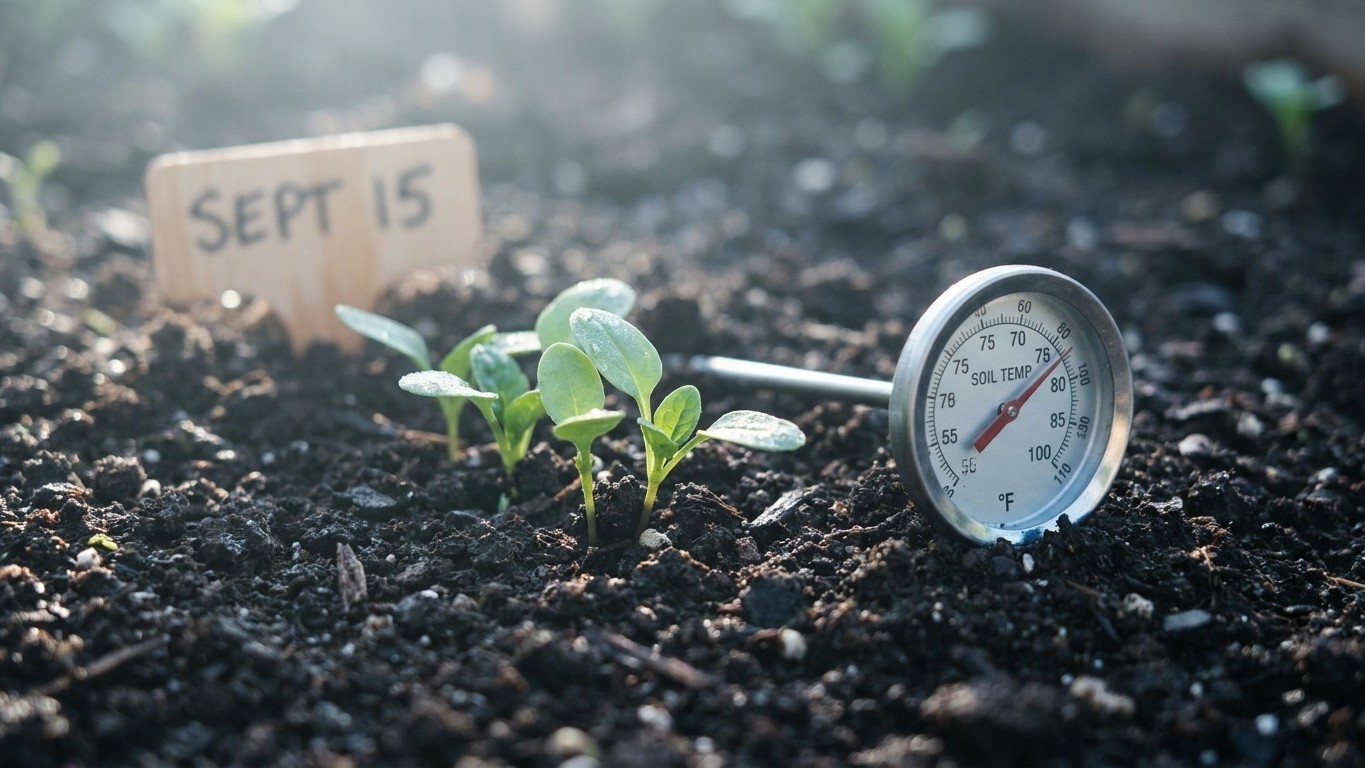
Utah State University Extension notes that spinach seed germination drops off once soil temperature climbs above 80 F. That’s the first thing standing between a gardener and a decent fall stand. In a region with a genuinely hot summer, this can push sowing well into September. Prince Edward Island’s cooler summer profile, with no days reaching even 90 F in the air, likely means soil doesn’t hold onto extreme heat the way it does farther south or inland. There’s no published soil-temperature data specific to this territory, so the exact date the ground drops back under 80 F isn’t something that can be stated as fact here. What can be said is that a cool Maritime summer gives soil less reason to stay hot deep into August, which works in the gardener’s favor for an earlier fall sowing than a hotter province would allow.
The frost that ends the season
The other boundary is the first fall frost, averaging October 17 at the Charlottetown A station. Utah State’s rule for fall spinach is to sow 50 to 75 days before the date you want to harvest. Counting back from October 17 gives a sowing window of roughly August 3 (75 days out) to August 28 (50 days out). Because the October 17 date is a mean rather than a guaranteed line, and frost arrives earlier than average in about half of all years, leaning toward the earlier end of that window, closer to the start of August, builds in some margin. Sowing right at August 28 assumes the season plays out exactly average, which is a coin flip at best.
None of the four spinach varieties commonly named in extension guidance (Bloomsdale, Melody, Teton, Olympia) come with published days-to-maturity figures from this source, so there’s no way to pin the harvest date than the 50-to-75-day range already allows.
| Season | Sowing window | What ends it |
|---|---|---|
| Spring | Late April to early June | Long daylight hours (up to 15:36) trigger bolting |
| Autumn | Roughly August 3 to August 28 | Soil warmth blocking germination early, frost (mean October 17) closing it out |
Common questions
Does a cool Prince Edward Island summer let me sow spinach later in spring?
No. The crop bolts under long daylight hours regardless of temperature, and PEI’s 15 hours 36 minutes on the longest day is enough to push spinach toward flowering on its own. The Island’s mild summer heat, with zero days above 90 F on average, doesn’t change that mechanism.
Why does warm soil matter more than air temperature for the fall sowing?
Because germination is what fails first. Utah State University Extension notes germination drops once soil hits above 80 F, so even a seed sown on a mild-aired day won’t come up well if the ground underneath is still holding summer heat.
How reliable is the October 17 frost date for planning a harvest?
It’s a mean, not a promise. Environment and Climate Change Canada’s 1981-2010 normals put it at October 17 for the Charlottetown A station, but frost falls later than that in roughly half of all years and earlier in the other half. Sowing toward the earlier end of the 50-to-75-day window gives some cushion against an early frost.
Are Bloomsdale, Melody, Teton, or Olympia better suited to Prince Edward Island’s climate?
The source naming these four varieties doesn’t publish comparative data on any of them, so there’s no verified basis here for recommending one over another for this territory.