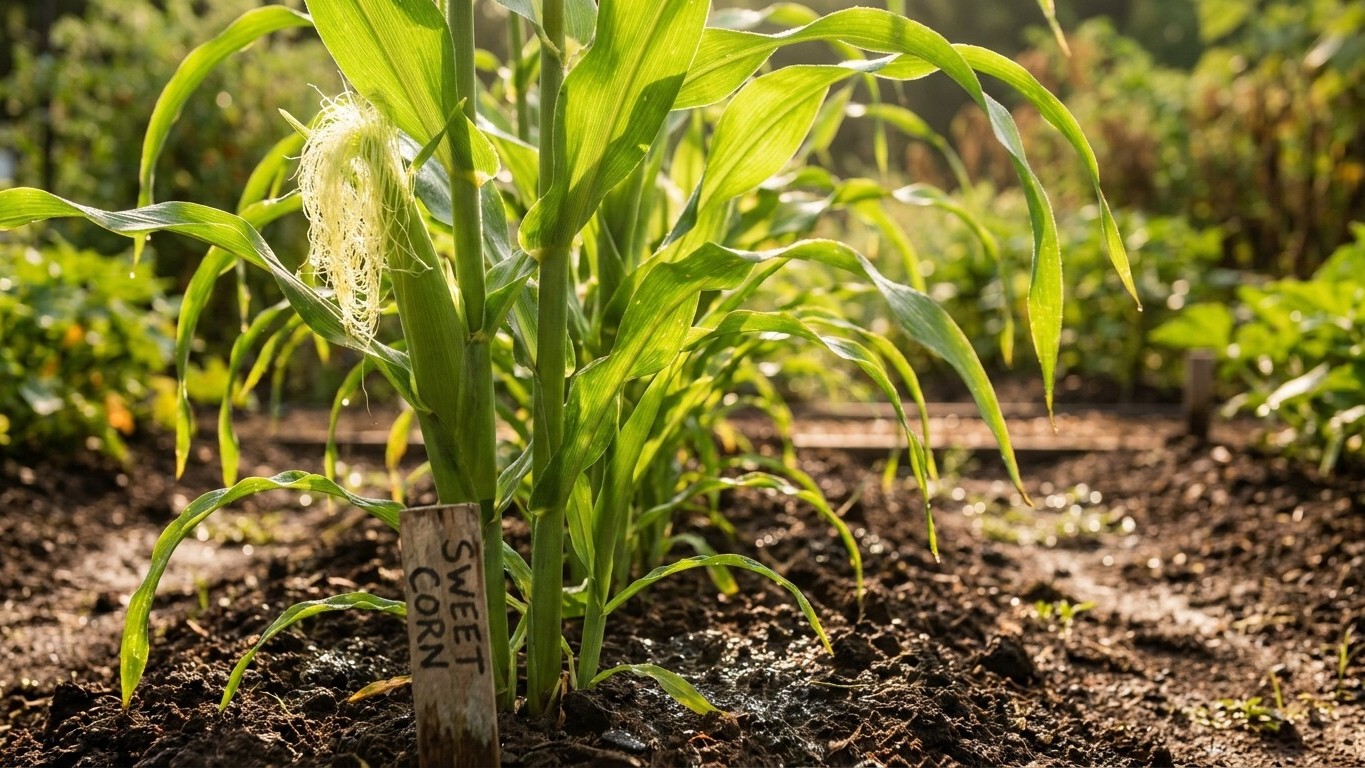

Yes, sweet corn ripens across most of South Carolina. The state’s frost-free stretch runs from late February or early March clear through late November or early December, a window wide enough to cover the crop’s 60- to 90-day life cycle several times over. The catch isn’t the calendar. It’s the soil, the variety pairing in the row, and a heat load that changes how the plant behaves once summer sets in.
The short answer
Sweet corn doesn’t care what the calendar says about frost. It cares about soil temperature, and that number lags well behind the last freeze. South Carolina’s last spring frost falls somewhere between February 28 and March 17, depending on where you sit in the state, but the ground underneath that frost-free air is still too cold to plant into. Soil needs to hold above 60 F before sweet corn seed will germinate reliably, and that threshold arrives weeks after the frost date clears, not on the same day. Treating the last frost as a green light for planting is the single most common miscalculation gardeners make with this crop here, and it costs a stand every year.
Once the soil does warm past 60 F, the math turns generous. Sweet corn needs 60 to 90 days from planting to reach maturity. South Carolina’s frost-free season, measured from that late-February-to-mid-March start through the first fall frost on November 20 to December 5, stretches roughly eight to nine months. Even after subtracting the weeks it takes the soil to catch up with the air, there’s room to plant, harvest, and often plant a second round before autumn closes the door. This is not a state where sweet corn is racing the clock the way it does farther north.
What does matter here is heat. The reference station used for these figures logs an average of 55.1 days a year at 90 F or hotter. That’s not a description of a hot afternoon here and there, it’s a measure of sustained thermal load across the growing season, and it’s the reason water demand spikes and pollen can struggle during the hottest stretch of summer. A crop that fits the calendar can still stumble if it’s tasseling during the worst of that heat run. Timing a planting to avoid peak heat during pollination matters more in South Carolina than the frost dates ever will.
The other regional wrinkle is geography inside the state itself. Peninsular Charleston sits milder than the airport station these frost dates are drawn from, while the Upstate runs several weeks tighter at both ends of the season. A planting calendar built for the coast will run early for a garden in the foothills, and the reverse holds just as true.
Does a late variety fit here?
The 60-to-90-day figure isn’t a single number, it’s a range, and where a variety falls in that range changes how it behaves against South Carolina’s calendar. A short-season type and a long-season type both fit the state’s window, but they fit it differently, and the difference matters more in years with an early heat spike or a late cold snap.
A 60-day variety
Planted once soil has cleared 60 F, a variety on the fast end of the range is finished well before summer’s hottest stretch even gets started. That gives it a wide safety margin against both a lingering cool spring and the mid-summer heat load the 90-plus-degree days represent. It also opens the door to a second planting later in the season, since 60 days leaves plenty of the calendar untouched even after accounting for the slow soil warm-up in early spring. For a gardener who wants two harvests, or who gardens in the Upstate where both frost dates run tighter, the short end of the range is the forgiving choice.
A 90-day one
A variety at the long end of the window asks more of the calendar, but South Carolina has the calendar to give. Planted after the soil has warmed, even a 90-day type reaches maturity with weeks to spare before the first fall frost arrives in late November or early December. This is not a state where the late variety runs out of runway, the way it might somewhere with a shorter frost-free stretch. The real risk with a 90-day type here isn’t the finish line, it’s the middle of the season: a long-season planting is more likely to have its tasseling period land inside the year’s hottest weeks, and that’s where the state’s heavy load of 90-degree-plus days can interfere with pollination even though the season length itself is not in question.
What goes wrong here
- Soil sown too cold. Planting on the last frost date instead of waiting for the soil to actually clear 60 F is the most frequent failure. Seed sits in cold, damp ground, rots before it germinates, or comes up thin and uneven. The fix is patience: let the frost date pass, then give the soil time to catch up before the seed goes in the ground.
- A variety pushed past what the season allows. This is rarely a South Carolina problem given how long the frost-free window runs, but it still happens when a planting goes in very late in the season, close to when the first fall frost is expected between November 20 and December 5. A 90-day variety planted too late in the year can run out of warm weather before it finishes, even in a state with this much season to work with.
- Sweetness lost because two types tasselled together. This has nothing to do with climate and everything to do with what’s planted nearby. Standard (su), sugary-enhanced (se), and supersweet (sh2) types cross-pollinate if their tassels shed pollen at the same time, and the result is starchy, disappointing corn on plants that looked perfectly healthy. The remedy is timing, not distance: stagger plantings so the types don’t tassel in the same window, and plant sweet corn in blocks of three or more rows rather than a single skinny row, since block planting improves pollination within a variety and makes it easier to manage which types are shedding pollen when.
Common questions
Can sweet corn be planted before the last frost date in South Carolina?
No. Even though the air may be frost-free, the soil typically hasn’t reached the 60 F threshold sweet corn needs to germinate. Seed planted into cold soil tends to rot rather than sprout.
Does South Carolina’s heat shorten the growing window for sweet corn?
It doesn’t shorten the calendar window, since the frost-free stretch is long enough to spare. What the state’s average of 55.1 days a year at 90 F or higher affects is water demand and pollination, particularly if tasseling lands during the hottest weeks of summer.
Is the Upstate different from the coast for timing sweet corn?
Yes. The frost dates used here come from a reference station, but the Upstate runs several weeks tighter at both the spring and fall ends, while peninsular Charleston runs milder. Adjust planting dates to local conditions rather than a single statewide number.
How do I know when sweet corn is actually ready to pick, not just planted long enough?
Look for three signs together: silks that have turned dry and brown, husks that are still moist and green, and a milky (not clear or dry) juice when a kernel is punctured. All three should show up at once before harvest, since any one sign alone can be misleading.