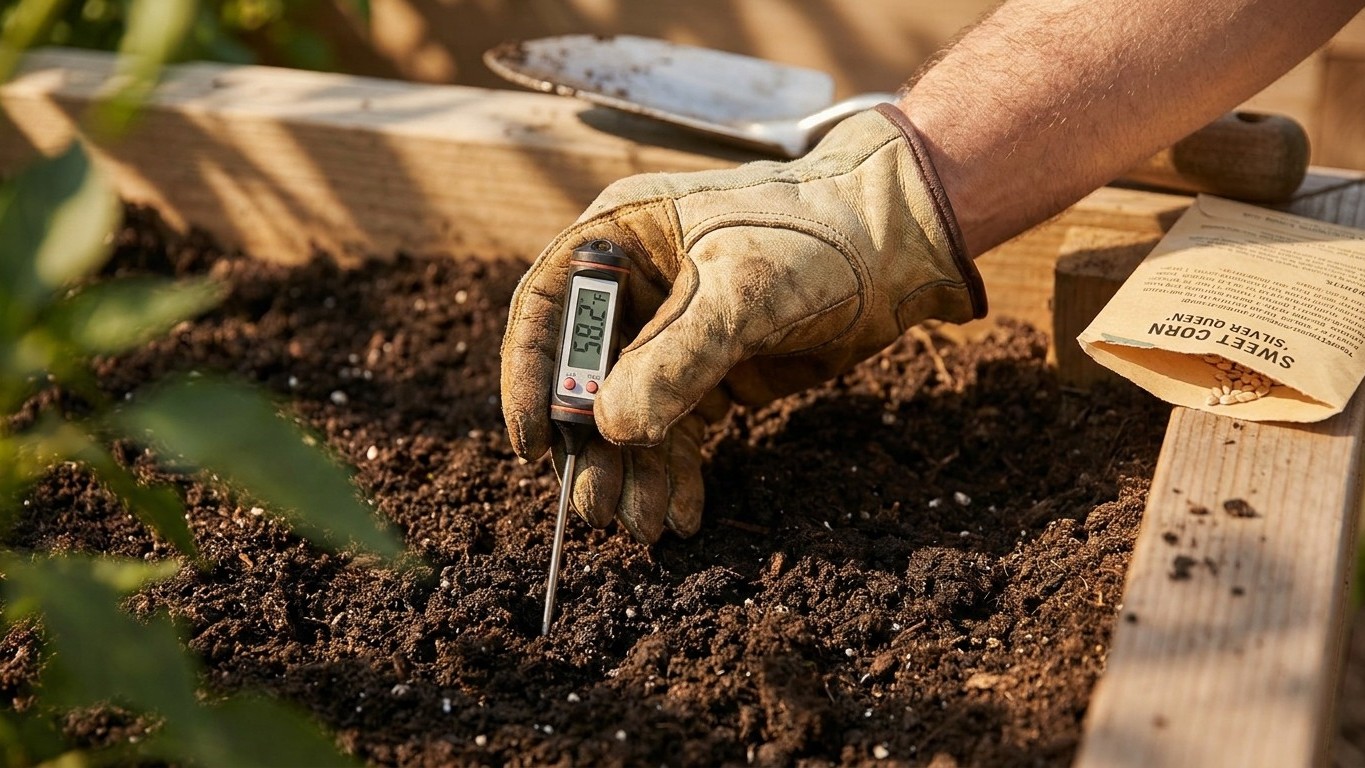

South Carolina gardeners can start sweet corn once soil reaches 60°F, a threshold that lands weeks after the last frost, not on it. From there, the state’s frost-free stretch, running from late February or March through late November or early December, leaves plenty of room for the 60 to 90 days sweet corn needs to mature, though timing still shifts by region and by how the crop handles the state’s heavy summer heat load.
The short answer
Soil warming to 60°F comes well after the last frost date, and that gap is where most planting mistakes start. NOAA’s 1991-2020 climate normals put the last spring freeze for the reference station (Charleston area, station USW00013880) between February 28 and March 17. Soil does not jump to 60°F the day frost stops. It climbs gradually over the following weeks as air temperatures stabilize and the ground itself absorbs heat, so a gardener who sows the week after the last frost is very likely planting into cold soil, whatever the calendar says.
Once that 60°F soil threshold arrives, though, the math turns generous. The first fall frost at the same reference station falls between November 20 and December 5. Stack that against a last spring frost of late February to mid-March and you get a frost-free window stretching close to nine months in the milder parts of the state. Sweet corn needs 60 to 90 days from planting to harvest, so even accounting for the delay before soil is warm enough to sow, there is room to spare in most of South Carolina. That is not the case everywhere in the state. Upstate South Carolina runs several weeks tighter at both ends, meaning both the spring wait for warm soil and the fall cutoff arrive sooner, shrinking the safe window without erasing it.
Peninsular Charleston sits on the milder end of that spectrum too. The airport station used for these normals reads colder than the immediate coastal city, so gardeners right along the harbor can often push planting a little earlier and stretch the fall harvest a little later than the raw dates suggest. Inland and upstate growers should treat the airport-based dates as closer to their own reality, or slightly optimistic, since their local frost dates likely arrive earlier in fall and linger later in spring.
The other variable worth weighing before picking a sowing date is heat, not cold. The reference station averages 55.1 days a year at 90°F or hotter. That is not a description of how hot an average summer day feels. It is a measure of sustained heat load, the kind that stresses germinating seed if soil is sown too early and warms too fast, and the kind that can interfere with pollination if tasseling lands in the thick of a July heat spell. Fitting sweet corn into South Carolina’s calendar means respecting both ends of the thermometer, not just the frost dates on a chart.
Does a late variety fit here?
South Carolina’s long frost-free stretch makes room for a range of maturity lengths, but “fits on paper” and “performs well” are not the same question. A variety’s days-to-maturity number only tells you whether the calendar has enough room. It says nothing about whether that stretch of the season lines up with the state’s heat pattern.
A 60-day variety
A fast, 60-day sweet corn is the easiest fit for this state. Planted once soil has reached 60°F, even a cautious mid-spring sowing leaves months of slack before the first fall frost in November or December. That slack is useful for more than peace of mind. It means a 60-day variety can be sown more than once, staggered a few weeks apart, and still finish well ahead of the fall frost window. For gardeners who want a longer harvest rather than one big crop all at once, the short-season type is the one built for succession planting in this climate.
A 90-day variety
A 90-day variety fits the calendar for a single spring planting almost anywhere in South Carolina. Sown as soon as soil hits 60°F, it has ample time to mature before even the earlier end of the fall frost range. Where it stops fitting comfortably is as a second, later planting. Push a 90-day type into a June or July sowing and its tasseling stage lands squarely inside the state’s heaviest heat stretch, the same window that produces those 55-plus days a year above 90°F. Pollination suffers in extreme heat, and a long-season variety sown late has no buffer left to recover a poor ear set before frost. In Upstate South Carolina, where the frost-free window runs several weeks tighter at both ends, a 90-day variety sown for anything but the earliest spring slot is pushing its luck. The plain answer: a late-maturing variety works here as a spring crop, not as a mid-summer second planting.
What goes wrong here
- Soil sown too cold. The last frost date is not a green light. Because soil takes weeks after that frost to climb to the 60°F sweet corn needs, seed sown right after the last freeze often sits in cold, damp ground and rots or germinates unevenly. The remedy is simple and does not require guessing: check actual soil temperature, not the calendar, before planting.
- A variety too late for the season it’s sown in. A 90-day type planted in early spring fits the state’s long frost-free stretch without trouble. The same variety sown in midsummer, aiming for a second harvest, runs its tasseling stage straight into South Carolina’s heaviest heat load, the 55-plus days a year at 90°F or above. Poor pollination and stunted ears follow. Save long-season varieties for the spring slot, and use a shorter-maturity type for any later planting.
- Sweetness lost because two types tasselled together. This one has nothing to do with frost or heat. Su, se, and sh2 sweet corn types cross-pollinate and lose their sweetness when they tassel at the same time, regardless of climate or region. The fix is timing, not distance: stagger planting dates so the varieties do not shed pollen in the same window, and grow sweet corn in blocks of three or more rows rather than thin single rows, which improves pollination within each block and reduces stray drift between different types.
Common questions
Can I sow sweet corn right after the last frost date in South Carolina?
Not reliably. The last frost only marks when freezing air temperatures are unlikely, not when soil has warmed enough. Sweet corn needs soil above 60°F, and that threshold arrives well after the frost date, so waiting a few extra weeks and checking soil temperature directly is the safer approach.
Is the planting window different in Upstate South Carolina?
Yes. The Upstate runs several weeks tighter at both ends of the season compared with the coastal reference station, meaning both the spring wait for warm soil and the fall frost cutoff arrive sooner. That shrinks the safe window for a second or late planting, though it still allows a well-timed spring crop.
Does the number of days above 90°F actually affect sweet corn?
It does, mainly at two moments: germination in soil that heats up too fast, and pollination if tasseling coincides with a stretch of extreme heat. With 55.1 days a year averaging 90°F or higher at the reference station, timing plantings so tasseling avoids the hottest weeks matters more in South Carolina than in cooler climates.
How do I stop two sweet corn types from losing their sweetness?
Keep su, se, and sh2 types from tasseling at the same time. Stagger the planting dates of different types so their tasseling windows do not overlap, and grow each type in its own block of at least three rows rather than a single thin row, which helps pollination stay within the intended type.
The Moon calendar is a separate, older custom: see when to plant corn by the moon, written as tradition rather than fact.