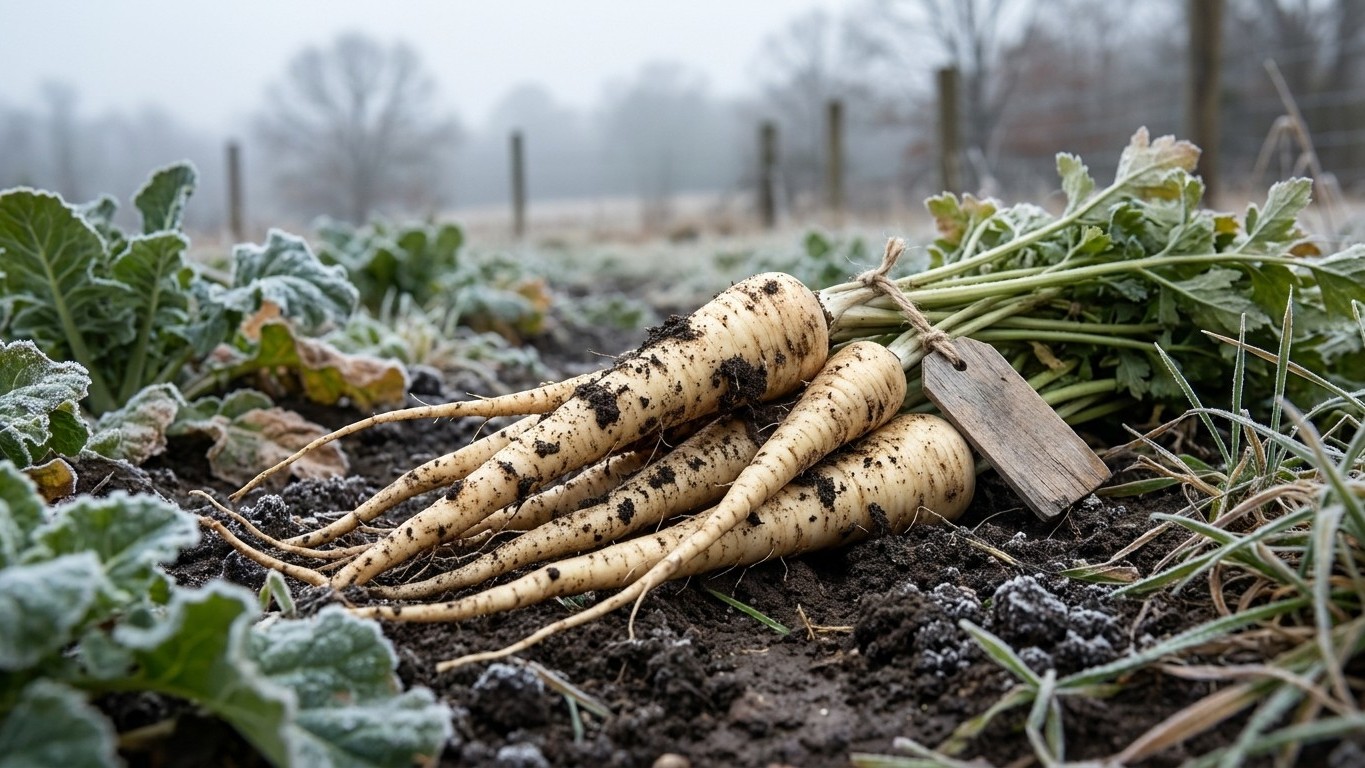

Yes, in most of Utah, parsnips will sweeten. The state’s winters bring the kind of sustained, repeated frost exposure that converts stored starch into sugar underground, and the reference climate station for Salt Lake City shows a coldest-month mean minimum of 24.2°F, comfortably below freezing for weeks at a stretch. The bigger question isn’t whether it gets cold enough, but whether the growing season leaves you a crop worth freezing.
The short answer
The question that actually decides this isn’t “how cold does it get on the worst night of the year.” It’s whether the territory delivers several consecutive frosty weeks while the roots are still in the ground and still alive. A single hard freeze does nothing for flavor. Repeated exposure over time is what triggers the starch-to-sugar conversion that makes a parsnip worth the wait.
At the Salt Lake City reference station, the mean daily minimum for the coldest month sits at 24.2°F. That’s not a record low and it’s not a monthly average pulled from a few unusually cold nights. It’s the typical low, night after night, through the coldest stretch of the year. A number that far under 32°F means frost isn’t an occasional visitor here. It’s a season-long guest that shows up reliably and stays.
For a root crop that needs that repeated chill to sweeten, this is close to ideal. Parsnips left in cold ground through several weeks of freezing nights will taste noticeably better than ones pulled early, and Salt Lake’s winter numbers suggest that window exists without much doubt. The valley isn’t flirting with frost. It’s getting the real thing, consistently, for an extended stretch.
That said, Utah is not one climate. The Salt Lake City station sits in a relatively mild valley by the state’s standards. Most of the state runs higher in elevation and colder overall, which if anything makes the sweetening process even more assured at higher ground. Southern Utah runs warmer, and gardeners there should treat the Salt Lake figures as a floor rather than a guarantee, since a milder winter narrows that frosty window the crop depends on.
So the answer splits cleanly into two parts. Will a parsnip grow here? Almost certainly, given a long enough season and reasonable soil. Will it sweeten? In the Salt Lake City area and in the colder, higher ground that makes up most of the state, the winter cold is more than adequate. In the state’s warmer southern pockets, the margin is thinner, and the crop may grow fine while never quite hitting that deep, nutty sweetness that only comes from sitting through real cold.
Does the season fit?
Parsnips are sown directly in the ground where they’ll grow, not started indoors and transplanted, and the full 100 to 120 days needed to reach maturity are counted from the day the seed goes into the soil. Here’s how that timeline lines up against Utah’s frost dates.
- Sowing window: Seed goes in 2 to 3 weeks before the last spring frost. With the last frost falling between April 12 and April 29 in the Salt Lake City area, that puts sowing somewhere in the range of late March to mid-April, depending on the specific spring.
- Germination: Parsnip seed is notoriously slow to sprout, typically taking 14 to 21 days to emerge. A gardener sowing in early April shouldn’t expect to see rows until late April or into early May, and shouldn’t dig around to check on progress before then.
- Maturity: Counting 100 to 120 days from that original seeding date, not from the day the seedlings finally show themselves, pushes maturity into mid-to-late July for an early sowing, or into August for a later one.
- Frost arrival: The first fall frost lands between October 18 and October 29. That leaves roughly two to three months of open calendar between a mature crop in July or August and the season’s first hard cold.
- The fit: This is a comfortable margin, not a tight squeeze. The roots have time to size up well before any frost risk, and then plenty of runway to sit in cooling soil through October’s first frosty weeks and beyond, which is exactly the exposure that builds sweetness.
The practical takeaway is that Utah’s frost-free window isn’t the bottleneck here. Gardeners have room to sow a little later than the earliest possible date if a wet spring delays fieldwork, and the crop will still mature with weeks to spare before the ground turns cold enough to matter for flavor.
What goes wrong here
- Forked roots from heavy or stony ground. Parsnip roots push straight down, and anything that blocks that path, compacted clay, buried rocks, or a hardpan a few inches under the surface, splits the taproot into forks. The remedy is working the bed deep before sowing, ideally double digging heavy soil to break up compaction well below where the root will reach, since amending the topsoil alone won’t fix a problem sitting a foot down.
- Forked roots from overwatering. This is a separate cause from soil texture, even though the symptom looks identical. Excess moisture, especially inconsistent watering that swings from soggy to dry, encourages the root to branch rather than grow as one straight taproot. The fix is steady, moderate watering rather than heavy soakings followed by dry spells, particularly in the first several weeks after germination.
- A season that runs out. In a garden with a genuinely short frost-free window, sowing too late leaves roots undersized when cold arrives. Utah’s frost dates give a wide enough margin that this is less of a risk than in colder states, but a late, wet spring that delays sowing by several weeks can still eat into that buffer. Sowing at the earlier edge of the recommended window, rather than waiting, protects against this.
- A winter too mild to sweeten. Parsnips can grow well in soil that never gets cold enough to trigger the starch conversion, leaving a technically fine but flat-tasting root. This is more of a concern in Utah’s warmer, lower-elevation southern areas than around Salt Lake City, where the 24.2°F coldest-month minimum suggests plenty of frost exposure. Gardeners in milder pockets of the state should leave roots in the ground as long as possible into the cold season rather than harvesting at the first sign of maturity.
Utah State University Extension also notes that parsnips prefer deep, sandy soil and that heavy ground needs to be double dug to give the root a clear path. That’s a starting point for diagnosing trouble, not a full explanation on its own, since watering habits and the timing of sowing matter just as much as what’s already in the ground.
Common questions
Can I harvest parsnips before the first frost in Utah?
You can, since the roots reach maturity well before frost given the season length worked out above, but harvesting early skips the sweetening process entirely. Leaving mature roots in the ground through several weeks of the fall’s frosty nights, rather than pulling them the moment they’re technically ready, is what produces the better flavor.
How long do parsnip seeds take to sprout in Utah?
Germination takes 14 to 21 days regardless of location, since this is a trait of the seed itself rather than the climate. Gardeners who don’t see rows after a week shouldn’t assume failure and shouldn’t dig up the bed to check; give it the full three weeks before deciding the sowing needs to be repeated.
Does soil type matter more than climate for sweetening?
No. Soil type affects root shape, mainly whether it grows straight or forks, but the sweetening itself comes from frost exposure, not from what the roots are growing in. Deep, sandy ground helps produce a well-formed root; only sustained cold turns that root sweet.
Is a comfortable hardiness zone the same as enough frost for sweetening?
No, and this is a common mix-up. A hardiness zone describes whether perennial plants survive winter there at all. Parsnip sweetening depends on a different measure entirely, the number of weeks the ground stays exposed to freezing temperatures while the roots are still in it. A mild winter can sit in a perfectly reasonable hardiness zone and still fail to deliver the frost exposure this crop needs.