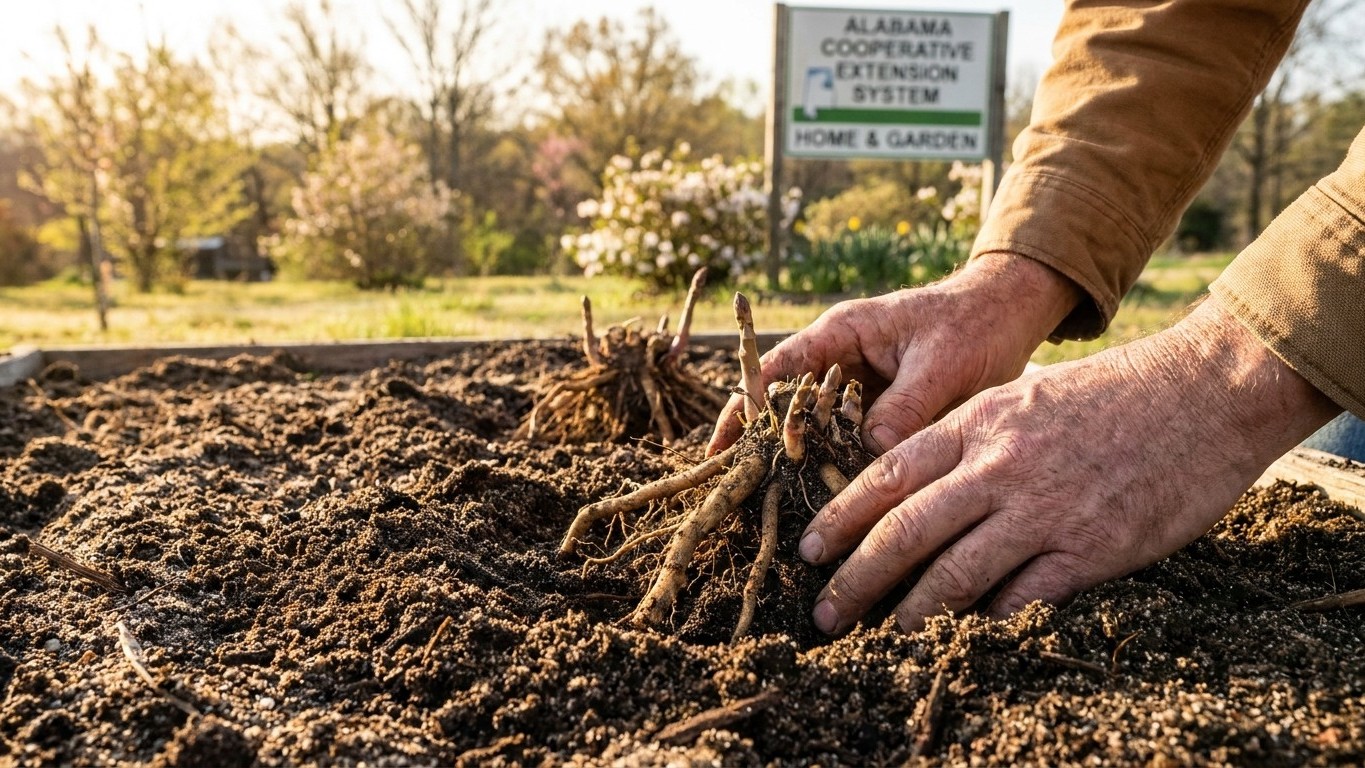

Plant Asparagus Crowns in western Washington in early spring, timed loosely to the region’s frost window of February 27 to March 18. That’s a mild date compared to most of the country, but cold, waterlogged soil often delays planting well past it. East of the Cascades, on high desert ground, the season runs on a different clock entirely, this window applies to the maritime west side only.
The short answer
An Asparagus Bed isn’t a season’s project. Once those crowns go into the ground, they’re expected to stay put and produce for 10 to 15 years, according to Utah State University Extension. That single fact should shape every decision about where the bed goes, because a soil problem you’d shrug off in a tomato patch becomes a decade-long headache in an asparagus row.
The extension’s only real requirement is drainage. Asparagus crowns rot in soil that stays soggy, and most other soil quirks, texture, fertility, even a rough pH, can be managed with amendments over time. Drainage, in a bed you won’t be digging up again, is much harder to fix after the fact.
Washington’s representative soil, the Tokul series, is an Andisol built from volcanic ash. It’s light and porous, with a surface makeup of roughly 45 percent sand, 45 percent silt and 10 percent clay, and it’s unusually good at holding onto both water and phosphorus. USDA lists it as moderately well drained, not fully well drained. That distinction matters here. Moderately well drained soil sheds water, but slowly enough that a low spot or a compacted layer underneath can turn a bed soggy in a wet spring. For a crop that has to sit in one place for over a decade, that’s a real caution flag, not a minor detail.
The same USDA data records organic matter at about 75 percent in this soil’s surface horizon. That figure is worth reading carefully: anything above roughly 20 percent organic matter usually means the mapped surface is a natural organic layer, like peat, muck or forest litter, not the kind of worked, cultivated topsoil a home gardener digs into. A backyard bed that’s been tilled, mulched and grown in for years will not carry anywhere near that number. The surface pH listed for this soil, about 4.5, is strongly acid, but that’s a property of the mapped series itself, not a target number for asparagus, and no pH requirement for the crop is published in the source used here.
None of this is a verdict on any one garden. The Tokul series describes what USDA maps as representative of Washington generally, not the ground behind a specific house. If a soil test or a simple percolation check (dig a hole, fill it with water, see how fast it drains) shows water sitting for more than a few hours, the practical fix is to raise the bed. A mounded row or a framed raised bed lifts the crowns above the slow-draining layer without requiring anyone to fight the native soil for the next fifteen years.
Will the summer here water it for you?
Asparagus beds have a fairly specific thirst. Utah State University Extension’s guidance calls for 1 to 2 inches of water every other week during the crop’s first two years while it establishes, tapering to roughly the same amount every three weeks once the plants are mature. Washington’s summer rainfall doesn’t come close to covering that on its own, especially where it matters most.
- Total summer rainfall runs light. NOAA’s 1991-2020 climate normals for the reference station put combined June, July and August rainfall at about 3.0 inches, over three full months, not per week.
- July is the dry month. Broken down, June averages 1.45 inches, July drops to just 0.6 inches, and August recovers slightly to 0.97 inches. July alone falls far short of even a single “every other week” watering cycle.
- The first two years need the most attention. At 1 to 2 inches every other week across a 13-week summer, an establishing bed could need somewhere in the range of 6.5 to 13 inches of water over the season. Actual rainfall of about 3 inches leaves a substantial gap that has to come from a hose, drip line or sprinkler.
- Established beds need less, but still more than the sky delivers. Once a bed matures past year two, the every-three-weeks schedule eases the burden, but July’s 0.6-inch average still won’t meet it without supplemental water.
- A rain gauge on the actual plot settles it. These are long-term averages for one reference station, not a forecast and not a guarantee for any specific yard. A rain shadow, a slope, or a spot too close to pavement can push real numbers well below the normal, so tracking actual rainfall at the bed itself is the only way to know exactly how much to add.
When to put the crowns in
Crowns go into the ground in early spring, once soil can actually be worked, not necessarily right at the last frost date, and not held back until it feels warm. Western Washington’s mean last spring frost falls somewhere around February 27 to March 18, based on NOAA’s 1991-2020 climate normals for the reference station. That’s an average drawn from three decades of data, not a promise for any single year, so “around” is the operative word rather than a fixed calendar day.
What actually holds gardeners back here isn’t frost. It’s the ground itself. Cold, waterlogged soil and the region’s low late-winter light can delay planting well past the point when the frost risk has technically passed. Waiting for soil that’s dry enough to dig and warm enough to work is usually the better guide than counting days from a frost date on a chart.
Once the ground is ready, Utah State University Extension’s method is to plant crowns in furrows about 8 inches deep. The furrow isn’t filled in all at once. Soil gets backfilled gradually over the course of the year, roughly 2 inches every other month, rather than dumped back in on planting day. That gradual fill lets the developing crown push upward without being buried too deep too soon.
Seed is the other route, though it adds a full extra year to the timeline before crowns are even ready for the ground. Most home gardeners skip it for that reason and start with purchased crowns instead. No flavor difference, yield advantage, or reason to favor one over another is published in that source, so any claim beyond the sex of the plant isn’t something this guide can back up.
Whichever variety goes in, the harvest clock doesn’t move faster for anyone. No spears get cut in year one or year two, full stop, the bed needs that time to build root reserves. Year three brings the first harvest, limited to about 4 weeks. Year four stretches to 6 weeks, and year five reaches 8 weeks. After that, the cue for stopping each season isn’t a date on the calendar at all — it’s the spears themselves. When most of what’s coming up is thinner than a pencil, harvest ends for the year, regardless of what week it happens to be.
If you follow the almanac, here is when to plant asparagus by the moon. It is a tradition, not a proven method.
Common questions
Can I Plant Asparagus Crowns in Washington in fall instead of spring?
The guidance used here is specific to early spring planting. Fall planting isn’t addressed in this source, so there’s no verified basis for recommending it as an alternative timing.
Does Washington’s soil need lime before planting asparagus?
The state’s representative soil, the Tokul series, does carry a strongly acid surface pH around 4.5, but that figure describes the mapped soil series, not a target range for the crop, and no adjustment recommendation is published here.
How long until an Asparagus Bed in Washington actually produces spears to eat?
Three full years pass with no harvest at all. The first cutting, in year three, runs about 4 weeks, followed by 6 weeks in year four and 8 weeks in year five, after which the bed can keep producing for 10 to 15 years total.
What if my yard’s soil doesn’t drain as well as the Tokul series described for Washington?
Given how long an Asparagus Bed stays in place, standing water is the one problem worth solving before planting rather than after. A simple percolation test tells the story quickly, and where drainage is questionable, raising the bed with a mound or a framed structure sidesteps the issue without requiring the native soil to change.