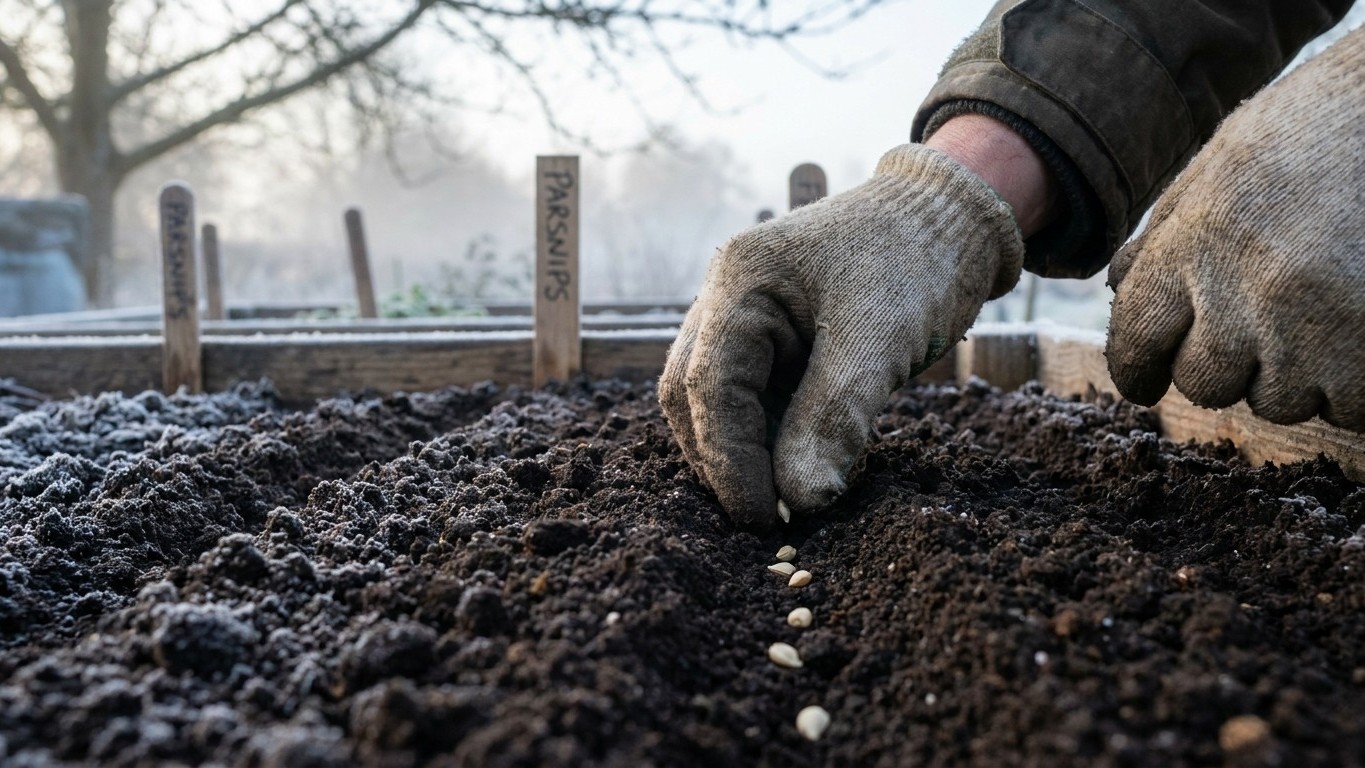

Late March through early April is the sweet spot for sowing parsnips in West Virginia, timed two to three weeks ahead of the last spring frost. The state’s cold winters and reliably frosty valleys mean a parsnip left in the ground through fall doesn’t just mature here, it sweetens.
The short answer
The question that actually decides this isn’t which USDA zone appears on a seed packet. It’s whether this particular ground gets cold enough, for long enough, to trigger the starch-to-sugar conversion parsnips are known for. In the Charleston reference station, the mean daily minimum temperature for the coldest month sits at 26.1°F, according to NOAA NCEI Climate Normals covering 1991 to 2020. That’s not a record low or a monthly average pulled from a single cold snap. It’s the typical overnight low across the coldest stretch of the year, and it sits well below freezing.
That number matters because parsnips don’t sweeten from cold soil alone. They sweeten from repeated exposure to frost, week after week, as the roots sit in the ground and convert stored starch into sugar. A single light freeze does almost nothing. A mild winter, even one that never technically kills the plant, can leave a parsnip crop that grew perfectly well but never develops that trademark sweetness gardeners grow the vegetable for in the first place.
West Virginia’s river valleys, Charleston among them, clear that bar with room to spare. A coldest-month average minimum of 26.1°F means multiple weeks of nights well below the freezing point, not a marginal dip that flirts with 32°F and retreats. That’s the kind of sustained cold parsnips need. Higher elevations across the state run colder still, and freeze earlier in the fall, which only reinforces the pattern rather than working against it.
So the short answer holds up under scrutiny: a parsnip sown in West Virginia ground will get its frost exposure. The climate here doesn’t just permit growth, it delivers the cold snap the crop is counting on. The remaining question isn’t whether the frost shows up. It’s whether the calendar lines up so the roots are mature and ready to receive it, which is a separate calculation involving sowing dates and the length of the frost-free season.
Does the season fit?
- Start with the sowing window. Parsnips go into the ground direct, not transplanted, and the recommended timing is two to three weeks before the last spring frost. NOAA NCEI’s 1991-2020 climate normals put West Virginia’s last spring frost, using the 32°F threshold at station USW00013866, somewhere between April 9 and April 23. Counting back two to three weeks from that range lands sowing dates roughly between mid-to-late March and early April, depending on how early or late spring behaves in a given year.
- Add the germination lag. Parsnip seed is slow. Expect 14 to 21 days before anything breaks the soil surface, according to Utah State University Extension. That’s not a delay in growth, it’s simply how long the seed takes to sprout, so a gardener checking at day 10 and seeing bare dirt hasn’t failed. The clock for the 100 to 120 day maturity period still starts at seeding, not at emergence.
- Count forward to maturity. From an earliest sowing near mid-to-late March, 100 days lands near late June and 120 days lands in mid-July. From a later sowing near early April, 100 days lands in mid-July and 120 days lands in early August. Either way, roots reach full size well before autumn arrives.
- Check that against the first fall frost. NOAA NCEI’s same climate normals put the first fall freeze, again at station USW00013866, between October 18 and November 1. That leaves a wide gap, often ten weeks or more, between when roots finish sizing up in midsummer and when the first frost even arrives.
- Read the fit. This is not a tight squeeze. West Virginia’s frost-free season runs comfortably longer than the 100 to 120 days parsnips need, and the surplus weeks do double duty: they give the crop time to finish growing and then leave plenty of room to sit in cooling soil, absorbing the frosty weeks that build sugar, well before the ground freezes hard.
Charleston’s river-valley setting also tends to run milder and later into fall than the state’s higher elevations, which freeze noticeably earlier. Gardeners working land in the mountains should expect that first frost, and the cooling that comes before it, to arrive somewhat ahead of the valley dates above.
What goes wrong here
- Forked or split roots from heavy or stony ground. Parsnip roots push straight down, and anything that blocks that path, compacted clay, rocks, hardpan, forces the root to divide around the obstruction. Utah State University Extension recommends deep, sandy soil and notes that heavy ground needs to be double dug before sowing, loosened well beyond the top few inches so the taproot has a clear, unobstructed run.
- Forked roots from overwatering. This is a separate cause from soil texture, and it’s easy to conflate the two. Inconsistent or excessive watering, soaking dry then flooding wet, encourages the root to branch rather than run straight, even in soil that isn’t particularly heavy. Steady, moderate moisture through the growing season keeps the root growing in one direction instead of several.
- Sowing too late and running the season short. Because the 100 to 120 day clock starts at seeding, not at germination, a sowing pushed past early April eats directly into the buffer between maturity and first frost. West Virginia’s frost-free window is generous, but it isn’t infinite, and a late start narrows the margin for roots to size up before cool weather sets in.
- Digging too early and missing the sweetening. A root pulled the moment it reaches size, before any real frost exposure, will be edible but bland. Given how far ahead of the first fall frost most West Virginia parsnip crops finish maturing, the fix here is patience: leave roots in the ground through several frosty weeks rather than harvesting on the first day they look ready.
The Moon calendar is a separate, older custom: see when to plant parsnips by the moon, written as tradition rather than fact.
Common questions
Can parsnips be transplanted instead of direct sown?
No. Parsnips are sown in place, directly where they’ll grow to maturity. The long taproot doesn’t tolerate the disturbance of transplanting well, which is part of why the 100 to 120 day timeline is counted from the seeding date rather than from any later stage.
Why hasn’t anything come up after two weeks?
That’s normal. Parsnip seed germinates slowly, typically 14 to 21 days according to Utah State University Extension. Checking before that window closes and finding bare soil isn’t a sign of failure, it’s simply how the seed behaves.
Does a mild winter ruin the crop?
It doesn’t ruin the root’s growth, but it can blunt the flavor. Sweetening depends on sustained exposure to frost, not on the plant simply surviving. West Virginia’s coldest-month average minimum of 26.1°F suggests the valleys get the sustained cold parsnips need, but a genuinely mild winter anywhere would leave roots that grew fine but never developed much sweetness.
Should mountain gardeners use the same dates as Charleston?
Not exactly. Charleston sits in a river valley, and NOAA’s climate normals note that higher elevations across the state freeze noticeably earlier in the fall. Gardeners at elevation should expect their frost dates, both spring and fall, to arrive somewhat earlier than the Charleston-based ranges given here.