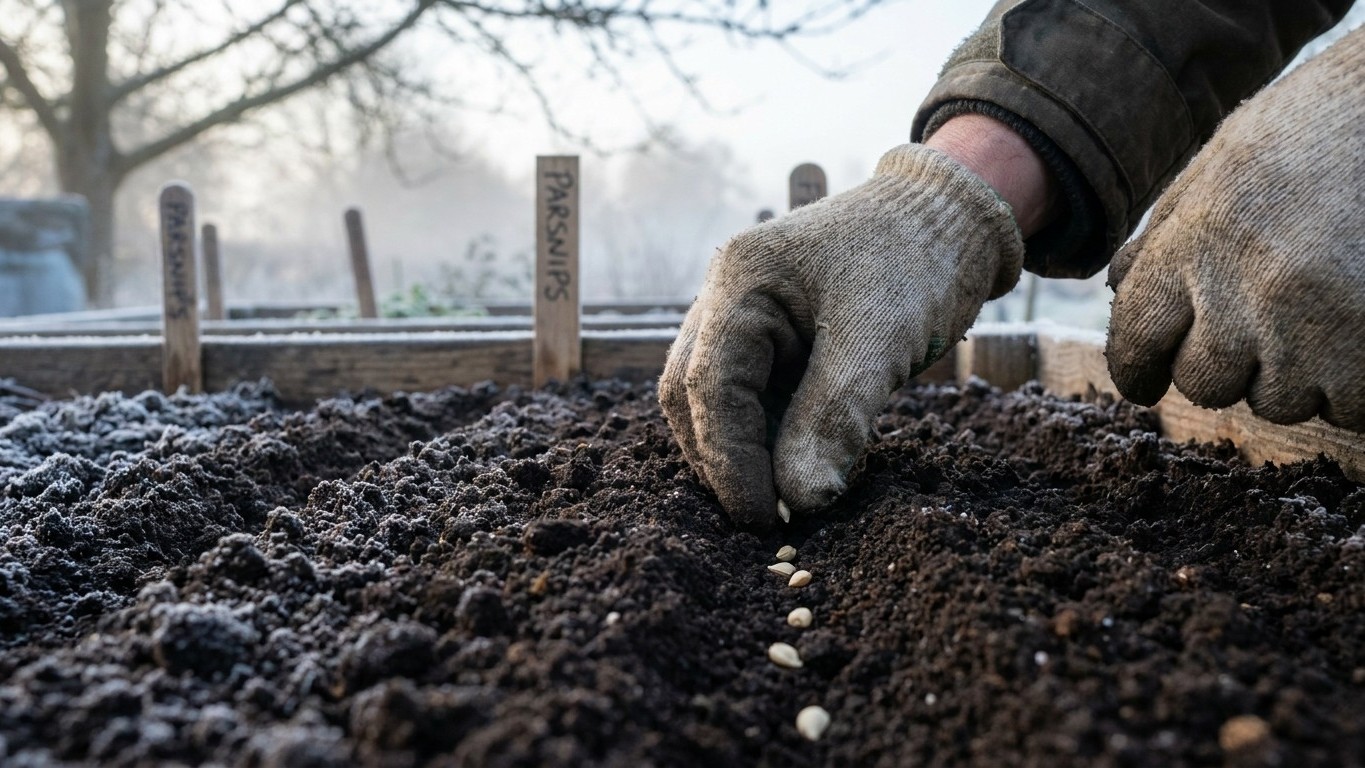

Sow parsnip seed directly in the ground from late March through mid-April across southern Wisconsin, roughly two to three weeks ahead of the last spring frost, which arrives between April 16 and April 29 depending on where you garden. Northern counties push that window later. Seeds take 14 to 21 days to germinate, so don’t panic if the row looks empty for a while.
The short answer
Everything about whether a Wisconsin parsnip turns out sweet or just turns out edible comes down to one number: how cold the coldest month actually gets, not what hardiness zone map you’ve glanced at. The reference station in Milwaukee logs a mean daily minimum of 17.2°F for the coldest month, using NOAA NCEI’s 1991-2020 Climate Normals. That figure describes an average low, night after night, across the depth of winter, not a single record cold snap and not a fuzzy zone label.
That distinction matters more than most gardeners realize. A hardiness zone tells you whether a perennial plant survives winter dormant in the ground. Parsnips aren’t asking that question at all. What they need is weeks of exposure to genuinely cold, frosty conditions late in the growing season, cold enough to trigger the root to convert its stored starch into sugar. A state can sit in a mild hardiness zone and still fail to deliver that conversion if the frost exposure never gets deep or long enough. Wisconsin doesn’t have that problem.
With a coldest-month average minimum sitting at 17.2°F, this state delivers repeated, sustained frost exposure well beyond the threshold parsnips need. That’s a real winter, not a token frost or two. Left in the ground through fall and into the first hard cold snaps, Wisconsin-grown parsnips get the sustained chill that pulls sugar out of starch and turns a merely edible root into the sweet, nutty vegetable parsnip fans actually want.
So the short answer holds up on both counts. Sow early enough to give the crop its full 100 to 120 days, and Wisconsin’s winter will finish the job the calendar started. The frost here isn’t marginal or borderline. It’s the kind of sustained cold exposure the crop was built around, and gardeners who leave roots in the ground into late fall, rather than pulling them the moment they size up, are the ones who taste the difference.
Does the season fit?
Parsnips need 100 to 120 days counted from the day you sow, according to Utah State University Extension, and that clock includes the slow 14 to 21 day germination stretch, not just the growing time after seedlings appear. The question for any territory is simple: does the stretch between last spring frost and first fall frost give that clock enough room to run. Here’s how the arithmetic works out for Wisconsin.
- Start date: sow two to three weeks before the last spring frost. With last frost falling between April 16 and April 29 depending on location, that puts sowing somewhere between late March and mid-April for most of the state.
- Germination lag: add 14 to 21 days before seedlings even break the surface. A late-March sowing might not show visible rows until mid-to-late April. This isn’t a failed planting, it’s just how slow parsnip seed is.
- Maturity window: count forward 100 to 120 days from the sowing date, not from germination. A sowing in late March to mid-April reaches maturity somewhere in July through mid-August.
- Frost-free season length: the stretch from last spring frost (April 16-29) to first fall frost (October 17-29) runs roughly 171 to 197 days across the state, well beyond the 100 to 120 days the crop requires.
- Buffer for sweetening: because maturity lands in mid-summer while the growing season stretches into late October, roots can stay in the ground for weeks after they’ve technically matured, soaking up the frosty weather that sweetens them, before you ever need to harvest.
That last point is the real payoff of Wisconsin’s long shoulder season. The crop doesn’t just squeak by here. It matures with room to spare, then sits through autumn’s cooling soil and the first frosts of the season, banking the sugar conversion Utah State University Extension describes. Comfortable fit, not a tight one.
What goes wrong here
- Forked roots from heavy or stony ground. Wisconsin gardens often sit on clay-heavy or rock-laced soil that stops a taproot cold and sends it splitting sideways. Utah State University Extension recommends deep, loose, ideally sandy soil, and says heavy ground needs to be double dug before sowing, breaking up compaction a foot or more deep so the root has a clear path down.
- Forked roots from overwatering. This is a separate cause from soil texture, and it’s easy to conflate the two. Saturated soil, especially after heavy rain or overzealous watering early in the season, can also cause the root to split or branch. Even in loose, well-worked soil, keep moisture even rather than soaked, watering deeply but letting the top inch dry between waterings.
- Bare-looking rows dug up and re-sown too soon. Parsnip seed germinates slowly, 14 to 21 days, and an impatient re-sowing after a week or two of nothing usually just doubles the seed cost without fixing anything. Mark the row, note the sowing date, and wait out the full three weeks before assuming failure.
- Sowing outside the window. Waiting past mid-April in southern counties, or sowing too early into cold, wet soil that rots seed before it germinates, both push maturity later than the frost-free season can absorb. Stick to the two-to-three-week-before-last-frost window and let the long season do the rest.
- Pulling roots too early. Wisconsin’s cold is plenty for sweetening, but only if the roots are still in the ground when the frosty weeks hit. Harvesting the moment a parsnip looks full-sized, rather than leaving it through several fall frosts, skips the starch-to-sugar conversion entirely and leaves you with a bland root despite a climate built to sweeten it.
Common questions
Can I sow parsnips directly after the last frost instead of before it?
You can, but you’ll lose part of the buffer that makes Wisconsin’s season comfortable rather than tight. Sowing two to three weeks before the last frost date takes advantage of parsnip seed’s tolerance for cool soil and gives the 100 to 120 day clock the earliest possible start.
Should I wait to harvest until after the first fall frost?
Yes, if you want the sweetness Utah State University Extension describes. Roots that mature in summer can simply stay in the ground through Wisconsin’s fall frosts, since the frost-free season here runs well past the crop’s maturity window, giving the roots weeks of cold exposure before you pull them.
Why hasn’t anything come up three weeks after I sowed?
That’s normal, not a failure. Parsnip germination runs 14 to 21 days under good conditions, and cool spring soil in Wisconsin can push that toward the slower end. Hold off on re-sowing until you’re past the three-week mark.
Does the north of the state need a different sowing date than the south?
Yes. The last spring frost and first fall frost dates used here (April 16-29 and October 17-29) come from a single reference station, and Wisconsin’s north typically freezes earlier in fall and later in spring than the south or the lakeshore. Adjust the sowing window a bit earlier in spring accordingly, and expect a shorter buffer before the first fall frost the farther north you garden.
Some gardeners also time this by the Moon: when to plant parsnips by the moon, as almanac tradition rather than fact.