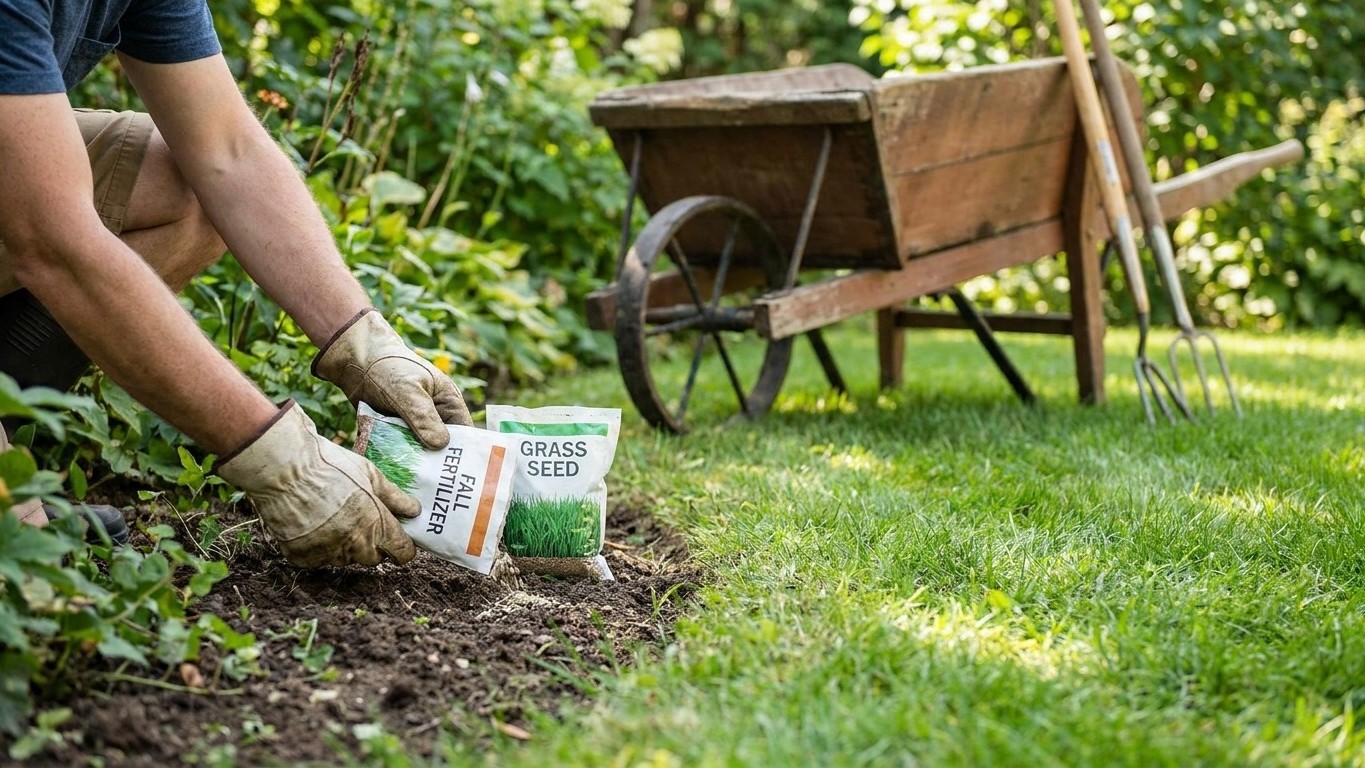

Quebec grows cool-season lawns, full stop. The province’s winter minimums run far too cold for warm-season turf to survive, so the grass that belongs here is Kentucky bluegrass, tall fescue, perennial ryegrass, or a blend of fine fescues. Feed that lawn in fall, not spring, and mow it high through summer. Skip anything sold as a warm-season blend at the garden center and put your seed money into a cool-season mix instead.
Which grass belongs in Quebec

Start with summer, because it’s the smaller half of the story. At Montréal/Pierre Elliott Trudeau Intl A, Environment and Climate Change Canada’s 1981-2010 normals count an average of just 2.8 days a year reaching 32°C, and 9.3 days a year above 30°C. That’s a warm summer, not a hot one, and it rules out any grass bred to thrive in true heat. It does not, on its own, rule out much: plenty of cool-season species handle a handful of warm days a year without complaint.
Winter is what actually decides the matter. The same ECCC normals put the mean daily minimum of the coldest month at Montreal at -14.1°C (6.7°F). That figure is not a record low, it’s the average nightly floor across the whole coldest month, year after year. A grass like bermudagrass or zoysia, both suited to milder winters, simply does not come back from a season with that kind of cold running through it every night. There’s no hedging to do here: Quebec sits squarely in cool-season territory, and the choice is which cool-season species suits your yard, not whether to plant one.
The species that hold up here
Clemson Cooperative Extension’s HGIC 1214 factsheet, together with Penn State Extension’s work on cool-season species, names the grasses that are built for this kind of winter. Quebec’s cool-season list matches other cold provinces such as Saskatchewan, where Saskatchewan Lawn Care: What to Plant and When to Feed It covers the same species for the same reason: brutal winter minimums leave only one family of turf standing.
- Kentucky bluegrass: forms a dense, self-repairing sod through underground rhizomes, but wants full sun and steady moisture.
- Tall fescue: deep-rooted and tolerant of drier stretches, the workhorse choice for a lawn that gets moderate care.
- Perennial ryegrass: germinates fast, often used to fill in a new lawn while slower bluegrass establishes underneath.
- Fine fescues: the shade specialists of the group, useful under trees where bluegrass thins out.
- Rough bluegrass: tolerates wet, shaded, low-traffic spots that the others struggle with.
Most Quebec lawns do best on a blend rather than a single species, pairing bluegrass for density with a fescue for drought tolerance and shade cover. A packet of pure perennial ryegrass looks tempting because it comes up fastest, but on its own it won’t carry a lawn through a Quebec winter the way a bluegrass-fescue mix will.
When to seed or sod here
Clemson Cooperative Extension’s HGIC 1203 factsheet sets the general rule: warm-season grasses go in around May, and cool-season grasses go in during mid to late September. Since Quebec is cool-season country, that September window is the one that applies, and it lines up well with the local calendar. Environment and Climate Change Canada’s 1981-2010 normals put the average first fall frost at the Montreal/St-Hubert A station at October 5, which gives a seeded lawn roughly three to four weeks of mild fall weather to root in before real cold sets in.
Why that window moves
Treat October 5 as a midpoint, not a deadline. It’s a mean date, which means in one year out of two the first frost actually falls later than that, and in the other half it falls earlier. Seed sown in the first half of September has the most cushion. Seed sown any later is racing a frost date that could arrive on schedule or could sit two or three weeks out, and there’s no way to know in advance which year you’ve got.
The far north of the province and any higher ground away from the St. Lawrence lowlands will run behind the Montreal-area date, sometimes by weeks, so a September seeding there needs to happen earlier in the window rather than later. Spring seeding is possible too, but it competes with weed germination and summer heat stress before the roots are established, which is why fall is the season Clemson and most cool-season growers favor. Sod can go down later than seed, since it arrives already rooted, but it still needs several weeks of open ground and mild temperatures to knit into the soil before frost locks things up.
The feeding calendar that fits this climate
Nitrogen timing follows the grass, not the month on the wall. A cool-season lawn does most of its root growth in fall, which is why the main feeding falls in September, not in spring the way a lot of homeowners assume. A warm-season lawn would be fed in late spring instead, but that calendar doesn’t apply to a cool-season yard, so ignore any fertilizer schedule built around a May application.
Where the exact numbers come from
Clemson Cooperative Extension’s HGIC 1219 tall fescue maintenance calendar lays out a split-application schedule measured in pounds of actual nitrogen per 1,000 square feet, tied to the tall fescue growing season specifically. Because rates depend on the nitrogen analysis printed on the bag and on what a soil test says the lawn already has, the calendar is the place to read the actual split rather than guessing at a number that might not fit your soil. What matters more than the exact figure is the sequence: the fall applications carry the season, with a smaller feeding in early spring to green the lawn up and nothing heavy going down in the heat of summer, when a cool-season lawn is under stress and quick to burn from excess nitrogen.
Skipping the September feeding and compensating with a heavier spring dose is the single most common mistake homeowners make with a cool-season lawn. It pushes soft top growth right before summer stress hits, instead of building the root reserves that get the grass through winter and back up strong the following spring.
Mowing height and watering here
Cool-season lawns are mowed taller than warm-season turf, and a taller cut is what keeps the roots shaded and the crown cool through a warm Quebec summer. A bluegrass-fescue blend does best kept in the upper end of its range rather than scalped short, since a taller blade shades out weed seedlings and holds soil moisture longer between waterings. Whatever height you settle on, follow the one-third rule: never remove more than a third of the blade in a single cut, or the grass spends its energy recovering instead of building roots.
Watering through a Quebec summer
An inch a week, including rainfall, is the common figure for a cool-season lawn in active growth. What changes it here is the combination of a relatively humid St. Lawrence lowland summer with only a handful of truly hot days. On a heavier clay soil, common across much of the lowlands, that inch can be applied in one deep soak and hold for the week. On sandy or fast-draining ground, the same inch needs splitting into two waterings or the lawn will show drought stress before the week is out. Humid stretches also mean the lawn dries slower after rain, and watering on top of that instead of waiting for the soil to breathe is what invites fungal trouble.
What goes wrong on lawns in Quebec

The problems that show up here follow directly from the climate, not from lawn care in general. A humid summer stretch, especially one that stays warm and damp overnight, is exactly the condition that brings on brown patch in tall fescue. The grass doesn’t die, it just needs air movement and a break from evening watering to recover.
Dormancy, salt, and snow mold
A dry spell in the warmer part of summer can push a cool-season lawn into dormancy, and a dormant lawn looks brown and lifeless even though the crown is alive underground. Resuming normal rainfall or watering usually brings it back green within a couple of weeks, so resist the urge to reseed a lawn that’s simply gone dormant. Long snow cover through a Quebec winter can also leave matted, moldy patches once the snow melts, a symptom known as snow mold, which usually rakes out and regrows on its own once the lawn dries and starts actively growing again.
Road salt used for winter de-icing is a real and specific problem for lawns along driveways and streets in this province, showing up as a dead strip of turf that follows the exact path of salt spray or runoff. Lawns further south face a different failure mode entirely, and Indiana Lawn Care: What to Plant and When to Feed It covers a transition-zone lawn that has to tolerate both winter cold and real summer heat in the same year, a trade-off Quebec’s cool, short summers never force on a homeowner here.
Local help
A soil test is the fastest way to stop guessing at fertilizer rates and lime needs, and Quebec’s Ministère de l’Agriculture, des Pêcheries et de l’Alimentation du Québec (MAPAQ) is the place to start for testing and for advice tailored to your part of the province. Local conditions along the St. Lawrence lowlands, the Eastern Townships, and further north differ enough that a province-wide recommendation only goes so far, and MAPAQ can point you toward more local guidance from there.
Common questions
Can I grow zoysia or bermuda grass in Quebec if I baby it through winter?
No, not reliably. Montreal’s mean coldest-month minimum of -14.1°C, per Environment and Climate Change Canada’s 1981-2010 normals, is well past what those warm-season species survive, and no amount of mulching or covering changes a nightly average like that across a whole month.
Why did my new grass seed germinate but then thin out over winter?
Seed sown too late in September doesn’t get enough weeks to build a real root system before frost, especially since Environment and Climate Change Canada’s October 5 average first-frost date at the Montreal/St-Hubert A station is a midpoint, not a guarantee, and can arrive earlier in a given year. Thin, shallow-rooted seedlings are the ones most likely to heave out or die back over winter.
Is it worth fertilizing in spring at all?
A light spring application to green the lawn up is fine, but it should stay smaller than the fall feeding described in Clemson’s HGIC 1219 tall fescue calendar. Heavy spring nitrogen pushes soft growth right before summer stress and disease pressure peak, which is the opposite of what a cool-season lawn needs.
My lawn turned brown in August. Is it dead?
Almost certainly not. A cool-season lawn browning in a dry August stretch is usually dormant, not dead, and it typically greens back up within a couple of weeks once regular rain or watering resumes. Digging up a plug to check for a white, firm crown underneath the brown blades is a quick way to confirm it’s still alive.
Do I need to reseed every year?
Not if the lawn is thick and healthy. A well-fed cool-season lawn on a fall nitrogen schedule fills in bare patches on its own through rhizome spread, especially with Kentucky bluegrass in the mix. Overseeding is worth doing where traffic, shade, or winter damage has thinned things out, not as a routine annual chore.