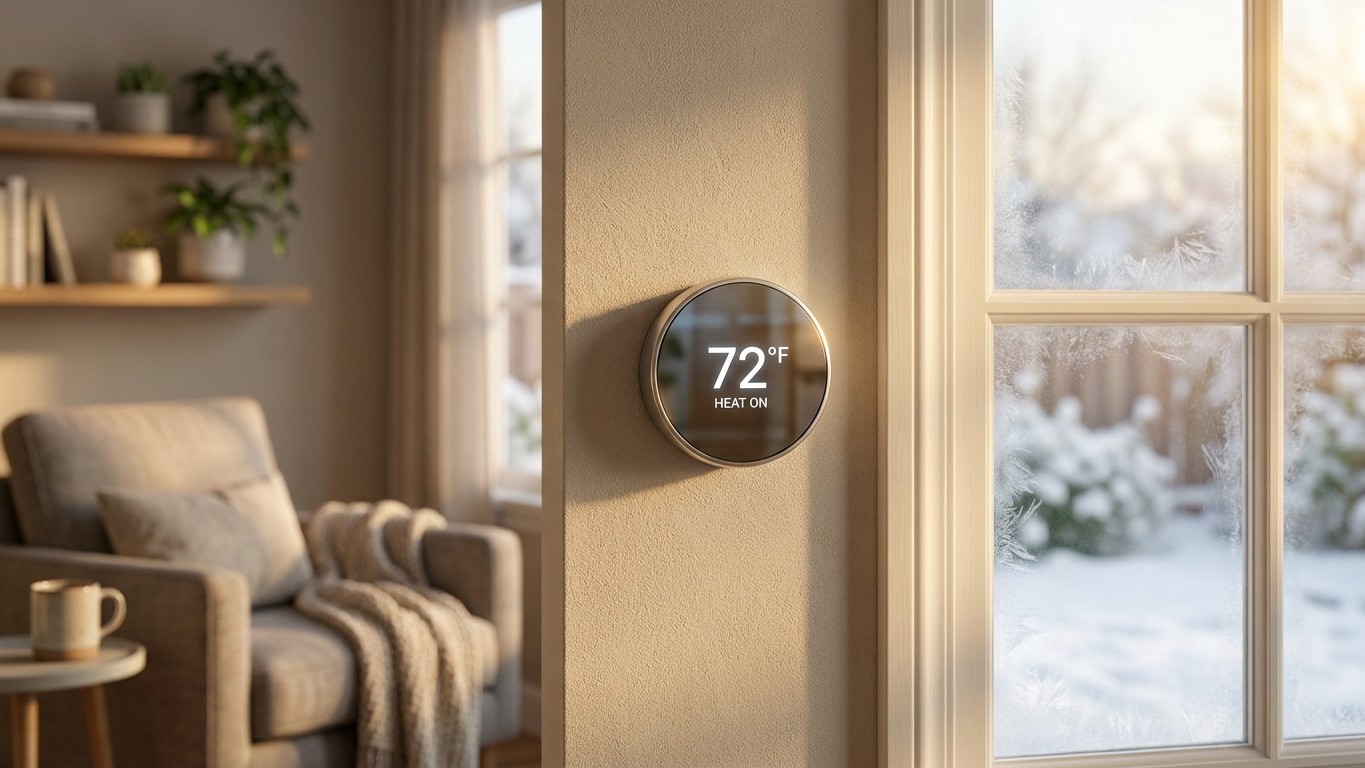

A heat pump Thermostat behaves differently because the equipment behind it works differently. Pushing the temperature down at night and recovering it in the morning, the classic setback trick that saves money with a furnace, often costs more with a heat pump. The reason: recovery speed. Ask a heat pump to climb several degrees quickly and it calls on its backup heat source, the most expensive way to warm a house. A shallow setback, or a Thermostat built to manage recovery intelligently, avoids that trap.
A different machine needs a different control
A furnace makes heat. A heat pump moves heat that already exists, pulling it from outside air (or ground, in geothermal setups) and concentrating it indoors. That single distinction explains almost every quirk homeowners notice once a heat pump replaces a furnace.
Moving heat is a slow, steady process. A heat pump is built to run for long stretches at a gentle output, not to blast a room warm in ten minutes. That’s actually how it earns its efficiency: low, continuous output uses far less electricity per unit of heat delivered than a short, intense burn. Compressors like consistency. Long, moderate cycles keep the refrigerant loop working near its sweet spot, and the whole system spends less energy per degree of comfort delivered.
The complication shows up when the house needs heat faster than the heat pump alone can supply it. That happens on the coldest days, when outdoor temperatures drop and the amount of heat available to move shrinks, and it happens any time the indoor temperature has fallen well below the setpoint and needs to climb quickly. In both cases, the system reaches for backup heat, usually electric resistance coils, sometimes a separate furnace in a dual-fuel setup. That backup heater makes heat the old-fashioned way, converting electricity directly into warmth with no efficiency multiplier. It works. It’s also the most expensive heat in the house.
This is the entire reason a heat pump needs a Thermostat that understands it. A standard Thermostat only knows one instruction: call for more heat until the setpoint is reached. It has no concept of “gently” or “not yet, let the compressor handle this.” Left unmanaged, it will trigger backup heat every time the gap between current and target temperature looks too wide, exactly the situation a setback schedule creates twice a day.
Auxiliary heat and emergency heat
Two labels appear on nearly every heat pump thermostat, and mixing them up is one of the most common ways homeowners quietly inflate their electric bill. Both refer to the backup heat source, but they mean opposite things.
| Label | What it means | When it activates | Should you select it manually? |
|---|---|---|---|
| Auxiliary heat (AUX) | The system has decided the heat pump alone can’t keep up and is supplementing it with backup heat | Automatically, during steep recovery or very cold outdoor temperatures | No. It’s a status indicator, not a setting you choose |
| Emergency heat (EM HEAT) | The heat pump is shut off entirely and only the backup heater runs | Only when manually selected by the homeowner | Only if the heat pump itself is broken or being serviced |
Auxiliary heat is the system talking to itself. It’s a normal, built-in response, and seeing that indicator light up occasionally on a frigid morning isn’t a malfunction. It becomes a problem only when it lights up constantly, which usually points to an oversized setback, a thermostat that recovers too aggressively, or a heat pump that’s undersized or losing capacity.
Emergency heat is a different animal entirely. Selecting it tells the thermostat to stop calling the heat pump altogether and run only the backup heater, full time, for every degree of warmth in the house. It exists for one situation: the compressor has failed, is frozen, or is otherwise out of commission and a technician hasn’t arrived yet. Used that way, for a day or two while waiting on a repair, it’s a reasonable stopgap.
Used because the house “feels slow to warm up” or because someone assumes it means “extra heat, faster,” it’s a costly mistake. Emergency heat means the efficient half of the system is switched off. Every hour it runs, the house is being heated entirely by resistance coils, at a fraction of the efficiency a working heat pump would provide. Homeowners who flip that switch during a cold snap and forget to flip it back can watch a single billing cycle jump sharply, with no fault in the equipment at all, just a setting left in the wrong position.
Why the usual setback advice backfires here
The U.S. Department of Energy states plainly: “You can save as much as 10% a year on heating and cooling by simply turning your thermostat back 7-10 F for 8 hours a day from its normal setting.” That figure is real, it’s well documented, and it applies broadly to home heating and cooling as a category. It is not a promise specific to any one type of equipment, and it was never framed as one.
The catch is what happens during recovery, the period right after the setback ends, when the thermostat has to climb those 7 to 10 degrees back up. With a furnace, that recovery is fast and stays efficient throughout, since a furnace burns fuel at roughly the same efficiency whether it runs for ten minutes or two hours. With a heat pump, recovery from a deep setback asks the compressor to close a wide gap quickly, and a wide, fast gap is exactly the condition that triggers auxiliary heat. The thermostat sees the house far below setpoint, decides the heat pump alone won’t close that gap fast enough, and brings in the resistance coils to speed things along.
Once that happens, some or all of the overnight savings gets spent again, at a worse exchange rate, during the recovery. In some cases the auxiliary heat runs long enough that the setback ends up costing more than simply holding a steady temperature all night would have. This isn’t the DOE figure being wrong. It’s describing a savings mechanism that assumes a heating system where recovery speed doesn’t carry an efficiency penalty. A heat pump paired with unmanaged backup heat is precisely the case that general figure doesn’t cover.
The practical fix isn’t to abandon setbacks, it’s to change how they’re done. A shallow setback, just two or three degrees rather than a full 7 to 10, closes a smaller gap during recovery and is far less likely to summon the backup heater at all. The other option is a thermostat built for heat pumps specifically, one that ramps the recovery gradually, starting the climb earlier and more slowly rather than waiting until the last minute and forcing a fast catch-up. Some of these systems also track outdoor temperature and adjust recovery timing so the compressor alone can usually finish the job before backup heat is even considered.
What to look for in the thermostat itself
A generic thermostat wired into a heat pump system will often work, in the sense that the house gets warm. What it won’t do is manage that warmth efficiently, and it may run the backup heater far more than necessary without ever showing that it’s happening. That gap stays invisible until the bill arrives. A thermostat built for the job closes that gap in four specific ways.
- It understands the reversing valve. A heat pump switches direction to heat in winter and cool in summer using a reversing valve, and the thermostat needs to control that switch correctly rather than treating the system like a simple furnace-and-AC pair.
- It controls auxiliary heat as its own stage. Rather than treating backup heat as just “more heat,” the thermostat should manage it as a distinct stage with its own thresholds, calling it only when the heat pump genuinely can’t keep pace, not as a default response to any gap.
- It offers adaptive or intelligent recovery. This means the thermostat calculates, based on past performance and outdoor conditions, when to start warming the house so it reaches the target temperature gradually, using the compressor alone whenever possible.
- It shows when auxiliary heat is actually running. A visible indicator, whether a light, an icon, or a status message, lets the homeowner see in real time that backup heat has kicked in, rather than discovering it only as a spike on next month’s statement.
That last point matters more than it sounds. Most homeowners never think to check for an auxiliary heat indicator, and most generic setups don’t make it easy to find even if they wanted to. A thermostat that surfaces this information turns an invisible cost into something a homeowner can actually respond to, adjusting the schedule, switching to a shallower setback, or simply confirming that a particular cold snap justified the extra help. Any work beyond checking settings, such as opening the thermostat’s wall plate or the equipment’s control board, calls for cutting power at the breaker first and photographing the wire terminals before disconnecting anything, so a technician (or the homeowner) can restore the connections exactly as found.
Common questions
Does Turning the heat down at night still save money with a heat pump?
It can, but only with a shallow setback, typically a couple of degrees rather than the deeper 7 to 10 degree range. Small setbacks reduce overnight energy use without forcing a fast recovery that triggers backup heat.
Is it normal to see the auxiliary heat light come on sometimes?
Yes, occasional activation during very cold weather or after a temperature swing is expected. It becomes a concern only when it happens constantly or during mild weather, which suggests the setback, schedule, or equipment sizing needs a second look.
Should emergency heat ever be used as a regular winter setting?
No. Emergency heat shuts off the heat pump completely and relies only on resistance backup heat, which is far less efficient. It should be used only when the heat pump itself is not working and a repair is pending.
Can a regular, non-heat-pump thermostat be installed on a heat pump system?
Sometimes it will technically function, but it typically can’t manage the reversing valve or auxiliary heat stages correctly, which often means backup heat runs more than it should, quietly raising electric costs without any visible warning on the thermostat itself.