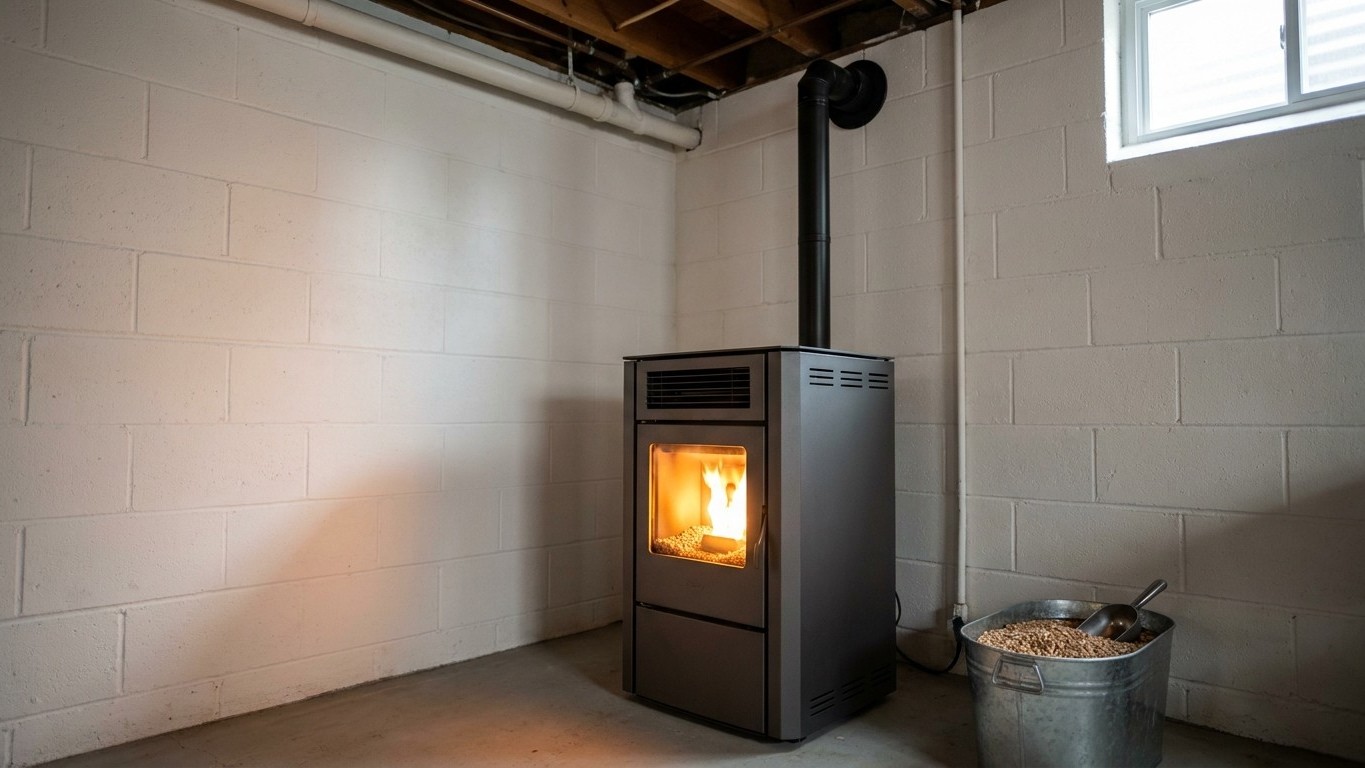

A pellet stove can heat a basement effectively, but the basement itself changes the equation. The concrete floor and block walls that make installation easy also change how heat moves, how combustion air gets pulled in, and how the vent has to be routed. Get those three things right, and a basement stove can quietly become the most efficient heat source in the house. Get them wrong, and you’ve got a warm basement and a cold living room.
Why it appeals, and what it assumes

Basements sell themselves as pellet stove locations. There’s a bare concrete floor that needs no protection from radiant heat or stray embers. There’s usually an exposed rim joist or foundation wall close to grade, which makes venting to the outside simpler than cutting through two stories of finished living space. And there’s room, real room, for a pallet of fuel to sit through a Midwest winter without crowding a garage or mudroom.
What a basement installation quietly assumes is that heat rises and finds its way to where people actually live. That’s only half true. Heat does rise, but it rises through whatever path offers the least resistance, and in most houses that’s not a tidy staircase leading straight to the living room. It’s gaps around plumbing chases, the stairwell itself, and whatever floor register or open door happens to be nearby. The basement gets warm first and warm the fastest. The floor above gets some of that heat, conducted up through subfloor and joists. Rooms at the far end of the house, especially anything upstairs, may get very little unless the house already has decent air circulation between floors.
What the stove itself is doing
The mechanics matter here because they explain both the heat output and the running cost. According to the U.S. EPA, “the pellets are poured into a hopper, which automatically feeds into the stove.” That auto-feed, along with the blower that pushes heat into the room, means the appliance isn’t passive like a wood stove radiating heat by proximity. It’s actively distributing warm air, which is exactly why placement inside a basement matters so much. A stove that could easily heat a small ranch house from a central great room may struggle to project heat two floors up from a basement corner.
The EPA notes that “EPA-certified pellet stoves usually fall into the 70-83% efficiency range, while heating capacities range from 8,000-90,000 Btu per hour.” That’s a wide spread, and the right capacity for a given basement depends on square footage, Insulation, and how much of the house the stove is expected to carry versus supplement. A dealer or the appliance’s own rating label, not a generic rule of thumb, is the place to size that decision. It’s also worth remembering that these units aren’t self-sufficient in a power outage: the EPA points out that “pellet stoves need an electrical supply to work because they use motorized components to feed the fire and blow out hot air,” which matters for anyone counting on a basement stove as backup heat during a storm.
Combustion air and the vent run
A basement is often the tightest, most sealed part of a house, especially in newer construction where foundation walls are insulated and any drafts have been sealed off during finishing work. That’s good for energy bills, but it means a pellet stove installed down there is drawing combustion air from a space that wasn’t built to supply it. Pellet stoves burn efficiently in part because they manage that air supply closely, but they still need a reliable source, and a sealed basement can end up starving for it or pulling air from unintended places, like a furnace flue or bathroom exhaust fan.
The vent itself has its own basement-specific challenge. Unlike a main-floor installation where the flue often runs straight up through the roof, a basement stove typically vents horizontally through the rim joist or foundation wall to a termination point above grade. That run has to clear windows, decks, walkways, and anything flammable, and it has to maintain proper pitch and length so the appliance drafts correctly. None of this is a guess-and-check job. Outside-air kit requirements, minimum vent lengths, elbow limits, and termination clearances are appliance-specific and governed by local code, so the two documents that actually answer these questions are the manufacturer’s installation manual for that specific stove and the requirements on file with the local building or code enforcement office. A contractor who installs pellet stoves regularly will already know which combination of kit and vent run satisfies both.
Clearance and upkeep don’t change because it’s a basement
Some homeowners assume a basement’s unfinished, utilitarian feel means the usual safety margins can be relaxed. They can’t. The U.S. Fire Administration is direct about this: “keep anything that can burn at least 3 feet from all heat sources including fireplaces, wood stoves, radiators, space heaters or candles.” That applies just as much to a basement full of storage boxes, holiday decorations, and scrap lumber as it does to a living room. Basements are exactly the kind of space where clutter accumulates near a heat source without anyone noticing.
Maintenance is the other piece that doesn’t get a basement discount. The EPA is specific that “pellet stoves need to be regularly cleaned to ensure that the stove runs efficiently and safely,” and adds that owners “should have your stove professionally cleaned at least once a year.” The U.S. Fire Administration echoes that from the chimney side, advising to “maintain heating equipment and chimneys by having them cleaned and inspected each year by a professional.” A basement location makes access easier for that annual visit, since there’s usually no furniture or finished flooring to protect, but it doesn’t reduce how often the appliance needs attention. Fuel quality plays into that maintenance cycle too: the EPA notes that “pellets can differ significantly in how well they’re made and how well they burn,” and that lower-quality pellets “may provide less heat and create a fine dust,” while better ones “tend to burn cleaner and produce less ash.” Buying by weight and price alone, without any attention to how a bag performs, tends to show up later as more frequent cleanings.
The problem that pays for itself
Here’s the upside that doesn’t get mentioned enough: a warm basement is a drier basement. Basements stay damp largely because cold surfaces let humid air condense, and because cold, still air holds onto moisture instead of letting a house’s ventilation carry it away. Running a pellet stove down there raises the ambient temperature and keeps air moving via the stove’s blower, both of which work against the musty, damp feeling that plagues so many unfinished basements. It’s not a substitute for fixing an actual water intrusion problem, but for a basement that’s damp from poor air circulation rather than a leak, added heat is a real, measurable improvement.
The flip side of that same coin is what a cold, uninsulated basement is doing to the rest of the house’s heating bill. A significant share of a home’s total heat loss happens through an uninsulated foundation and rim joist, the band of framing where the house sits on the foundation wall. That’s often the leakiest, least-insulated few inches of the entire structure, and it sits right at the level where a basement pellet stove would be installed. Heating a basement without addressing that loss is a bit like filling a bathtub with the drain half open: the stove works, but a chunk of its output is escaping through gaps and cold surfaces the moment it’s produced.
This is where a basement installation and basement Insulation work become the same project rather than two separate ones. Sealing and Insulating the basement walls and addressing the rim joist before or alongside a stove installation means more of the heat that stove produces stays where it’s generated, and more of it makes it upstairs instead of leaking straight back out through the foundation. Homeowners who install a pellet stove in an already-insulated basement tend to report needing less fuel to hit the same comfort level than those who install into a bare, uninsulated one, simply because there’s less heat loss competing with the stove’s output.
Common questions
Will a basement pellet stove heat the whole house?
It depends on the house’s layout and how open the path is between floors. A basement stove sized and placed well can supplement or even carry a small, open-plan house, but homes with closed floor plans, multiple stories, or long hallways away from the stairwell often need the basement stove paired with another heat source for the far rooms.
Does a basement installation need its own outside air source?
Most basements are tight enough that an outside-air kit is worth discussing with an installer, since the appliance’s manual and the local code office set the actual requirement for that specific model and that specific vent run.
Can a pellet stove run during a power outage?
No, not without a backup power source. The EPA notes that pellet stoves rely on motorized components to feed pellets and circulate heat, so a loss of electricity stops both functions even if there’s fuel in the hopper.
How often does a basement pellet stove need professional service?
At least once a year, same as any other location. The EPA recommends annual professional cleaning for the stove, and the U.S. Fire Administration recommends the same annual cleaning and inspection schedule for the venting and chimney system.