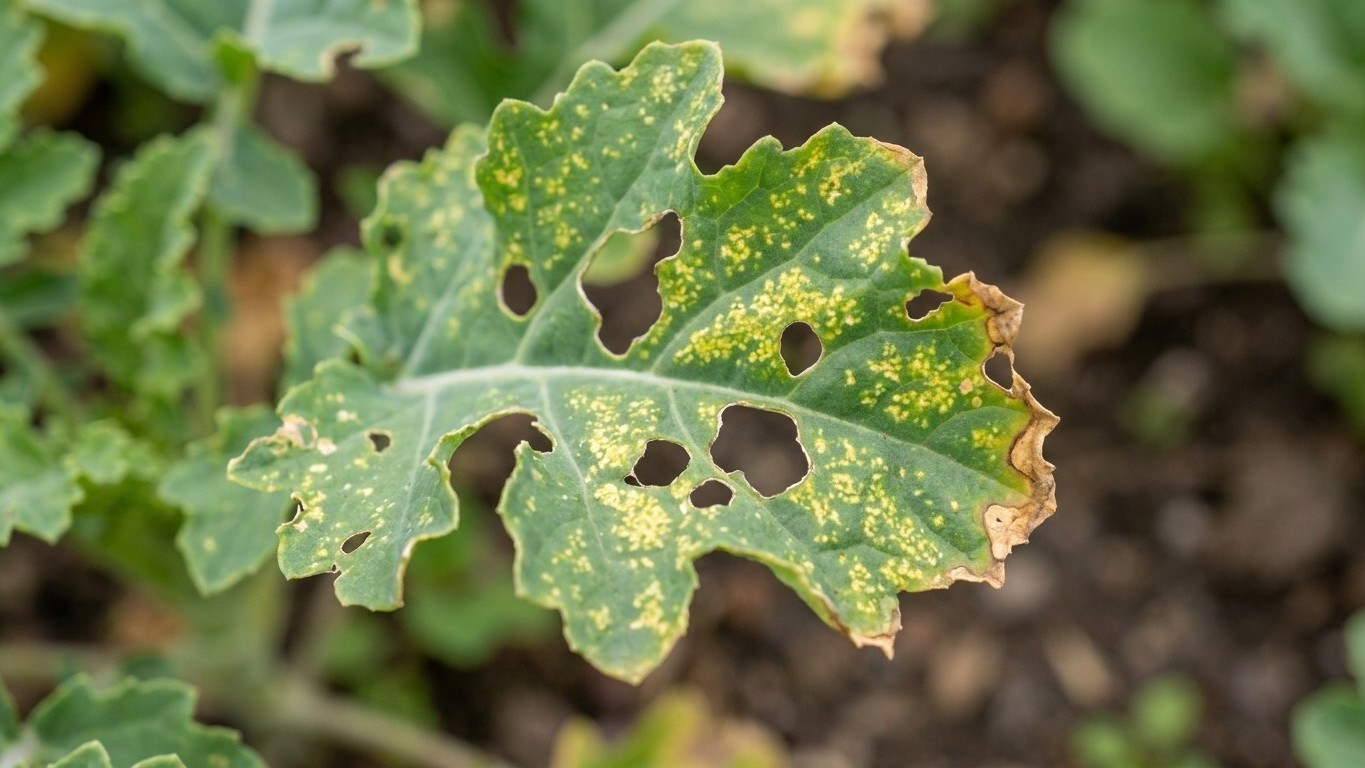

Summer squash in Newfoundland and Labrador gardens deals with three insects worth watching: striped cucumber beetle and squash vine borer through the growing season, plus seedcorn maggot right at planting, when cool, wet soil slows germination. The rest of what shows up on regional pest lists targets other plants entirely. Timing for all three tracks the frost-free window here, which runs on average from May 30 to October 17.
Which pests attack summer squash in Newfoundland and Labrador

University of Maine Cooperative Extension, which documents pests for the closest comparable growing region with published information, lists ten species relevant to home gardens in this climate:
- Browntail moth (Euproctis chrysorrhoea)
- Cabbage maggot
- Colorado potato beetle
- Emerald ash borer
- Lily leaf beetle (Lilioceris lilii)
- Seedcorn maggot (Delia platura)
- Spotted wing drosophila
- Squash vine borer
- Striped cucumber beetle
- Winter moth
Species that don’t belong on a squash plant
Browntail moth feeds on oak and fruit tree foliage, so a caterpillar spotted on squash leaves isn’t this one. Emerald ash borer and winter moth are both tied to trees, ash for the borer and a mix of deciduous species including apple for the moth, and neither has any reason to be near a squash hill. Lily leaf beetle sticks to true lilies and fritillaries. Colorado potato beetle and cabbage maggot both target unrelated plant families, potatoes and eggplant for the beetle, broccoli and other crucifers for the maggot, while summer squash belongs to the cucurbit family and isn’t on either menu. Spotted wing drosophila lays eggs in soft, thin-skinned fruit like raspberries and blueberries, and the tougher skin of a summer squash doesn’t interest it.
The three that actually feed on this crop
Squash vine borer, striped cucumber beetle, and seedcorn maggot are the only species on this list documented to damage summer squash or the seed and seedlings it grows from. Squash vine borer larvae tunnel into the stem itself. Striped cucumber beetle feeds on leaves and flowers and can carry bacterial wilt from plant to plant. Seedcorn maggot attacks the seed underground before it even sprouts. None of the other seven pests need to factor into how this crop is managed here.
When each one shows up, and what it does first
Early in the frost-free window
Seedcorn maggot is the earliest threat, and it has nothing to do with squash foliage. It attacks the seed underground, tunneling into it while it’s swollen with moisture, and rotting seed is just as attractive to it as healthy seed. The average last spring frost here falls on May 30, but that’s a midpoint, not a guarantee: frost still arrives after that date in roughly half the years on record. Seeding into cold, slow-draining soil while that risk is still live is exactly when maggot damage shows up as seeds that never break the surface, or seedlings that collapse before the first true leaf opens.
Striped cucumber beetle turns up next, usually as soon as young plants have their first leaves out. It chews small, round holes in cotyledons and new leaves, damage that can look almost cosmetic at first. The bigger issue isn’t the chewing. It’s that this beetle can carry bacterial wilt from plant to plant as it feeds, so a handful of beetles on week-old seedlings can do more long-term harm than a much larger population later, once the vine has toughened up.
Once vines are running
Squash vine borer arrives later, once the vines have put on real growth and started to run. The adult moth, often mistaken for a wasp, lays eggs at the base of the stem, and the larvae bore inward within days of hatching. The insect itself is rarely the first thing noticed. What’s noticed is a vine that looked fine a week earlier and is now wilting, with a small pile of sawdust-like frass sitting at the base of an otherwise healthy-looking stem. Because the frost-free season here runs on average through October 17, borer damage tends to surface well before the season’s first fall frost ends growth on its own.
Telling the damage apart from everything else
Wilting, chewed leaves, and seeds that fail to come up all have more than one possible cause, and treating the wrong one wastes a short growing season. The one test that settles it fastest is a physical check at the source, digging up the seed, cutting the stem, or looking closely at the leaf edge, rather than guessing from the symptom alone.
| Symptom | Possible cause | What tells them apart |
|---|---|---|
| Seeds don’t sprout, or seedlings collapse young | Seedcorn maggot vs. cold, waterlogged soil | A dug-up seed damaged by maggots shows visible tunneling and a hollowed-out interior; cold-rotted seed is mushy but intact |
| Small round holes in young leaves | Striped cucumber beetle vs. slug or mechanical damage | The beetle itself is visible, yellow-and-black striped, active in daylight; slug damage is more ragged and comes with slime trails at dawn |
| Sudden wilting of an Established vine | Squash vine borer vs. bacterial wilt vs. drought stress | Borer damage shows sawdust-like frass at the stem base; bacterial wilt produces a stringy sap when the stem is cut; drought wilt recovers within hours of watering, the other two don’t |
When to send a sample instead of guessing
None of these signs are exclusive enough to diagnose from a description alone, and a leaf or stem sample sent to a local extension office settles it far more reliably than comparing photos online. That step matters most for the wilting vine, since bacterial wilt and vine borer damage call for different responses and look almost identical from a distance.
What actually works here, and what is a waste of time
Covering seedlings with a floating row cover from the day they go in the ground, then removing it once flowers open, is the single step that does the most work in this climate. It blocks the cucumber beetle from ever reaching the seedling stage and stops the vine borer moth from laying eggs at the stem base, during the exact weeks both are most damaging. The cover has to come off once flowers appear, though, since summer squash needs pollinators to set fruit, and a cover left on past that point trades one problem for another.
What doesn’t work
Waiting for wilting to appear before doing anything about vine borer is a losing strategy, because by the time a vine wilts, the larva is already inside the stem and out of reach. Treating only after cucumber beetles are spotted on mature plants also misses the window that matters most, which is the seedling stage, when a small number of beetles does outsized damage. Seeding too early to get ahead of the season backfires the other way, since cold, wet soil during that stretch is exactly when seedcorn maggot does its damage. Crop rotation and prompt removal of spent vines at season’s end both help reduce carryover for next year, without requiring any product at all. For anything beyond covers, rotation, and sanitation, a local extension office can say what’s actually registered for use in this province.
Where to check this for your own county
The pest list used here comes from University of Maine Cooperative Extension, a neighboring region with published documentation, not from a provincial survey conducted in Newfoundland and Labrador itself. That distinction matters: it’s a reasonable starting point given the shared climate, but it isn’t a confirmed local record for any specific garden on the Avalon Peninsula, the west coast, or in Labrador.
Contacting the provincial office directly
Newfoundland and Labrador’s Department of Fisheries, Forestry and Agriculture is the place to check what’s actually been confirmed locally, and whether a particular pest has shown up in a given region this season. Insect presence varies inside a province just as much as it varies between provinces, shaped by soil, elevation, and how close a garden sits to the coast. A backyard near St. John’s and one further inland or further north won’t necessarily see the same pressure from the same species, even in the same summer.
Anyone dealing with a squash plant that doesn’t match the symptoms described above, or who wants confirmation before treating anything, gets more out of a direct call or a submitted sample to that department than from matching a photo to a description online.