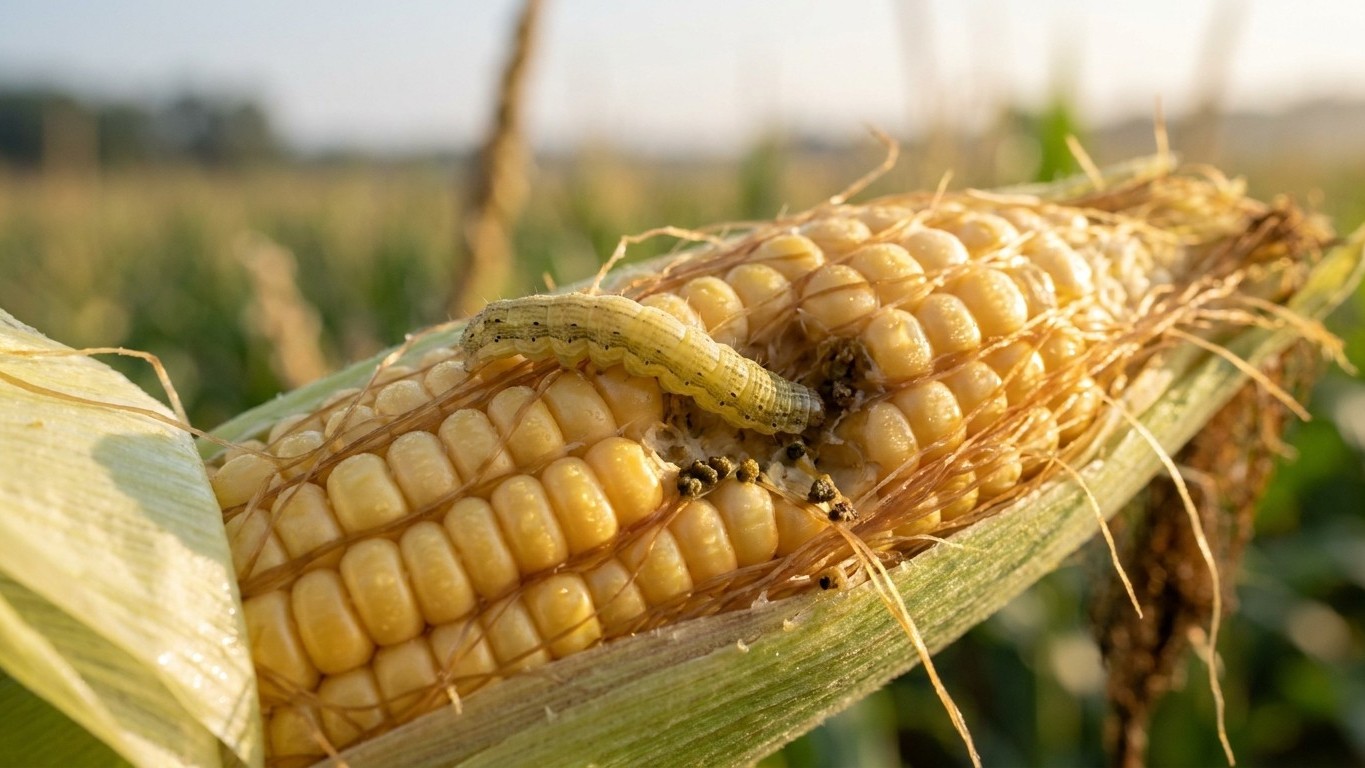

Corn earworm shows up in Wisconsin gardens from midsummer into early fall, with numbers building through July and peaking by mid-August as moths move north from warmer states. The insect doesn’t overwinter here, so every season starts fresh with migrating adults. Planting timing, tight-husked varieties, and a few drops of mineral oil on the silks are the main tools that actually help once ears start forming.
The weeks to watch

Corn earworm activity in Wisconsin runs from April through September, but the population doesn’t reach damaging levels early in that stretch. According to the University of Wisconsin-Madison Division of Extension, most corn pests, earworm included, don’t become abundant until mid-August. That’s a full season removed from when corn typically gets planted, and it matters because it tells you where the real risk window sits: not at emergence, not at tasseling, but right around when ears are filling out.
Early season (April through July)
Pressure stays low through spring and early summer. Moths are still arriving from southern states during this stretch, and populations haven’t built up enough to cause widespread silk or kernel damage. Corn planted and pollinated in this window generally dodges the worst of it.
Peak infestation (mid-August onward)
By mid-August, corn earworm numbers climb sharply, according to the same extension guidance. This is when home gardeners start finding chewed silks and damaged kernel tips. Late-planted corn, or corn with a delayed silking stage, sits squarely in this higher-pressure window. The extension source also flags squash vine borer separately, noting that squash plants begin wilting from that pest in late July, a useful reminder that “corn pest season” and “squash pest season” don’t line up on the same calendar even though both fall under the same April-through-September umbrella.
Reading the calendar from your last frost

Corn earworm doesn’t check a calendar. It responds to how warm the season has gotten and when host plants reach the growth stage it needs, mainly silking corn and fruiting tomatoes. That means an early spring or a late one shifts the whole timeline, and the one date most Wisconsin gardeners actually plan around is the last spring frost.
Across the state, NOAA’s 1991-2020 climate normals put the last spring freeze between April 16 and April 29, based on 32°F freeze probabilities at a long-running Wisconsin station. That’s a range, not a single day, and it should stay a range when you use it. Corn planted right after that window matures and reaches the silking stage well before the mid-August pest surge described above. Corn planted later, especially anything going in the ground in June, risks silking right into the peak window.
- Start from the frost window: April 16 to April 29 is when the last spring freeze typically clears in Wisconsin, per NOAA normals. Corn seeded soon after this window has the best shot at silking before pest pressure builds.
- Count forward to the pest peak: Since corn pests don’t become abundant until mid-August, any corn planted early enough to finish silking before that point faces a much lower risk than corn still forming ears when the peak hits.
Note the caution baked into that frost data: Lake Michigan pushes the first fall freeze later along the shoreline, while inland southern Wisconsin usually freezes by early October and the north freezes considerably earlier. That affects how long your growing season runs on the back end, but the spring frost window above is what determines your planting start.
What it attacks, and what the damage looks like

The first sign most gardeners notice isn’t a bug at all. It’s a corn ear with a chewed, discolored tip, or silks that look ragged and matted, sometimes with a bit of sawdust-like frass poking out near the husk opening. On tomatoes, it shows up as a small, clean-edged hole bored into the fruit, often near the stem end. Peppers and beans can show similar entry holes. By the time you spot any of this, the damage is already done, because it’s the larval stage, the caterpillar itself, that does all the feeding. Adult moths lay eggs on fresh silk or on developing fruit, and the newly hatched larvae tunnel in almost immediately.
Crops most commonly affected in Wisconsin gardens include:
- Sweet corn (feeding on silks and kernel tips)
- Tomatoes (boring into the fruit, which is why the same insect is often called the tomato fruitworm)
- Peppers
- Snap beans
- Okra, where it’s grown
Because the larva burrows in quickly, the stage that matters for control is almost always before it enters the plant tissue. Once it’s inside an ear or a tomato, external treatments have very little left to work with.
How Wisconsin sits in this pest’s range

Corn earworm doesn’t survive Wisconsin winters. Unlike pests that overwinter in garden soil or crop debris, this one migrates back in every year, with adult moths flying north from warmer states as the season warms. That migratory pattern is well established across its range in North America, and it means presence here depends on timing and weather patterns each year rather than on a local overwintering population building up season after season.
The practical takeaway is that Wisconsin’s position doesn’t put the state at an unusual edge of the insect’s range in the way a limited-range pest might. Corn earworm is broadly distributed, and what differs from one place to another tends to be when the pressure builds, not whether the insect eventually shows up. The extension guidance available for Wisconsin frames this pest within the same April-through-September window it uses for garden insects generally, with the mid-August abundance mark specific to corn pests as a group. There isn’t a separate, more localized Wisconsin-specific earworm forecast published in that source, so the mid-August marker is the most useful benchmark home gardeners here currently have.
What actually works against it

- Plant early enough to beat the peak. Since corn pests, including earworm, don’t build up until mid-August, timing corn so it silks before that point sidesteps a large share of the pressure. This costs nothing beyond planning around your last frost date.
- Choose tight-husk varieties. Corn varieties with longer, tighter husk coverage over the ear tip make it physically harder for newly hatched larvae to reach the kernels. This is a mechanical barrier, not a repellent, so it only helps before the larva finds an entry point.
- Apply a few drops of mineral oil to the silk channel after pollination. This is a long-used home gardening technique; the oil coats the silk tunnel and can smother young larvae trying to move down toward the kernels. It has to go on after pollination is complete, since oil applied too early can block pollen from reaching the ovules and reduce kernel fill.
- Check silks and fruit regularly and hand-pick visible larvae. This works only while the larva is still exposed near the entry point. Once it has tunneled deeper into an ear or a tomato, hand-picking no longer reaches it.
- Rotate crops and clear old plant debris at season’s end. Because corn earworm migrates in fresh each year rather than overwintering reliably in Wisconsin, this step matters less for this particular pest than it does for insects that do overwinter locally, but it remains reasonable general garden practice.
Home remedies involving copper barriers or ultrasonic repellents sometimes get mentioned for garden pests broadly, but there’s no established evidence tying either method to corn earworm control, and formal trials on copper’s effect against caterpillar pests haven’t produced consistent results one way or the other.
Common questions
Does corn earworm survive winter in Wisconsin?
No. It migrates north each year from warmer regions rather than overwintering reliably in Wisconsin’s climate, so local populations depend on annual moth flights rather than a buildup from the previous season.
Can I still eat corn with earworm damage?
Most gardeners simply cut off the damaged kernel tip and use the rest of the ear. The larva typically feeds only in the top inch or two of the ear.
Is mineral oil safe to use on all corn varieties?
It’s a widely used physical method, but timing matters: applying it before pollination is complete can interfere with kernel fill by blocking pollen from reaching the silks.