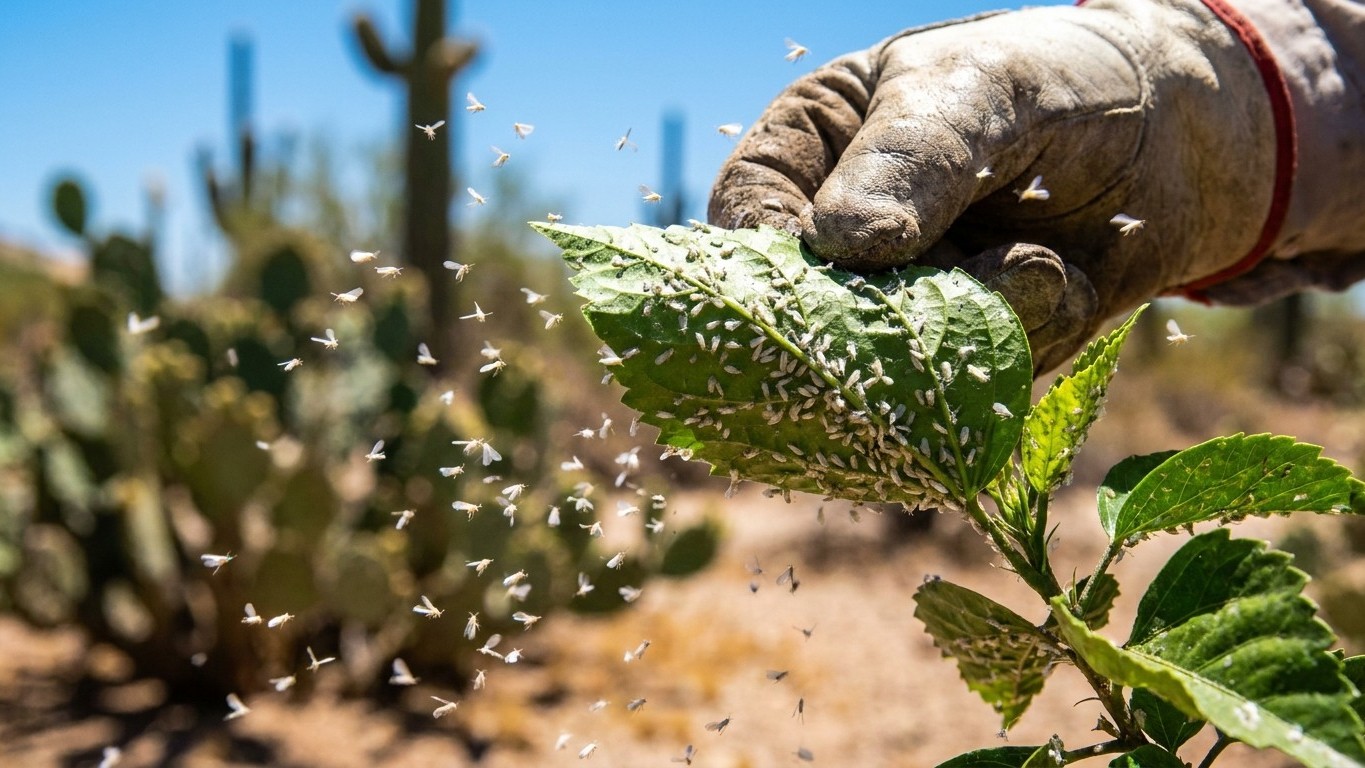

Whiteflies show up in West Virginia gardens from late spring through summer, tracking the same warm stretch that brings aphids and cabbage worms. There’s no fixed calendar date because these insects respond to soil and leaf temperature, not the month on a wall calendar. What stops them is mostly physical: covers, traps, and clearing out the places they overwinter.
The weeks to watch

WVU Extension’s pest management calendar does not list a specific window for whiteflies. It tracks slugs, Colorado potato beetle, and flea beetle starting in April, asparagus beetles and cucumber beetles from May, cabbage worms, Japanese beetles, and aphids in June, then hornworms, corn earworm, brown marmorated stink bug, and spotted wing drosophila in July. Whiteflies aren’t named in that lineup, so the honest answer is that the state’s extension service hasn’t published a dated window for this particular pest. What gardeners can lean on instead is the general shape of the season: sap-feeding insects like aphids become active in June, and whiteflies feed the same way, on the underside of leaves, so their build-up tends to follow a similar arc.
Why there’s no single flight to mark
Unlike a beetle with one clear emergence, whiteflies run through overlapping generations once temperatures stay warm. Eggs, nymphs, and adults exist on the same plant at the same time by midsummer, because a female can lay eggs continuously as long as leaves stay tender and warm. That overlap is why extension bulletins for many pests give a single date but treatments for whiteflies talk about ongoing monitoring instead of a start date.
Where the pressure builds fastest
Greenhouses, high tunnels, and indoor seed-starting setups create the steadiest warmth, and that’s typically where whiteflies show up earliest and in the largest numbers, since the insects never face a hard frost to reset their population. Outdoor plantings lag behind, picking up pressure only once the surrounding air and soil catch up through late spring and into June.
Reading the calendar from your last frost

The one date most West Virginia gardeners already track is the last spring frost, which for the Charleston area falls between April 9 and April 23, based on NOAA’s 30-year climate normals. That’s a range, not a promise, and it shifts with elevation, since higher ground across the state cools and warms on its own schedule. Whiteflies don’t answer to a printed frost date at all. They answer to how quickly the soil and surrounding air warm up afterward, so an early, mild spring pulls their arrival forward and a cold, wet one pushes it back.
- Start from your local last frost date, roughly April 9 to April 23 in the Charleston area.
- Add several weeks of steady warmth after transplanting before nymphs typically become numerous enough to notice, since populations build gradually rather than appearing overnight.
That gap matters for row covers. Put them on at transplanting, before adults have a chance to land and lay eggs, and plan to pull them once flowers need pollinator access or once daytime heat under the cover becomes a bigger problem than the whiteflies themselves.
What it attacks, and what the damage looks like

Most gardeners spot the damage before they spot the insect. Leaves turn yellow and mottled, plants look weirdly weak despite regular watering, and a sticky film coats the foliage, sometimes followed by a black, sooty-looking mold growing on that residue. Disturb the plant and a small cloud of tiny white insects lifts off the leaves and resettles almost immediately, which is usually the moment people realize what they’re dealing with.
The nymphs do the real damage. They’re flat, nearly clear or pale, and stay glued to the underside of leaves feeding continuously, which is why they’re the life stage that determines whether a treatment still has a chance of working. Adults fly around, mate, and lay more eggs, but it’s the stationary nymphs draining sap that weaken the plant and produce the sticky honeydew behind the mold problem.
Crops commonly affected include:
- Tomatoes
- Peppers
- Cucumbers and other cucurbits
- Beans
- Ornamental houseplants and greenhouse starts
How West Virginia sits in this pest’s range

Whiteflies aren’t a species confined to a narrow band of the country. They’re established broadly across the United States, which means West Virginia isn’t sitting near some geographic edge of their range the way a cold-sensitive insect might. The meaningful difference between states isn’t whether whiteflies show up, it’s when, and that comes down to local frost timing and how long the growing season stretches. A river valley location like Charleston, where the climate data for this piece comes from, warms up somewhat earlier than the state’s higher ridges and mountain valleys, and those higher elevations also see a noticeably earlier fall freeze. That gap between valley and ridge means two gardens sixty miles apart in West Virginia can see meaningfully different whitefly pressure in the same year, simply because one sits several hundred feet higher and gets fewer frost-free weeks to work with.
What actually works against it

- Time transplanting around your frost window. Getting seedlings established and past their tender stage before whitefly populations build gives plants a head start; it doesn’t prevent whiteflies but it reduces how vulnerable young growth is when pressure ramps up.
- Use row covers from transplant until flowering. A physical barrier keeps adults from landing on leaves and laying eggs in the first place. The mechanism is purely physical, not chemical, which is why it stops working the moment the cover comes off or gets torn.
- Set out yellow sticky traps. Adult whiteflies are drawn to yellow, and traps placed near susceptible plants catch adults and give a running count of how bad the pressure is getting, which helps decide whether stronger steps are worth it.
- Hose off or hand-remove nymphs on accessible leaves. This physically knocks nymphs loose or crushes them, but it only reaches what a person can see and touch, so it’s a stopgap on a few plants, not a whole-garden fix.
- Clear plant debris and rotate crops each season. Whiteflies and their eggs can overwinter on plant material left in the garden or in greenhouses, so removing old foliage and not planting the same susceptible crop in the same spot cuts down on where the next generation starts from.
None of these measures reach whiteflies once nymphs have settled deep into dense foliage or greenhouse plantings have heavy, established populations. At that point, covers and traps are monitoring tools at best, not a cure, and the more realistic goal becomes limiting how much the population spreads rather than eliminating it outright.
Common questions
Do whiteflies survive a West Virginia winter outdoors?
Outdoor populations generally die back once hard freezes set in, but whiteflies sheltering in greenhouses, high tunnels, or brought-in houseplants can persist year-round, which is why indoor plantings often show pressure earlier than the outdoor garden does.
Are whiteflies the same as aphids?
No, though they’re often confused because both are small, soft-bodied sap feeders that produce sticky honeydew. Whiteflies are true flies-related insects that flutter up in a small cloud when disturbed, while aphids stay put and cluster densely on stems and leaf undersides.
Does copper tape or an ultrasonic repellent work on whiteflies?
Neither has a demonstrated mechanism against whiteflies specifically. Both are more commonly marketed for slugs and other pests, and existing trials on those broader claims don’t reach a firm conclusion about effectiveness, so they shouldn’t replace covers or sticky traps as a primary strategy.