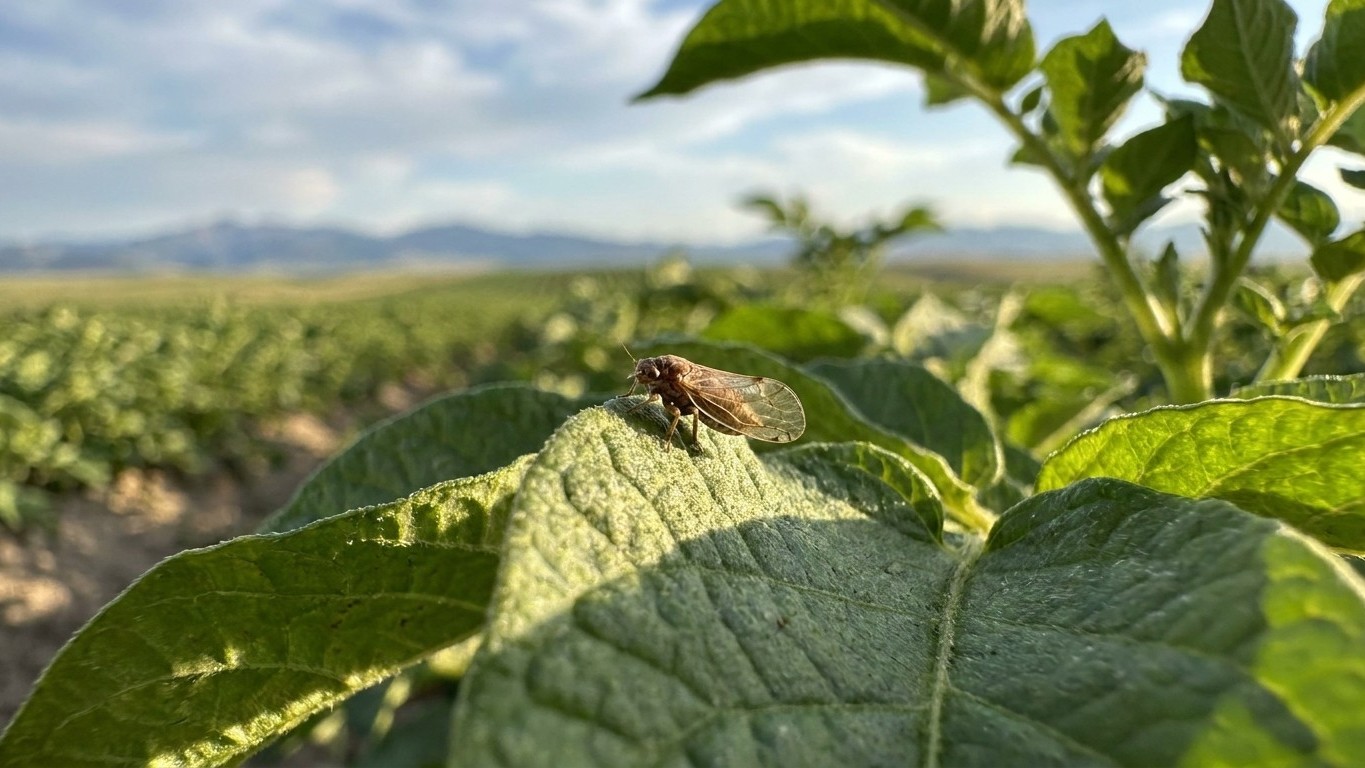

Adult potato psyllids don’t follow a fixed date on a Colorado calendar. They ride warm air currents north each year, and how early they show up on Front Range and Western Slope nightshades depends entirely on how fast spring warms up, not on what the calendar says. That single detail changes almost everything about when to act.
The weeks to watch

Colorado State University Extension’s PlantTalk Colorado library, the source behind the pest-timing data used across this site, tracks flea beetles, squash bugs, spider mites, and corn earworm with specific seasonal windows. It does not publish a dedicated flight or generation window for potato psyllid. That’s worth saying plainly rather than papering over: if you’re searching for an exact “psyllids arrive on this date” answer from Colorado’s own extension service, it isn’t published in these sources. What extension entomologists do describe, across sap-feeding and piercing insects broadly, is a season that runs from late spring through late summer, with pressure building as temperatures climb and easing once nights turn cold in fall. Potato psyllid fits that general pattern.
Early migrants
Potato psyllid doesn’t overwinter reliably through a Colorado winter the way a soil-dwelling grub might. Adults arrive as migrants, carried on wind currents from milder regions to the south. The first wave typically coincides with the same stretch of warming weather that triggers other sap-feeders into activity, meaning late spring is the period to start checking new growth, not high summer.
Later buildup
Once migrant adults settle in, they lay eggs on the undersides of leaves, and local populations can build through multiple generations over the warm months. This is why pressure often feels worse in July and August than it did in May, even though the insects arrived weeks earlier. Scouting shouldn’t stop once the first wave passes; the buildup phase is often the more damaging one.
Reading the calendar from your last frost

NOAA’s 1991-2020 climate normals put Colorado’s last spring frost, based on the Denver-area station, somewhere between May 1 and May 11. That’s a normal, not a promise. Some years the freeze risk clears earlier, some years it lingers past mid-May, and mountain towns or the western slope run on entirely different schedules, sometimes with frost risk into July.
Potato psyllid activity answers to soil and air temperature, not to a printed date, so an early, warm spring pulls its arrival forward and a cold, wet one delays it. That means the frost date is a starting point for a calculation, not a substitute for watching your own thermometer and your own plants.
- Start from your local frost-free window (May 1 to May 11 for Denver-area, Front Range plantings; check your own station if you garden elsewhere in the state).
- Count forward from there to the point when nighttime lows hold reliably above the mid-40s and daytime soil has warmed, since that’s the stretch when migrant adults become active and new transplants start putting on the tender growth psyllids prefer.
Gardeners who transplant right at the frost-free date, rather than pushing earlier under cover, tend to see damage show up gradually as the plant grows, since psyllids target actively growing tissue rather than dormant or barely-established seedlings.
What it attacks, and what the damage looks like

Most gardeners notice the plant before they notice the insect. Upper leaves on potato and tomato plants take on a yellow or purplish cast, curl inward, and growth stalls even though the soil looks fine and water hasn’t been an issue. On potatoes specifically, the tell can show up underground: tubers develop dark streaking inside when cut open and cook up with a discolored, striped pattern, a symptom commonly called zebra chip. That damage traces back to a toxin injected while the insect feeds, not to any visible chewing damage on the leaf itself.
The crops most at risk in a home garden are all in the nightshade family:
- Potato
- Tomato
- Pepper
- Eggplant
- Tomatillo
The nymphs, the flattened, scale-like immature stage that stays put feeding on leaf undersides, do the bulk of the damage. Adults feed too and can spread the toxin, but it’s the settled nymph population injecting saliva over days and weeks that produces the yellowing and tuber symptoms. That distinction matters for treatment timing: once nymphs have been feeding for a while, the toxin’s effect on the plant doesn’t reverse even if the insects are later removed.
How Colorado sits in this pest’s range

The extension sources used for this site’s pest-timing data don’t break out potato psyllid by state or give a territory count for its range, so no ranking or severity claim can be made from them here. What can be said with confidence is that potato psyllid is a recognized pest of solanaceous crops across the western United States, and Colorado’s potato and tomato growing regions, including the Western Slope’s commercial potato acreage, fall within the area where it’s documented and monitored.
Because the insect arrives as a migrant rather than establishing a permanent year-round population tied to one location, the practical difference between Colorado and neighboring states is less about whether It Shows Up and more about when and how heavily, which circles back to how early and how warm the spring turns out to be.
| Region | Frost pattern | Practical effect on timing |
|---|---|---|
| Front Range / Denver-area plains | Last frost typically May 1-11 | Standard window for scouting to begin |
| Mountain towns | Much shorter season, frost risk into July | Migrant activity compressed into a narrower summer window |
| Western Slope | Differs from Front Range normals | Local station data should be checked separately, especially for commercial potato acreage |
What actually works against it

Cheapest measures come first, and each one has a point where it stops helping.
- Plant on your normal frost-free schedule rather than rushing transplants weeks early. Younger, still-hardening plants attract less feeding than lush, actively growing tissue, so avoiding an artificially early, tender growth flush reduces the window of peak attraction.
- Use row covers from transplant through early establishment. A physical barrier keeps migrating adults from landing on foliage and laying eggs in the first place. The catch: covers have to come off before flowering on fruiting crops like tomatoes and peppers so pollinators can reach the blooms, and once nymphs are already established underneath a cover, the cover no longer helps and can even trap them against the plant.
- Scout leaf undersides weekly. Look for small yellow-orange eggs along leaf margins and flattened nymphs on the underside of leaves. Catching a population before it builds through a second generation is far more manageable than dealing with an established infestation in August.
- Hand-remove affected leaves and any volunteer potato plants or nightshade weeds nearby. Volunteer potatoes and weedy relatives like nightshade can host psyllids between plantings, and clearing them reduces the local population that migrant adults can join up with.
- Rotate solanaceous crops where garden space allows. This has real but limited value here, since migrant adults arrive from a distance rather than emerging from last year’s exact planting spot; rotation helps more with soil-dwelling pests than with a flying, wind-carried migrant like this one.
Once nymphs have been feeding for an extended stretch and the toxin has already triggered yellowing or tuber streaking, none of these measures reverse existing damage. At that point the goal shifts from prevention to limiting how much further the population spreads to unaffected plants nearby.
Common questions
Does Colorado State University Extension give an exact date range for potato psyllid arrival?
No. The PlantTalk Colorado and related CSU fact sheets covering insect timing address flea beetles, squash bugs, spider mites, and corn earworm with specific windows, but they don’t publish a dedicated arrival date for potato psyllid. The general late-spring-through-late-summer pattern for sap-feeding pests is the closest documented guide.
Can potato psyllid survive a Colorado winter outdoors?
It behaves as a seasonal migrant in this region, arriving on wind currents rather than overwintering reliably in place through a Colorado winter, which is part of why its local timing tracks spring warmth so closely rather than a fixed calendar date.
Is zebra chip in potatoes always caused by this insect?
The dark internal streaking known as zebra chip is linked to the toxin potato psyllid nymphs inject while feeding. Discolored tubers should prompt a check of the plant’s upper leaves for the yellowing and curling that typically accompanies an active infestation before assuming another cause.