
Cabbage loopers turn up in Indiana gardens from late May through the first hard frost, with the heaviest feeding pressure hitting cole crops in July and August. The moth doesn’t overwinter in Indiana’s climate, so every season starts with adults migrating up from warmer states, which means the timeline shifts year to year depending on spring weather patterns. Controlling them comes down to three things: catching the caterpillars early, using Bt sprays before they get large, and protecting young transplants with row covers before eggs get laid.
How to Identify a Cabbage Looper

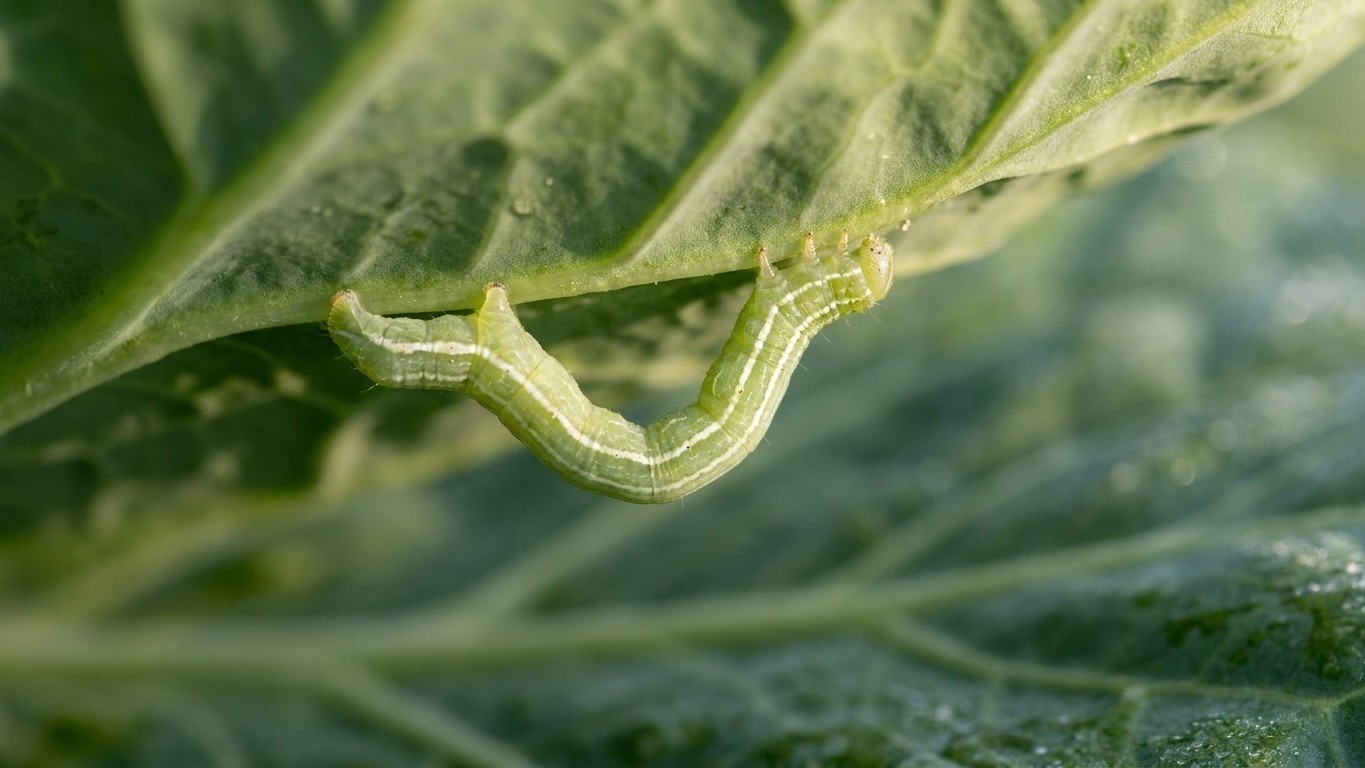
The caterpillar is the stage that does the damage, and it has a signature move that gives it away instantly. Watch one crawl and you’ll see it arch its middle into a loop, then pull the back half forward, then stretch out again, the same motion an inchworm uses. That’s because the looper only has three pairs of prolegs near its rear instead of the full set most caterpillars carry, so it has no choice but to hunch up to move.
Color runs pale green to jade, and a full-grown larva stretches to about 1.5 inches. Look closely along the sides and you’ll spot thin white stripes running the length of the body, plus a narrow line down the back. Young larvae are almost translucent and easy to miss against a cabbage leaf’s underside, which is exactly where they like to feed.
The adult moth is a mottled grayish-brown insect with a wingspan around 1.5 inches, marked by a small silvery spot shaped like a figure-eight or a check mark on each forewing. Moths fly at night and rest on plants or nearby structures during the day, so gardeners rarely notice them until the caterpillars have already started chewing.
Cabbage Looper vs. Other Cole Crop Pests
Indiana gardens often deal with cabbage looper alongside imported cabbageworm and diamondback moth larvae, and mixing them up leads to the wrong treatment timing. Imported cabbageworm caterpillars are velvety green with a faint yellow stripe down the back and move in a normal crawling motion, no looping involved. Diamondback moth larvae are smaller, more slender, and tend to wriggle rather than loop when disturbed. If a caterpillar arches its body into a distinct hump while moving, it’s a looper.
When Cabbage Loopers Show Up in Indiana
Indiana sits across USDA hardiness zones 5a to 6b, and the cabbage looper’s arrival tracks with how quickly southern moth populations build and ride weather fronts northward each spring. In a typical year, the first moths reach Indiana fields and gardens in May, with egg-laying and the first generation of caterpillars showing up by late May or early June. Because the insect can complete two to four generations per season depending on temperature, populations build through summer and usually peak in late July through August, right when fall broccoli and cabbage transplants are going into the ground.
That timing creates a real headache for gardeners planning a fall cole crop harvest. Transplants set out in July for an autumn cabbage or kale crop land right in the window of highest looper pressure, while spring-planted crops harvested by early July often dodge the worst of it. Warm, dry summers tend to push populations higher because natural fungal diseases that knock down looper numbers need moisture to spread.
The insect doesn’t survive Indiana winters in any life stage. Every population present in a given year traces back to moths that flew or were carried north on wind currents from Gulf Coast states, which is why looper numbers can vary sharply from one summer to the next depending on regional weather earlier in the season.
What Plants Get Hit and What the Damage Looks Like
Cole crops take the brunt of it: cabbage, broccoli, cauliflower, kale, collards, and Brussels sprouts. Loopers also feed on lettuce, spinach, tomato, potato, and even some ornamentals, though cole crops remain the preferred host across most Indiana gardens and commercial fields.
Early feeding shows up as small, irregular holes chewed between leaf veins, usually on the underside of outer leaves where eggs were laid. As larvae grow, the holes get bigger and ragged, and heavy infestations can skeletonize leaves down to the veins. On cabbage and other heading crops, the real economic damage happens when larvae bore into the developing head, since that contamination makes the whole crop unmarketable even if actual tissue loss is minor.
Dark green fecal pellets scattered across leaves are often the first visible sign, showing up before the caterpillars themselves are spotted. Checking the undersides of outer leaves on a weekly basis, starting in late May, catches infestations before they reach the head.
Cultural Controls That Work Before Spraying Anything
Floating row covers placed over transplants at planting time block adult moths from laying eggs in the first place, and they’re one of the most reliable tools available to home gardeners. Covers need to go on before moths find the plants, and they have to be sealed at the edges with soil or weights, since a gap of a few inches is all an adult moth needs to slip through.
Crop rotation helps less with cabbage looper than with soil-dwelling pests, since the moths fly in from outside the region each year rather than emerging from Indiana soil. Still, avoiding back-to-back cole crop plantings in the same bed reduces the concentration of pheromone and feeding cues that draw in egg-laying females.
Removing crop debris after harvest matters more for other cole crop pests, but it doesn’t hurt looper management either, since old plant material can host late-season larvae that finish development and add to local moth numbers before the season ends.
Encouraging natural enemies pays off too. Parasitic wasps in the genus Trichogramma and Copidosoma attack looper eggs and larvae, and general predators like lacewings, ground beetles, and paper wasps all take a toll on caterpillar populations. Avoiding broad-spectrum insecticide use except when populations demand it keeps those predator numbers intact.
Biological and Chemical Options
Bacillus thuringiensis, sold under various trade names as Bt or Bt kurstaki, remains the standard treatment for cabbage looper in home gardens because it targets caterpillars specifically and leaves bees, beneficial wasps, and other pollinators unharmed. It works best on young larvae, so spraying at the first sign of small holes or fecal pellets gets far better results than waiting until caterpillars are large. Bt breaks down quickly in sunlight, so reapplication every 7 to 10 days during active feeding periods is typically needed, and coverage on leaf undersides matters since that’s where larvae feed.
Spinosad is another option with lower toxicity to beneficial insects compared to older synthetic pesticides, and it works on a broader range of caterpillar sizes than Bt does. Both products are approved for organic production, which makes them the go-to choice for gardeners avoiding conventional pesticides.
Conventional insecticides labeled for cabbage looper on vegetable crops do exist and can knock down heavier infestations faster, but they also kill parasitic wasps and other predators that would otherwise help suppress future generations. For a home garden with moderate pressure, that tradeoff usually isn’t worth it. Reserve stronger chemical options for infestations that have already caused significant head damage and Bt hasn’t kept pace.
Hand-picking works surprisingly well on a small home garden scale, especially once gardeners know to check leaf undersides. A single female moth can lay several hundred eggs over her lifetime, so removing even a handful of larvae before they mature cuts down significantly on the next generation’s numbers.
Monitoring Through the Indiana Growing Season
Pheromone traps designed for cabbage looper moths give gardeners and small-scale growers an early warning system, flagging when adult moths are active in the area before eggs even get laid. Checking traps weekly starting in mid-May lines up with when Indiana’s first moth flights typically arrive, giving enough lead time to get row covers in place or plan a first Bt application.
For anyone growing a fall cole crop, the smarter play is starting transplants indoors or in a protected nursery bed during peak moth activity in July, then moving them to the garden with row covers already in place rather than exposing bare transplants during the highest-pressure weeks of summer. That single adjustment avoids most of the damage that catches gardeners off guard on second and third plantings.