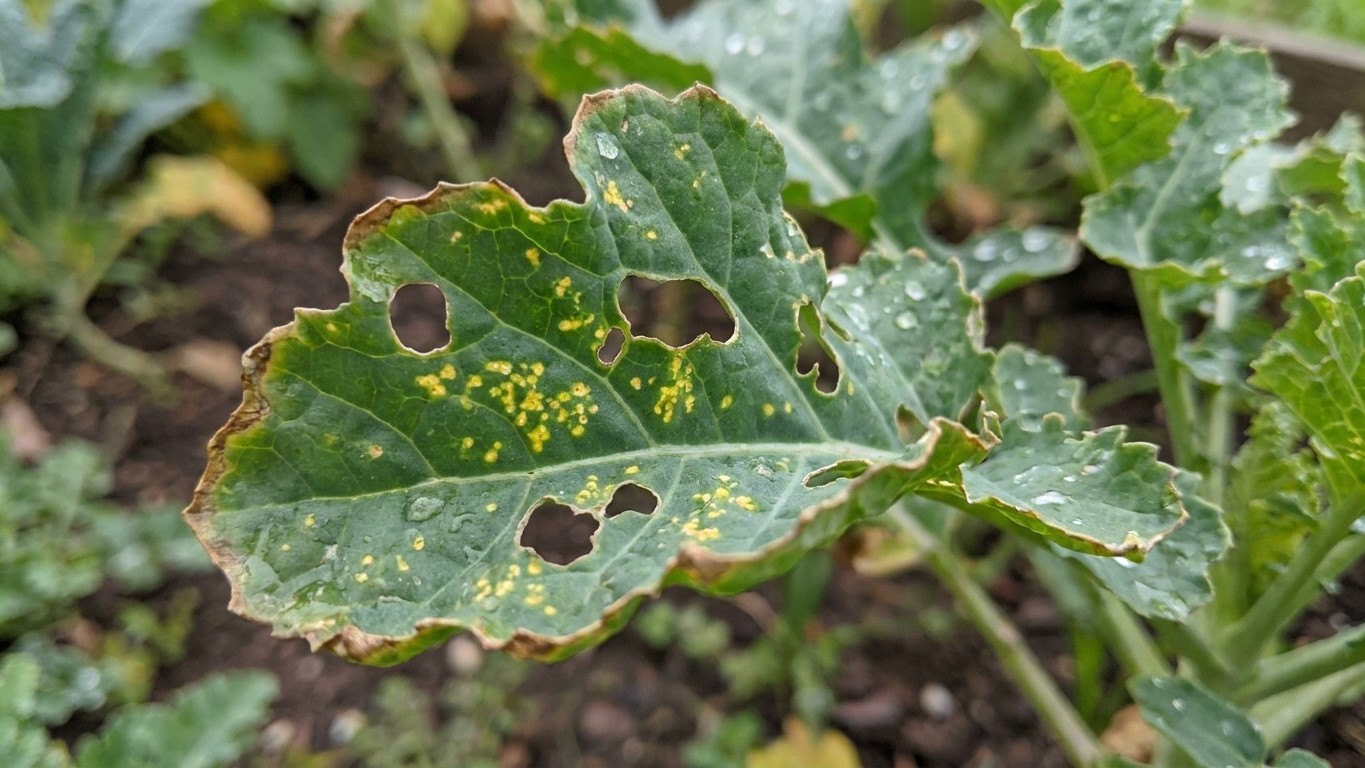

Texas A&M AgriLife Extension tracks ten species that regularly damage Summer Squash in home gardens across the state, from squash bugs that suck sap through the stem to vine borers that tunnel inside it while the plant still looks fine from the outside. Which one shows up first depends less on the calendar month than on how far the plant has moved past transplanting, and on how many days that season has already logged above 90°F.
Which pests attack Summer Squash in Texas
Texas A&M AgriLife Extension documents thirteen insects and related pests tied to vegetable gardens in the state, but not all of them touch a squash plant. The full list: cabbage looper and Diamondback moth, corn earworm, fire ants, flea beetles and cucumber beetles, grasshoppers, Leaffooted bug, melon aphid and other aphids, pickleworm and melonworm, root-knot nematodes, spider mites, squash bug, squash vine borer, and whiteflies.
Three of those have no business on this page. Cabbage looper and Diamondback moth are cole-crop specialists, they feed on cabbage, broccoli and their relatives, and largely ignore a cucurbit leaf. Corn earworm does most of its damage inside a corn ear, and while it’s a documented state pest, it isn’t a squash feeder in any meaningful sense. Fire ants are a real hazard in a Texas garden bed, but they don’t chew squash foliage or bore into the fruit, they’re a stinging nuisance and occasional scavenger, not a plant pest here.
That leaves ten species that actually feed on summer squash: flea beetles and cucumber beetles, grasshoppers, Leaffooted bug, melon aphid and other aphids, pickleworm and melonworm, root-knot nematodes, spider mites, squash bug, squash vine borer, and whiteflies. The single fact that shapes all ten is the length of the frost-free season, which at the Houston reference station runs from a last spring frost between February 4 and March 1 to a first fall frost between December 1 and December 19. That’s over nine months without a hard freeze, long enough for several of these pests to run more than one generation on the same planting.
When each one shows up, and what it does first
Flea beetles and cucumber beetles are usually the earliest visitors, arriving while seedlings still have their first true leaves. Flea beetles leave small round shot-holes across the leaf; cucumber beetles chew ragged edges and can also spread bacterial wilt while they feed, so a wilting seedling with beetle damage nearby deserves a closer look before it’s blamed on drought.
Once the vine starts running, squash bugs move in. The first sign is rarely the adult, it’s clusters of bronze eggs on the underside of a leaf, followed by gray nymphs that suck sap and leave yellow speckling that turns brown and crisp. Squash vine borer works on the same timeline but hides its entry: the first visible clue is often a small pile of moist, sawdust-like frass at the base of the stem, not a hole itself.
As the plant moves into bloom, melon aphid and whiteflies build up on new growth and the undersides of leaves, leaving a sticky residue that later grows sooty mold. Spider mites tend to peak once the heat load stacks up, and the Houston area averages 102.4 days a year at or above 90°F, that stretch of high heat and low humidity is exactly when mite populations explode, showing up first as a fine stippling and faint webbing on the underside of leaves.
Once fruit sets, pickleworm and melonworm larvae tunnel into the young squash itself, leaving a small entry hole plugged with frass, and by that point the fruit is usually a loss. Leaffooted bugs arrive around the same stage, piercing developing fruit and leaving small dimpled or discolored spots. Grasshoppers feed whenever they’re present and hungry, chewing ragged notches out of leaf edges at any point in the season. Root-knot nematodes work underground the whole time, so their damage, stunted growth and wilting on hot afternoons, only gets confirmed when someone pulls a plant and finds swollen, knotted roots.
Telling the damage apart from Everything else
A squash plant that looks sick isn’t always a pest problem. Blossom-end rot, uneven watering, powdery mildew and simple heat stress all produce symptoms that overlap with insect damage, and treating the wrong cause wastes a week a short growing season doesn’t have.
The clearest tell for squash vine borer versus ordinary heat wilt is timing: a plant stressed by heat or dry soil usually perks back up once the sun goes down or after a good watering, while a vine hollowed out by a borer stays wilted overnight and doesn’t recover, because the stem’s plumbing is gone, not just short on water.
| What you see | Could be insect damage | Could also be | What settles it |
|---|---|---|---|
| Yellow stippled leaves, fine webbing | Spider mites | Nutrient deficiency, drought stress | Hold a white sheet of paper under the leaf and tap; mites fall as moving specks, deficiency doesn’t move |
| Sudden wilting vine that stays down | Squash vine borer | Bacterial wilt, root damage from cultivating too close | Split the stem near the base; borer tunnels and frass are visible inside |
| Sticky leaves, black sooty coating | Melon aphid or whiteflies | Fungal disease unrelated to insects | Sooty mold from insects wipes off with a damp cloth; disease spotting doesn’t |
| Small holes tunneled into fruit | Pickleworm or melonworm | Mechanical damage from handling or hail | Insect entry holes are plugged with frass; mechanical wounds are clean-edged |
| Stunted plant, wilts on hot afternoons | Root-knot nematodes | Compacted soil, underwatering | Pull a struggling plant and check for swollen, beaded roots |
None of this replaces a diagnosis. If the plant is worth saving, or the same bed keeps failing year after year, a local county extension office can look at a sample and say what’s actually there, rather than guess from a description.
What actually works here, and what is a waste of time
Timing beats product choice on a squash crop this size. A floating row cover set over seedlings the day they go in the ground keeps flea beetles, cucumber beetles and squash bug adults from ever laying eggs on the plant, which is a lot easier than fighting the next generation two weeks later. The cover has to come off once the plant starts flowering, or squash won’t get pollinated and there won’t be any fruit to protect in the first place.
Handpicking still works better than most people expect. Checking the underside of leaves every few days for the bronze egg clusters squash bugs lay, and crushing them before they hatch, keeps a small infestation from becoming an unmanageable one, and it costs nothing but a few minutes. Pulling and destroying a vine once borer frass shows up at the base also limits how far that generation spreads to the next plant.
Rotating squash out of the same bed for a season or two matters most for root-knot nematodes, since they build up in soil around cucurbit roots and don’t have a quick fix once established. What doesn’t help: spraying on a fixed schedule regardless of what’s actually present, since it kills the beneficial insects that would otherwise keep aphid and mite numbers down, and often doesn’t touch a borer that’s already inside the stem. Waiting until fruit is visibly damaged before checking the base of the stem or the underside of leaves also means the pest has usually had a two-to-three week head start already.
Beyond that, any product decision, what’s labeled for vegetable gardens and legal to use in Texas, belongs with the local extension office, not a general gardening article.
Where to check this for your own county
Everything above comes from Texas A&M AgriLife Extension, and it describes what’s documented across the state, not what’s necessarily in one backyard. Pest pressure shifts noticeably even within a metro area: the two Houston-area reference airports used for climate records run about two weeks apart in their frost timing, and a garden a county away can be running on a different pest calendar entirely.
The most useful next step is contacting the county extension office directly, through Texas A&M AgriLife Extension at agrilifeextension.tamu.edu, where a county-specific office can confirm what’s actually active locally this season, not just what’s been recorded statewide.
A statewide list is a starting point for knowing what to look for, not a guarantee of what’s in a specific garden bed. Anyone dealing with repeated squash losses, or unsure whether what they’re seeing matches one of the ten pests above, gets a faster and more accurate answer from that local office than from comparing photos online.