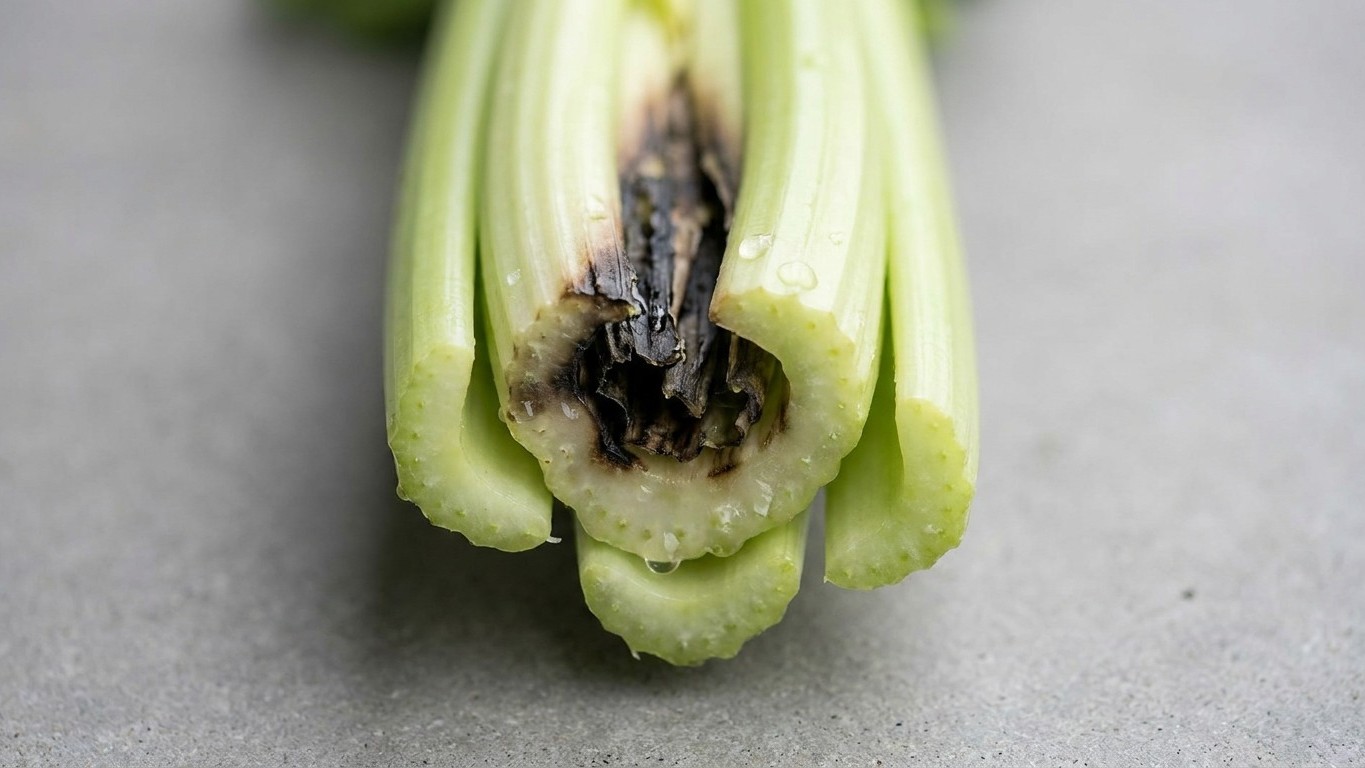

Black heart in celery shows up as a blackened, collapsed center while the outer stalks still look fine, and the cause isn’t a soil that ran short on calcium. Utah State University Extension identifies black heart as a localized calcium deficiency, meaning the mineral existed in the plant but never reached the innermost leaves where new cell walls were forming. Water stress interrupts that delivery, and by the time the black tissue appears, the damage already happened weeks earlier.
The short answer
Black heart isn’t caused by too little calcium in the soil. It’s calcium that never made it to where the plant needed it most. Utah State University Extension describes black heart as “black discoloration of leaves in the center of the plant,” with injury that “occurs gradually and is not visible until later in the season.” The extension calls it “a localize deficiency of calcium which is essential for cell development,” and localized is the operative word. The ground around the roots can hold plenty of calcium while the celery still develops black heart, because the mineral stalls somewhere between the roots and the innermost leaves.
That’s why “deficiency” and “shortage” don’t mean the same thing here. A shortage implies there isn’t enough of something available. A deficiency, in this case, means enough calcium exists in the soil but it isn’t arriving at the growing point in the right amount at the right time. Calcium travels through a plant mostly by riding along with water moving up through the stem. Outer leaves pull water fast and get a steady supply of calcium along with it. The tightly wrapped, still-forming leaves at the center pull far less water, so they sit last in line for whatever calcium is moving upward. Any interruption in that flow shows up there first, not on the outside.
Utah State University Extension ties this directly to water stress, naming it as the trigger and pointing to the fix: “avoiding water stress is a good way to minimize this problem.” The recommended remedy pairs a steady watering routine with calcium-rich fertilizer, specifically bone meal, blood meal, or calcium sprays. None of these treatments undo damage already done. They’re aimed at the leaves still forming, the ones that haven’t reached their calcium limit yet.
That timing gap is why black heart feels like it comes out of nowhere. The dry spell that causes it happens first, and the plant keeps growing normally on the outside while the center quietly falls behind. Injury occurs gradually and isn’t visible until later in the season, so the blackened core often surfaces weeks after the stress event, once the damaged leaves finally unfurl enough to reveal dead tissue at their base.
What actually decides it

One mechanism explains nearly Everything gardeners see with black heart: calcium moves passively with water, and the celery’s own growth habit puts the most vulnerable tissue at the end of that water line.
Why the calcium stalls before it reaches the center
Celery’s outer leaves are older, larger, and lose water to the air constantly through their pores. That steady water loss, called transpiration, pulls a continuous stream of water and dissolved minerals up from the roots. Inner leaves are younger, smaller, and tightly packed, so they transpire far less and pull far less of that stream toward themselves. Calcium doesn’t move well through the plant on its own; it needs water flow to carry it. When conditions are stable, enough reaches even the low-demand inner leaves to keep cell walls forming correctly. When water flow drops, even briefly, the inner leaves are the first tissue cut off, because they were already receiving the smallest share.
Why a tight watering schedule beats extra calcium in the soil
Because the bottleneck is transport, not supply, adding more calcium to soil that already has enough won’t fix an uneven watering routine. Utah State University Extension’s remedy leads with water management for exactly this reason, then adds calcium-rich fertilizer, bone meal, blood meal, or calcium sprays, as a supporting measure. A celery bed that dries out between waterings and then gets soaked creates the exact stop-and-start water flow that starves the center. A bed watered on a consistent schedule keeps that internal water stream steady enough for calcium to keep reaching the leaves that need it, even though those leaves are pulling the least water of any part of the plant.
How to do it
- Start celery seed indoors, counting back nine to 13 weeks from your area’s last frost date. This is the seed-to-transplant window Utah State University Extension identified as workable, and counting from your own frost date adapts it to your climate instead of a fixed calendar date.
- Harden off the seedlings gradually, then transplant them into the garden once your last frost date has passed and the soil has warmed enough to support steady root growth.
- Space Transplants 12 inches apart in rows set 2 feet apart. Utah State University Extension notes that a tight planting helps force tall growth and long petioles, which are the traits gardeners actually want from celery stalks.
- Set a consistent watering schedule starting at transplant and hold to it through the season, since inconsistent watering is the trigger Utah State University Extension names for black heart.
- Feed the bed with a calcium-rich fertilizer, using bone meal, blood meal, or calcium sprays, to support the inner leaves still forming their cell walls.
- Water in the morning rather than the evening, so leaves have time to dry during the day. This same habit that protects against water-stress swings also reduces conditions favorable to powdery mildew.
- Check new growth regularly for curled or crinkled leaves, a sign of aphids, and treat early with insecticidal soap or a strong stream of water before the population builds.
What goes wrong

- Black heart appears mid-season with no obvious cause. The dry stretch that caused it happened weeks earlier, and injury occurs gradually and isn’t visible until later in the season. Once the blackened tissue shows up, it cannot be undone. The response is forward-looking: steady watering and calcium-rich fertilizer, bone meal, blood meal, or calcium sprays, to protect the leaves that haven’t yet reached their calcium limit.
- White patches spread across the plant. This is powdery mildew, which starts on older leaves before moving through the whole plant. Choosing resistant varieties helps, and watering so the leaves have time to dry during the day keeps the surface conditions less favorable for it to spread.
- New leaves curl or crinkle instead of growing flat. This points to aphids feeding on the tender growth. Insecticidal soap or a strong stream of water from a hose knocks populations down before they distort more of the plant’s new leaves.
- Watering “when it looks dry” instead of on a schedule. Irregular watering is precisely the water stress Utah State University Extension names as the black heart trigger. A fixed schedule, rather than a reactive one, keeps the internal water flow steady enough for calcium to keep reaching the plant’s center.
Common questions
Can black heart be fixed once it appears?
No. Utah State University Extension notes the injury occurs gradually and isn’t visible until later in the season, meaning the damaged tissue formed weeks before it turned black. Treatment shifts to protecting new leaves going forward, using steady watering and calcium-rich fertilizer.
Does adding more calcium to the soil prevent black heart?
Only as a supporting step. Because Utah State University Extension frames black heart as calcium that failed to reach the plant’s center, water stress is the primary trigger to manage, with calcium-rich fertilizer, such as bone meal, blood meal, or calcium sprays, as an added measure.
How far apart should celery transplants be spaced?
Utah State University Extension recommends 12 inches apart in rows spaced 2 feet apart, noting that a tight planting helps force tall growth and long petioles.
How does watering affect other celery problems besides black heart?
Watering habits also affect powdery mildew. Utah State University Extension recommends watering so leaves have time to dry during the day, which lowers the humid leaf surface conditions the mildew needs to spread.