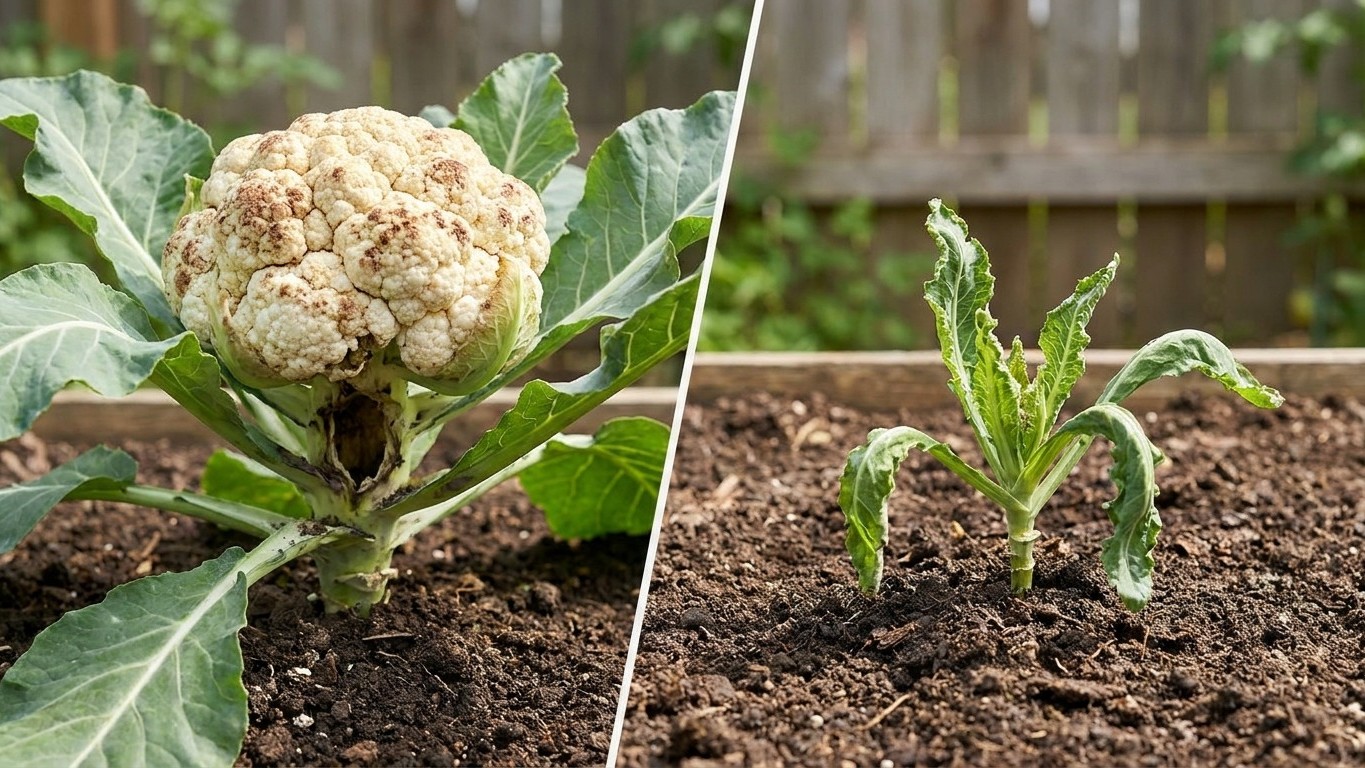

Boron deficiency in Cauliflower shows up as brown spotting on the head and a hollow, discolored stem just below it, while molybdenum deficiency stunts the entire plant and leaves narrow, incompletely formed leaves. Utah State University Extension lists both as distinct disorders in its guide Cauliflower in the Garden, and the two point in opposite directions: one marks the crop you were about to harvest, the other stops the plant from getting there at all.
The short answer
Look at where the damage sits. If the head itself carries brown spots and the stem tissue just under it looks hollow and off-color, that’s boron, according to Utah State University Extension. The plant usually reaches full size. The failure shows up late, right at the part you’re growing the whole crop for. The Extension guide ties this to excess fertilizer, high pH soils, or a stretch where the plant went thirsty for too long.
Molybdenum deficiency reads almost like a different crop entirely. The plant stays small. Leaves come in narrow and don’t finish developing the way they should. There’s no head to inspect for spotting because the plant hasn’t grown enough to form one properly. Utah State University Extension frames this as a transplant-stage problem: a complete fertilizer for the Transplants, plus a trace element mix applied to them, is the stated response.
That contrast is the whole point of separating these two. A gardener who sees a small, oddly-leaved plant and assumes boron trouble will reach for the wrong fix, and a gardener who sees head spotting and dumps on more fertilizer, thinking it’s a general nutrient gap, can make a boron problem worse rather than better. Excess fertilizer is named directly as a contributor to boron deficiency symptoms, not a cure for them.
Neither disorder is described as a groundbreaking mystery. Both come down to what was in the soil, and how the plant was watered, before the symptom ever appeared. Boron issues trace back to soil chemistry and water stress during the growing period. Molybdenum issues trace back to what the transplants received before they ever went in the ground. That timing difference matters more than it might seem, because it changes what you can still fix once you spot the problem, and what’s already locked in.
The practical takeaway from Utah State University Extension’s pairing of these two disorders is this: don’t treat symptom location as optional detail. Head and stem versus whole-plant size and leaf shape is the entire diagnostic difference, and it’s enough to tell the two apart without a soil test.
What actually decides it

Soil pH and water stress drive boron symptoms
Boron deficiency, per Utah State University Extension, tends to show up in high pH soils or where plants have gone through a stretch of water stress. Both conditions interfere with how the plant takes up boron even when some is present in the soil, which is why the fix isn’t necessarily “add boron” so much as “fix the conditions blocking it.” Excess fertilizer is named as a factor too, which points toward over-application, not under-application, as part of the problem. This is a disorder produced by the growing conditions the plant experienced, not something baked in from the start.
Transplant nutrition decides molybdenum outcomes
Molybdenum deficiency is described by Utah State University Extension as a transplant-stage issue. The remedy given is to use a complete fertilizer when growing transplants and to apply a trace element mix to those transplants specifically. That’s a decision made in hand, at the transplant tray, Weeks Before the plant goes into garden soil. If the transplants didn’t get that trace element mix early on, the stunting and narrow leaf pattern is the result showing up later, once the plant is already in the ground and growing.
Why the two can’t be confused for a single “nutrient problem”
These aren’t two versions of the same deficiency. One is a late-season, head-and-stem event tied to soil chemistry and irrigation habits during the crop’s active growth. The other is an early, whole-plant event tied to what happened at the transplant stage, well before the plant reached the garden. Lump them together as “nutrient stress” and you’ll miss the actual lever, since one calls for adjusting soil conditions and watering, and the other calls for a transplant-stage fertilizer and trace element application that, by the time symptoms show, has already happened or already been missed.
How to do it
- Count backward from your own last frost date. Utah State University Extension places cauliflower transplants in the ground 1 to 2 weeks before that date, a narrower window than cabbage or broccoli, which go out 2 to 3 weeks ahead.
- Before that transplant date arrives, apply a trace element mix to the transplants themselves. This is the step tied directly to preventing molybdenum deficiency, and it happens while the plants are still in their trays or pots, not after they’re in the garden.
- Feed transplants with a complete fertilizer during that same pre-transplant stage, rather than waiting until after planting out.
- Check soil pH before planting if you have any reason to suspect it runs high. High pH is one of the two conditions Utah State University Extension names as a driver of boron deficiency.
- Once plants are in the ground, keep watering even and avoid letting the soil dry out for extended stretches. Water stress is the other named driver of boron deficiency, and it’s controllable through irrigation habits alone.
- Hold off on extra fertilizer once plants are established, since excess fertilizer is named as a contributor to boron-deficiency symptoms rather than a way to prevent them.
- Watch the Temperature range as the season goes on. Cauliflower’s named ceiling is 75 F and its named low is 32 F, a tighter band than cabbage (80 F/25 F) or broccoli (75 F/28 F), and staying inside it reduces the kind of general stress that compounds nutrient problems.
- If you’re choosing a cultivar for a particular planting window, Utah State University Extension names specific days-to-maturity figures: Snow Crown at 50 days, Self Blanche at 60 days, Amazing at 65 days, White Contessa at 65 days (noted as heat tolerant), and Denali at 80 days, the last one intended for summer planting toward a fall harvest.
What goes wrong

- Brown spotting on the head with a hollow, discolored stem underneath. This is boron deficiency as described by Utah State University Extension, and the guide points to high pH soil or water stress as the drivers. If the stress happened during head formation, the spotting on that head can’t be undone. Adjust soil pH and keep watering consistent for the next planting, and avoid piling on extra fertilizer, which the source names as a contributing factor rather than a fix.
- Stunted plants with narrow, incompletely developed leaves. This is molybdenum deficiency, and Utah State University Extension ties it to what the transplants received before planting. If the trace element mix and complete fertilizer weren’t applied at the transplant stage, a stunted plant already in the garden won’t fully catch up. The lesson carries forward to the next round of transplants, not to the current stunted crop.
- Concentric, sooty-black spots on leaves. Utah State University Extension identifies this as Alternaria leaf spot, driven by overhead irrigation and repeated planting in the same soil. Switching to soil-level watering and rotating where cauliflower goes each season are the named responses.
- Worms hiding inside developing heads. Cabbage worms and loopers are named as pests that hide in cauliflower heads specifically, meaning visual checks from the outside can miss them entirely. Checking heads directly, not just scanning the outer leaves, catches this before harvest.
- Seedlings dying soon after emergence. Flea beetles are named as a cause of seedling death. Once a seedling is killed at that stage, it’s gone. The response is protecting the next round of seedlings rather than trying to save the current ones.
- Crinkled, distorted leaves on established plants. Aphids are named as the cause. Leaf crinkling from aphid feeding is a recorded response to that earlier feeding damage and doesn’t reverse once it’s set in, even after the aphids are dealt with.
Common questions
Can boron and molybdenum deficiency show up on the same plant?
Utah State University Extension lists them as separate disorders with separate causes: boron ties to soil pH and water stress during growth, molybdenum ties to transplant-stage nutrition. Nothing in the source suggests they’re linked or that one causes the other.
Does adding more fertilizer fix boron deficiency?
No. Utah State University Extension names excess fertilizer as a contributor to boron deficiency symptoms, alongside high pH soils and water stress. Adjusting soil conditions and irrigation is the direction the source points toward, not additional fertilizer.
Is molybdenum deficiency treatable once the plant is stunted?
The fix Utah State University Extension gives, a complete fertilizer plus a trace element mix, applies to transplants before they’re stunted. A plant already showing narrow, incompletely developed leaves has already passed through the stage where that treatment was meant to be applied.
How far before my last frost date should I put out cauliflower transplants?
Utah State University Extension places cauliflower transplants in the ground 1 to 2 weeks Before the Last Frost date, which is a shorter lead time than cabbage or broccoli, both set at 2 to 3 weeks ahead of frost.