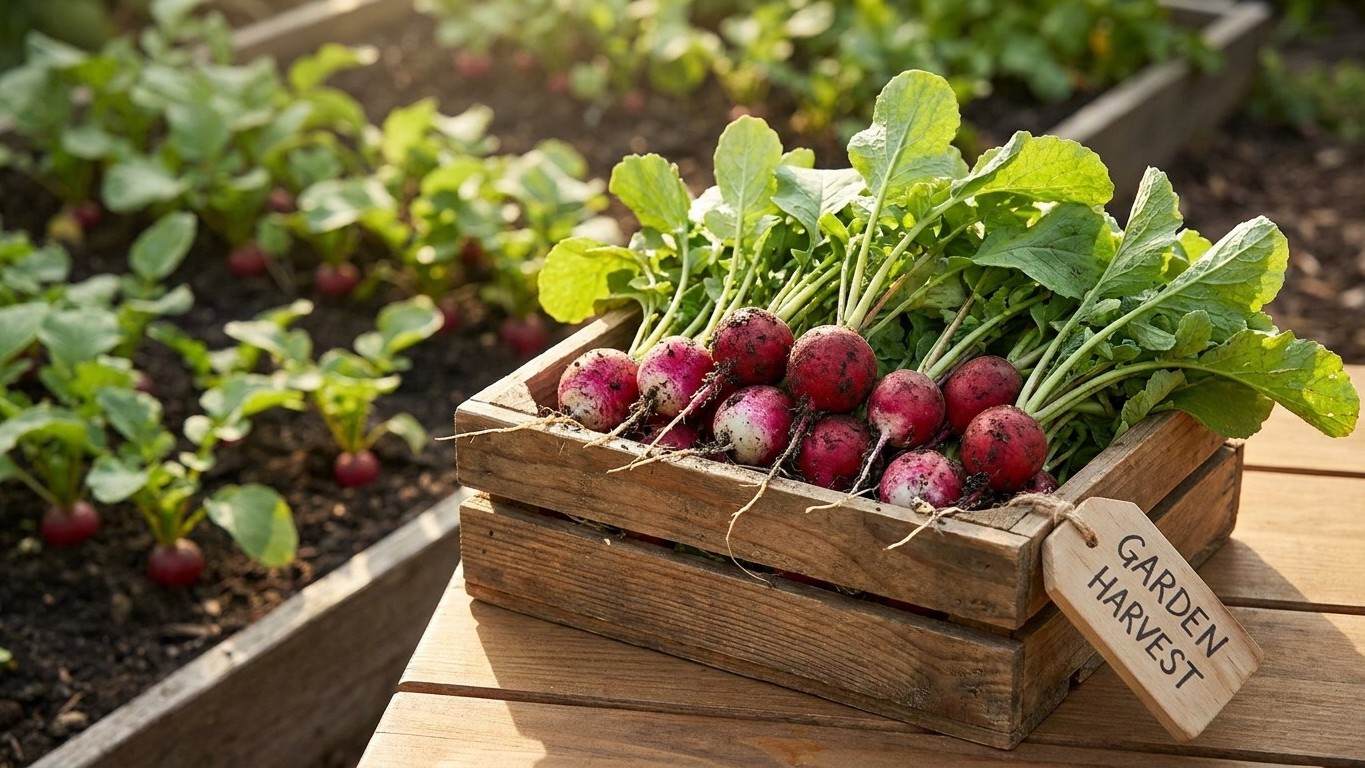

Twenty-five to forty-five days. That’s the entire life of a radish root, start to harvest, according to Utah State University Extension’s guide Radishes in the Garden. No other common garden vegetable moves through its whole cycle that fast. The catch: every day past that window, working against you, turns a crisp, mild root into something spongy, hollow, or unpleasantly hot.
The short answer
A radish is good when it’s fast, and it stops being good the moment it slows down. Utah State University Extension puts the maturity window at 25-45 days from seeding, depending on variety, which makes this the quickest crop grown in most home vegetable plots. There’s no transplanting step to shave off time, either. Radishes are direct-sown into the garden bed where they’ll grow their entire lives, so the clock starts the day the seed goes into the soil, not weeks earlier in a seed tray.
That speed is not a bonus feature. It’s the whole point. A radish that takes six or seven weeks instead of four hasn’t just grown a little slower, it’s had extra time to accumulate the stress compounds that make roots pithy, hollow, or bitter. The Extension guide is explicit about this: the “hotness” of radishes comes from how long they’ve grown, and roots that grow too slowly, get heat stressed, or simply sit in the ground too long past maturity are the ones that turn hot. Speed and quality aren’t two separate goals here. They’re the same goal.
Because radishes are always direct-sown, timing isn’t a matter of picking a calendar month, it’s a matter of counting backward from your local frost date. For a fall crop, count 25 to 45 days back from your area’s average first heavy frost, using the longer end of that range if you want a buffer against a cool, slow finish. That math works the same whether the garden sits in coastal Oregon or high-desert Utah. The frost date changes by location; the arithmetic doesn’t.
The practical takeaway is that a gardener planning a radish crop should think less about a season and more about a countdown. Once seed hits soil, the goal is to get that root from seed to harvest as fast as growing conditions allow, and every choice along the way, from spacing to watering to timing, exists to protect that speed.
What actually decides it

Radishes have one governing rule: speed. Everything the Extension guide flags as a problem with radish quality traces back to something that slowed the root down. There isn’t a separate list of unrelated defects. There’s one mechanism, and three ways it shows up.
Heat slows growth and hollows the root
Utah State University Extension states that radishes grow best when temperatures don’t exceed 80 F. Push past that and two things happen at once. High summer heat triggers many varieties to bolt, sending energy into a flower stalk instead of the root. It also causes bitterness, intensifies “hot” flavors, and produces root hollowness, a texture defect gardeners often mistake for a disease or a bad batch of seed. It’s neither. It’s heat doing exactly what heat does to a plant that’s built to finish fast in cool weather.
Slow growth concentrates heat compounds even without extreme heat
A radish doesn’t need a heat wave to turn hot-tasting. The Extension guide is specific that radishes that simply grow too slowly, for any reason, tend to develop that sharp, peppery bite even in otherwise mild conditions. Compacted soil, uneven watering, or overcrowded rows can all drag out the growing period without a single day of extreme heat involved. The compounds that create “hot” flavor build up with time in the ground, not Temperature alone.
Early stress rewires the whole plant
The first six weeks matter more than any other stretch of a radish’s life. According to the Extension guide, stress during that early window often leads to premature flowering and low yields down the line. A radish stressed early doesn’t just recover and grow a smaller root, it frequently abandons the root project altogether and channels its energy into producing seed. That’s a plant that has decided, in effect, that survival matters more than the crop a gardener was hoping to harvest.
How to do it
- Pick a bed with loose, well-worked soil. Radishes are direct-sown, so the soil they meet on day one is the soil they’ll grow in for their entire short life. There’s no transplant step to compensate for a rough start.
- Sow seed about half an inch deep. This is the depth given in the Extension guide’s body text for radish planting, and it’s shallow enough that the seed can push through quickly without wasting early growth days.
- Space seeds 1 to 2 inches apart within the row. Crowded radishes compete for water and root room, and that competition is exactly the kind of slowdown that leads to hot, woody roots later.
- Leave 10 to 12 inches between rows. This gives each row enough breathing room that neighboring plants aren’t shading or crowding one another as the tops fill in.
- Water consistently from the day of sowing onward. Since the first six weeks are the stretch where stress does the most damage, steady moisture in that window is doing more work than at any later stage.
- Count forward from seeding, not from a date on the calendar. With a 25 to 45 day maturity window, mark the sowing date and start checking roots as that window opens rather than guessing by looking at the leafy tops.
- Harvest as soon as roots reach usable size. Waiting past maturity doesn’t make the roots bigger in a good way, it gives heat and time more room to work against flavor and texture.
What Goes Wrong
- Roots taste hot or bitter because of heat stress. If daytime temperatures have been running above 80 F, the Extension guide points to heat as a direct trigger for bitterness and hot flavor. The fix is timing: plan the crop so its growing weeks fall in cooler conditions, counting back from frost rather than sowing during the hottest stretch of summer.
- Roots taste hot even though weather has been mild. This points to slow growth from a different cause, usually compacted soil, inconsistent watering, or crowding. The fix is spacing and soil prep: keep plants 1 to 2 inches apart, rows 10 to 12 inches apart, and work the soil loose before sowing so roots aren’t fighting for room.
- Roots taste hot because they were left in the ground too long. Even a radish that grew under good conditions turns sharp and woody if it sits past its maturity window. The fix is simply harvesting inside the 25-45 day range instead of leaving roots in the ground “just in case” they get bigger.
- Roots are hollow inside. The Extension guide ties this directly to hot weather during growth. There’s no fixing a hollow root after the fact; the remedy is preventive, keeping the crop’s growing period under 80 F by adjusting sowing timing relative to frost dates.
- Plants bolt to flower instead of forming a root. This traces to stress in the first six weeks, whether from heat, drought, or crowding. The fix is protecting that early window specifically, since the Extension guide identifies it as the period where stress does the most lasting damage.
- Lots of leafy top growth, little root to show for it. This usually signals that plants were sown too close together, forcing energy into competing for light rather than building a root below ground. Thinning to the 1-2 inch spacing recommended in the guide’s body text corrects it for the next sowing.
Common questions
How do I know when a radish is ready to pull?
Since radishes fall inside a 25-45 day maturity window from seeding, the most reliable method is counting days from your sowing date rather than judging by the tops. Roots can size up fast, and waiting for a certain leaf appearance often means pulling a root that’s already past its best texture.
Can I start radishes indoors and transplant them out?
No. Radishes are direct-sown, according to Utah State University Extension, meaning the seed goes straight into garden soil rather than into trays for later transplanting. Root vegetables generally don’t tolerate the root disturbance that transplanting involves, and radishes are no exception.
Why do some radishes turn out hot even when I didn’t grow them in summer heat?
Heat isn’t the only trigger. The Extension guide notes that radishes grown too slowly, for any reason, tend to develop that sharp flavor, and roots left in the ground past maturity do the same even under mild conditions. Hot flavor is really a signal of time, not just temperature.
Does variety choice change how fast a radish matures?
Maturity varies by variety within that 25-45 day range, though the Extension guide doesn’t attach a specific day count to any single named variety. What decides the outcome more than the variety label is how consistently the plant grows once it’s in the ground, since stress and slow growth affect flavor and texture regardless of which variety was sown.