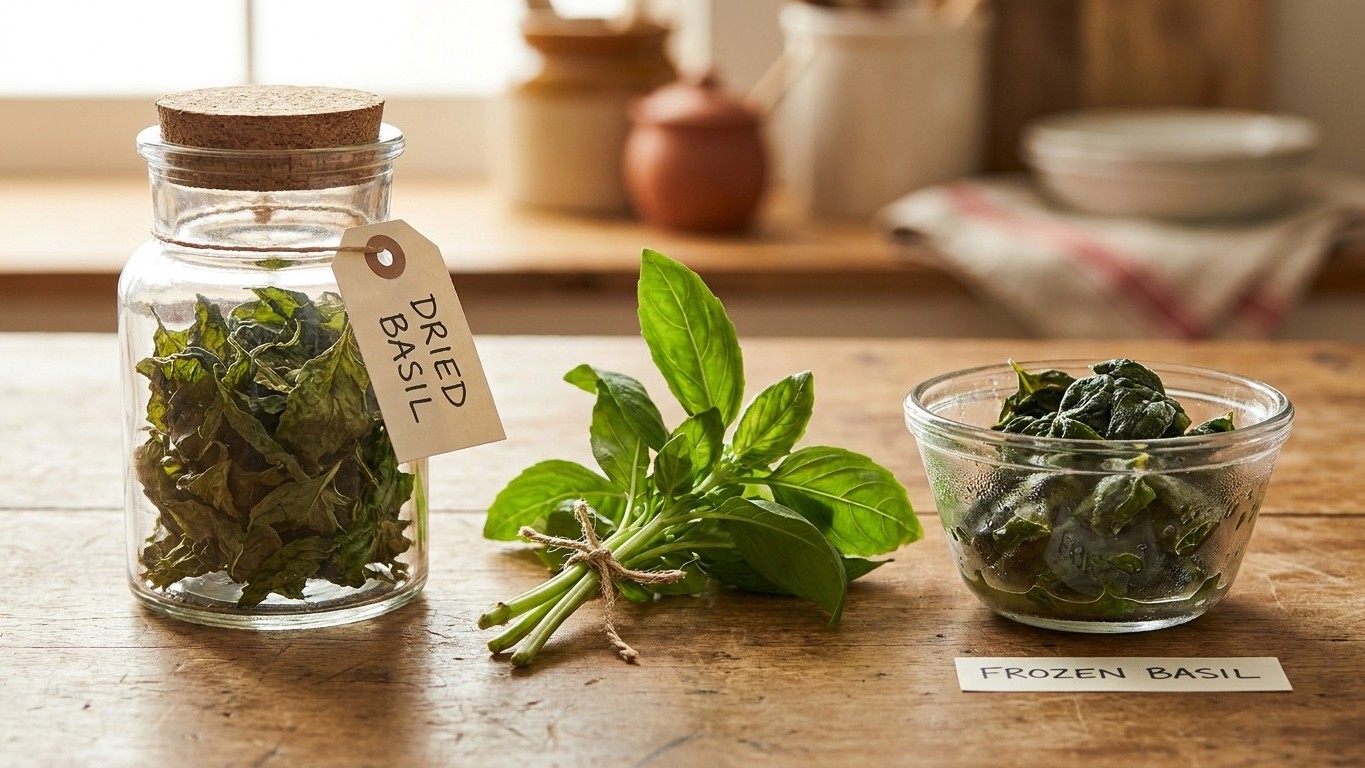

Dried basil keeps its flavor for about a year in a sealed jar; plain frozen basil turns mushy and loses taste within months. That’s the finding from Utah State University Extension’s guide Basil in the Garden, and it settles a debate a lot of home cooks have never thought to question. Drying works because it removes water slowly and evenly. Freezing plain leaves fails for the same reason it seems convenient: ice crystals rupture the leaf cells, and what thaws out is a wet, blackened clump with a fraction of its original aroma.
The short answer
If you’re choosing one preservation method and want it to actually taste like basil in three months, dry it. Utah State University Extension lays out a simple process: tie harvested stems and leaves into bunches, hang them indoors or in a shady spot, and let them dry for 5-10 days. Any leaves that haven’t fully dried on their own can finish in the oven, 3-5 minutes at 150-200°F. Pack the dried leaves into a jar with an airtight lid, store it somewhere cool and dark, and you’ve got basil that holds its flavor for about a year.
Freezing isn’t useless, but freezing leaves plain is a mistake the source addresses directly: basil leaves can be frozen, but they turn mushy when thawed and don’t hold onto their flavor well. If you want frozen basil that’s actually worth using later, you need a workaround, not the plain-freeze method most people default to when they’ve got more basil than they can use.
Timing matters more than most gardeners assume, too. Basil goes into the ground after your last frost date, whatever that looks like where you live. There’s no universal calendar month that works from Utah to Florida; what matters is the soil has warmed and the frost risk has passed. Get that part right and you’ll have enough basil that the drying-versus-freezing question becomes worth asking in the first place.
What actually decides it

Water content and cell structure
Basil leaves are mostly water held inside thin-walled cells. Drying pulls that water out gradually, at low heat and without direct sun, so the cell walls collapse gently and the leaf’s aromatic oils stay mostly intact. Freezing does the opposite: water inside the cells expands into ice crystals, which puncture the cell walls. When the leaf thaws, that structural damage shows up as a limp, dark, waterlogged mess. This is basic plant tissue behavior, not something specific to basil, but basil’s especially thin, tender leaves make the effect more obvious than it would be with a tougher herb like rosemary.
Why the common “pinch the flowers” advice misses the point
Here’s where a lot of standard garden advice goes wrong, and Utah State University Extension is specific about the distinction. Removing leaves from a basil plant before it flowers encourages the plant to branch out and produce more foliage. That’s the gesture that actually increases your harvest. Pinching off the flowers once they’ve already formed does not do the same thing. According to the source, pinching flowers “encourages flowers to form in the axils of the leaves thus reducing the yield.” the advice to “pinch the flowers to get more leaves” has it backwards once flowering has already started. The real fix is preventive: harvest leaves regularly and early, keep the plant from getting stressed, and stagger your plantings with successive sowings so you’re never relying on one plant that’s already gone to flower.
Nitrogen is not optional here
If you’ve grown beans or peas, you may have learned to go easy on nitrogen because those crops fix their own from the air and don’t need much help. Basil is a different plant entirely. It needs nitrogen to keep producing the leafy growth you’re actually harvesting, and skipping it (out of habit from other crops in your garden) will slow that growth down. Treat basil like the leaf crop it is, not like a legume.
How to do it
- Wait for the right window. Plant basil after your last frost date has passed. Basil has zero cold tolerance, and setting it out too early just means replacing dead seedlings later.
- Harvest leaves before flowers form. Pinch or snip leaves regularly, working from the top of the plant down. This is the gesture that triggers branching and more foliage, and it’s different from pinching flowers, which doesn’t help once they’ve appeared.
- Cut more than feels comfortable. A light snip here and there won’t trigger the branching response the plant needs. Take whole stem sections down to a leaf pair, leaving the plant with a modest set of leaves rather than a full canopy, so it’s forced to send out new side shoots instead of just replacing what you took.
- Tie the harvested stems into bunches. Group them loosely enough that air moves through the bunch.
- Hang the bunches to dry indoors or in a shady spot. Direct sun is off the table here; it degrades the leaves faster than it dries them and washes out flavor and color.
- Let them hang for 5-10 days. Check periodically. Leaves should feel brittle and crumble easily when they’re ready.
- Finish stubborn leaves in the oven if needed. Anything that hasn’t fully dried after hanging can go in the oven for 3-5 minutes at 150-200°F.
- Pack the dried leaves into a jar with an airtight lid. Crumble or leave whole, your choice, but seal it well.
- Store the jar somewhere cool and dark. A pantry shelf works better than a spot near the stove or a sunny window.
- Use it within about a year. That’s the shelf life the flavor holds up for before it starts to fade.
What Goes Wrong
- Freezing whole leaves in a bag. This is the failure that trips up the most people, because it seems like the obvious shortcut. Plain frozen leaves turn mushy and lose flavor once thawed. The workaround: freeze whole leaves inside ice cubes, so the water surrounding the leaf freezes into a protective block instead of the leaf’s own cells rupturing directly. Use the frozen cubes within 3-6 months.
- Drying in direct sunlight. It feels efficient, but sun exposure breaks down the aromatic oils that give basil its flavor and fades the leaf color. Hang bunches indoors or in shade instead.
- Pinching flowers expecting more leaves. Once a basil plant flowers, pinching those flowers doesn’t restore leaf production. It can actually push more flowers to form at the leaf axils, cutting your yield further. Prevent this by harvesting leaves consistently before flowering starts, and stagger plantings so you always have younger plants coming up behind the ones that bolt.
- Skipping nitrogen because of habits from other vegetables. Gardeners who’ve grown beans or peas sometimes carry over a low-nitrogen approach that doesn’t suit basil. Basil needs steady nitrogen to keep producing leaves, so treat its feeding schedule differently than you would a nitrogen-fixing legume.
- Making pesto and freezing it loose. Freezing pesto without portioning it makes it awkward to thaw only what you need, and repeated thawing degrades flavor. Freeze pesto in ice cube trays instead, so you can pull out single portions and keep the rest frozen.
Common questions
Can you dry basil in a microwave instead of the oven or air-drying?
Utah State University Extension’s guidance covers hanging to air-dry for 5-10 days, with an oven finish (3-5 minutes at 150-200°F) for leaves that haven’t fully dried. No microwave method is part of that guidance, so stick to the air-dry-then-oven sequence for a result that matches the tested shelf life.
Does freezing basil in ice cubes work as well as drying it?
It’s a genuine improvement over freezing plain leaves, but it’s not equivalent to drying in terms of storage length. Frozen basil, whether as whole leaves in ice cubes or as pesto in ice cube trays, should be used within 3-6 months. Dried basil holds its flavor for about a year, so if long-term storage is the goal, drying wins.
Do certain basil varieties dry or freeze better than others?
The source doesn’t compare varieties on drying or freezing performance. What it does note is foliage yield: ‘Genoa Green’ is described as a top foliage producer, while ‘Purple Ruffles’ is a low foliage producer. If your goal is maximizing the amount of leaf material you have to preserve in the first place, that yield difference matters more than the variety name itself.
Why does my basil plant slow down leaf production even though I’m not pinching flowers?
A few things can cause this, but nitrogen deficiency is a common one, especially for gardeners used to growing legumes that don’t need supplemental nitrogen. Basil needs a steady nitrogen supply to keep producing leaves. If leaves are thinning out and the plant hasn’t flowered, check your feeding routine before assuming it’s a harvesting problem.